
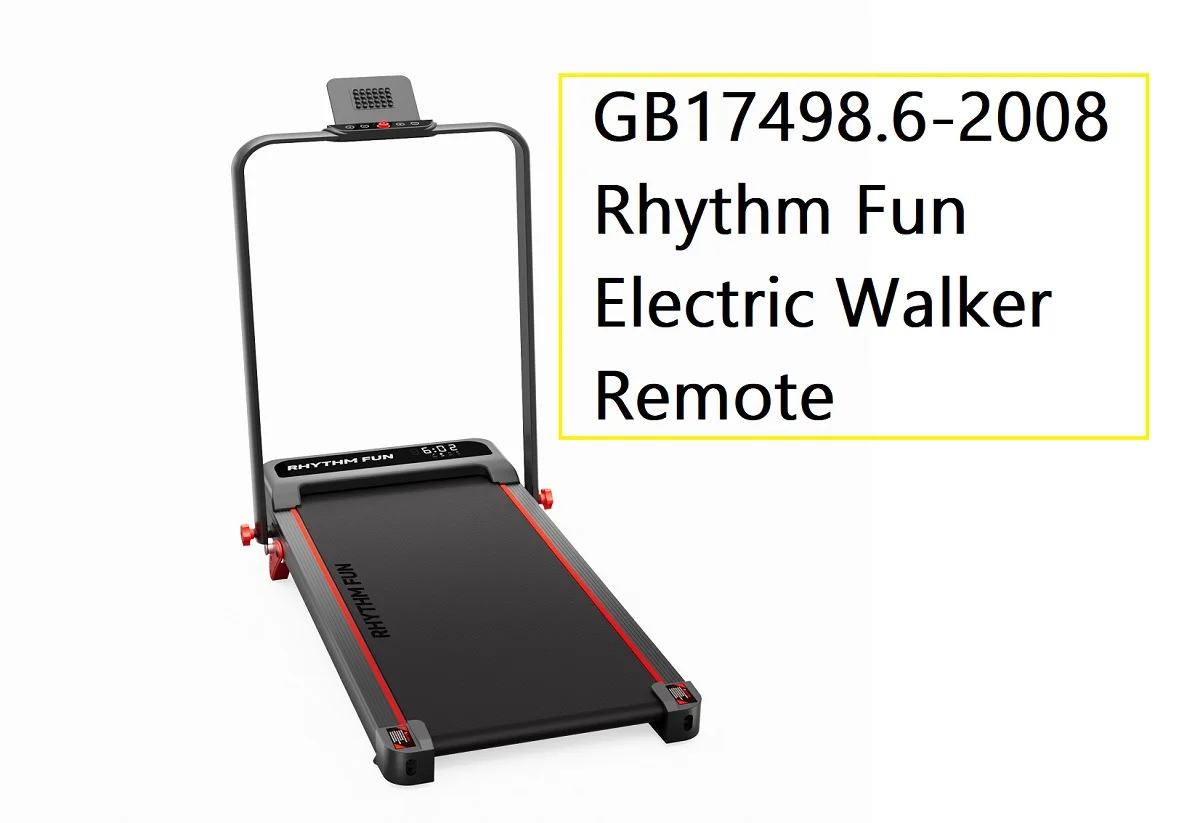
If you’ve seen “GB 17498.6-2008” printed on a compliance label, buried in a factory audit report, or listed as a required test in a sourcing agreement, it’s not a product code. It’s a national safety standard, and it’s one part of a two-part system that treadmills sold or manufactured in China have to satisfy.
Here’s the short version: GB17498.6-2008 covers the safety and testing requirements specific to treadmills. It doesn’t work alone. It sits on top of a broader standard, GB 17498.1-2008, which covers general safety requirements for all stationary fitness equipment. A treadmill has to pass both.
That relationship, one general standard plus one equipment-specific addendum, is the whole story, but it’s worth unpacking properly if you’re a manufacturer, an importer, or a compliance reviewer trying to figure out what actually applies to you.
What GB17498.6-2008 Covers
The standard’s own scope language is direct: it applies to power-driven and human-powered treadmill-class fitness equipment, and it’s meant to be used together with GB 17498.1, not as a replacement for it.
In practice, that means GB 17498.6 doesn’t repeat the basics- things like general electrical safety, stability, or materials that GB 17498.1 already handles for every category of stationary training equipment. Instead, it adds the specific hazards that only show up on a treadmill: belt speed control, sudden start or stop behavior, running surface dimensions, incline mechanisms, and emergency stop function. Think of it as a specialty rider attached to a master policy.
This structure isn’t unique to treadmills. The same GB 17498 series has parallel parts for other equipment types, like GB 17498.5-2008 for pedal-crank machines (think stationary bikes and ellipticals with crank mechanisms). Each part adds equipment-specific rules on top of the same GB 17498.1 foundation.
GB 17498.1: The Standard That Comes First
You can’t really understand GB 17498.6 without knowing what GB 17498.1 already requires, since it’s the base everything else builds on.
GB 17498.1-2008 sets the general terms, classifications, safety requirements, and test methods for stationary fitness equipment as a category. It applies broadly, covering equipment used in gyms, hotels, rehabilitation centers, and clubs (what the standard calls Class S and Class I equipment), as well as home-use equipment (Class H) and motor-driven machines generally. One notable exclusion: it doesn’t apply to stationary fitness equipment intended for children.
Here’s the detail that trips people up: where a category-specific part like GB 17498.6 sets its own requirement, that specific rule takes priority over the general one in GB 17498.1. So a treadmill manufacturer isn’t choosing between the two standards. Both apply, and where they overlap, the treadmill-specific rule wins.
How This Fits Into International Standards
If you’ve worked with equipment safety standards outside China, this framework will look familiar, and that’s not a coincidence. GB 17498.1-2008 is an identical adoption of ISO 20957-1:2005, the international standard for general safety requirements on stationary training equipment. Following the same pattern, GB 17498.6-2008 aligns with ISO 20957-6, the treadmill-specific addition to that same ISO series.
The European equivalent runs on the same logic: EN 957-1 sets general requirements, and EN 957-6 (now updated through EN 957-6:2010+A1:2014) adds treadmill-specific rules, again designed to be applied together rather than separately.
So if you’re already certifying a treadmill against ISO 20957-1 and ISO 20957-6, or the EN 957 equivalents, you’re working from the same structural blueprint China uses. That doesn’t mean the specific test values or thresholds are identical (they aren’t always), but the underlying “general standard plus equipment-specific addendum” model is shared across all three systems.
Who Actually Needs to Care About This Standard
Manufacturers producing treadmills in China, whether for domestic sale or export, need to test against both GB 17498.1 and GB 17498.6 as part of standard product compliance, and this pairing typically feeds into China Compulsory Certification (CCC) requirements for the relevant product category.
Importers and buyers sourcing treadmills from Chinese manufacturers should treat a GB 17498.6 reference on a compliance document or product label as one piece of the certification picture, not the whole thing. Ask whether GB 17498.1 testing was also completed, since one without the other is an incomplete compliance claim.
Compliance and QA teams doing supplier audits will often see this standard cited alongside others on a product’s certification paperwork, sometimes next to international equivalents like EN 957-6 or ISO 20957-6 if the manufacturer is producing for multiple markets. Seeing all of them listed together on one label, as happens on multi-market treadmill manuals, generally signals the manufacturer tested against several regional frameworks at once rather than just one.
Consumers who spot this code on a treadmill’s compliance label don’t need to do anything with it directly. It’s a background signal that the equipment was tested against a recognized national safety standard, similar in spirit to seeing a UL or CE mark on other products.
What the Standard Actually Tests
While the full technical detail lives in the standard document itself (available through Chinese national standards resellers or via GB standards libraries), the categories of requirement generally fall into a few buckets shared across the GB 17498 and ISO 20957-6 frameworks:
- Running surface and belt requirements, including size, stability, and slip resistance
- Speed control and start-stop behavior, so the belt can’t accelerate unexpectedly or fail to stop when needed
- Emergency stop mechanisms, including accessibility and reliability under load
- Incline mechanism safety, for treadmills with adjustable elevation
- Structural and electrical safety, layered on top of what GB 17498.1 already requires generally
None of this replaces reading the standard itself if you’re the one responsible for certification. This article is a map, not the territory.
GB 17498.6 vs. GB 17498.1: The Difference in One Line
If you only remember one distinction: GB 17498.1 is the rulebook for stationary fitness equipment in general, and GB 17498.6 is the treadmill-specific chapter that gets added on top of it. Certification requires both, and where they conflict, the treadmill-specific version in GB 17498.6 takes precedence.