
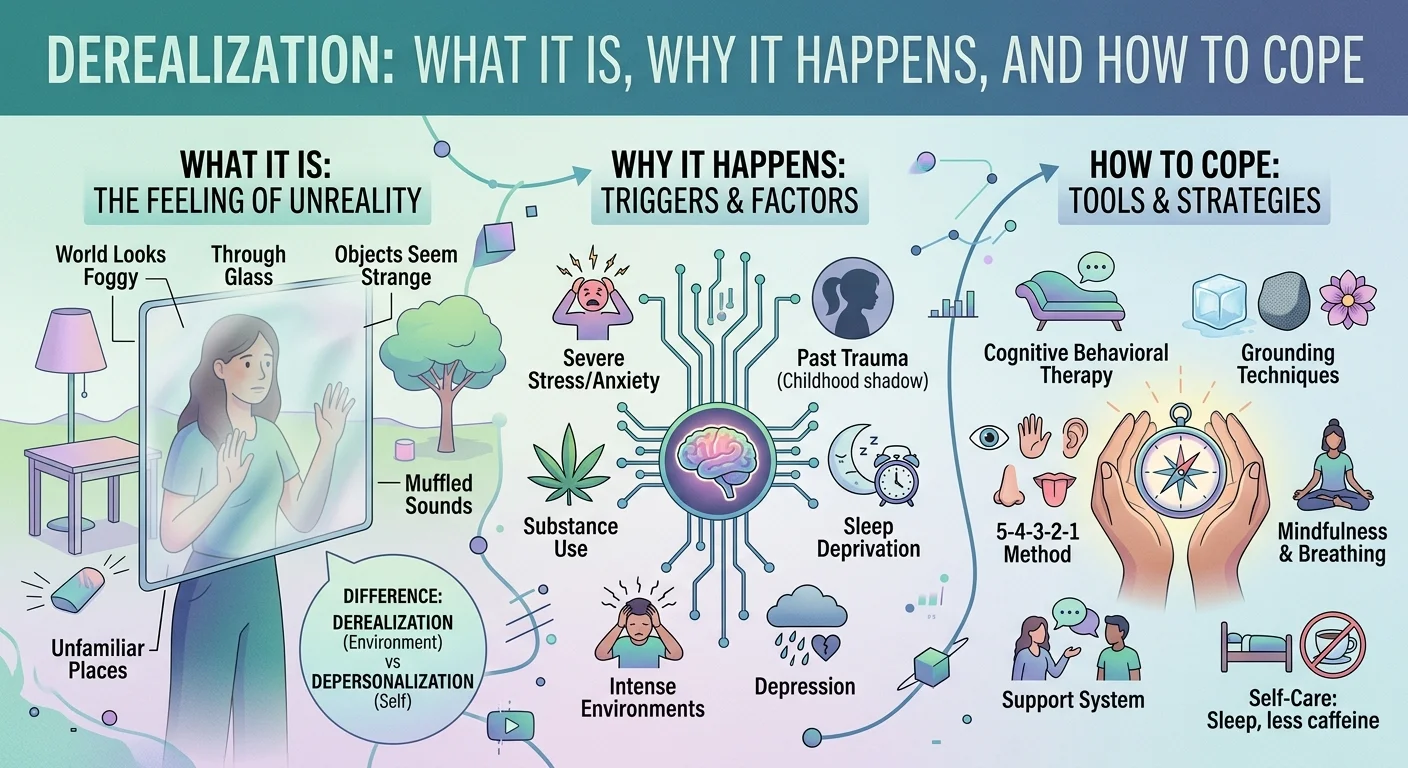
Derealization is the unsettling sense that the world around you isn’t quite real, as if you’re looking at life through fog, glass, or a screen. It can last a few minutes or stretch on for weeks, and it’s one of the more disorienting experiences the mind can produce. Here is what current medical and psychological research says about what derealization is, why it happens, and what actually helps.
What Is Derealization?
Derealization is a dissociative symptom in which your surroundings feel unreal, distant, or artificial, even though nothing has actually changed. People, places, and objects you know well can suddenly seem unfamiliar, flat, or staged, like a film set rather than real life.
Unlike psychosis, derealization doesn’t involve losing touch with reality. Most people experiencing it know, on some level, that their perception is distorted. That awareness is part of what makes it so unsettling: you can tell something feels wrong, but you can’t think your way out of it.
A brief episode, brought on by exhaustion, stress, or a frightening event, is common and usually passes on its own. When episodes are persistent, recur often, or cause real distress, clinicians may diagnose depersonalization-derealization disorder (DPDR), a condition classified as a dissociative disorder in the DSM-5.
What Derealization Feels Like
People describe derealization in strikingly similar terms, even though the experience itself is hard to put into words. Common descriptions include:
- The world looking foggy, dreamlike, or seen through glass
- Colors appearing flat, dull, or two-dimensional
- Objects seeming the wrong size, shape, or distance away
- Sounds that feel muffled, far off, or oddly loud
- Time feeling sped up, slowed down, or strangely frozen
- A sense of watching your own life like a movie, rather than living it
- Familiar places suddenly feeling strange or unrecognizable
These sensations can be frightening in the moment, but on their own they are not physically dangerous. Many people also feel a surge of anxiety during an episode, which tends to make the sensations feel more intense, not less.
Derealization vs. Depersonalization
Derealization and depersonalization are closely related, and many people experience both together.
Derealization changes how you perceive the outside world, meaning your surroundings, objects, and other people. Depersonalization changes how you perceive yourself, meaning your body, thoughts, or sense of identity. Someone going through depersonalization might feel like they’re watching themselves from outside their body, or that their own voice sounds unfamiliar.
Because the two so often overlap, doctors and researchers usually discuss and diagnose them together, under the umbrella of DPDR.
What Causes Derealization?
Researchers don’t yet fully understand why derealization happens, but it’s closely tied to the body’s stress response. Several factors show up again and again in the research:
- Intense stress or anxiety, including panic attacks and panic disorder
- Past trauma, particularly emotional neglect or abuse in childhood
- Substance use, especially cannabis and hallucinogens, as well as withdrawal from certain substances
- Severe sleep deprivation or prolonged exhaustion
- Unfamiliar or overwhelming environments, including travel
- Depression, which frequently occurs alongside derealization
- Less often, migraines or other neurological conditions
Many researchers describe derealization as a kind of protective response, a way the brain creates distance from something that feels overwhelming. That may explain why it shows up so often alongside anxiety, panic, and trauma-related conditions.
How Common Is Derealization?
Brief, passing derealization is far more common than most people assume. Estimates vary between studies, but some research suggests that somewhere between one quarter and three quarters of people experience at least one short episode at some point in their lives.
Persistent depersonalization-derealization disorder is far less common, affecting an estimated 1 to 2 percent of the general population. It typically begins in the mid to late teenage years or early adulthood, and it’s rare for it to start in childhood or later in life.
How Derealization Is Diagnosed
There’s no blood test or scan that can diagnose derealization. A doctor will usually start by ruling out medical causes, such as neurological conditions, medication side effects, or substance use, sometimes with bloodwork or other tests.
From there, diagnosis relies mainly on a conversation about your symptoms, history, and how they affect daily life. A diagnosis of depersonalization-derealization disorder generally requires:
- Persistent or recurring episodes of depersonalization, derealization, or both
- Awareness, during these episodes, that the distorted perception isn’t objectively real
- Significant distress, or real difficulty functioning at work, school, or in relationships
- Symptoms that aren’t better explained by substance use, another medical condition, or another mental health disorder, such as a psychotic or anxiety disorder
Treatment Options
Psychotherapy is considered the main treatment for ongoing derealization, particularly cognitive behavioral therapy (CBT). A therapist can help identify personal triggers, challenge unhelpful fears about the symptoms themselves, such as worrying that something is seriously and permanently wrong, and build grounding skills for use during episodes.
No medication is approved specifically to treat derealization. A doctor may still prescribe medication, often an antidepressant or anti-anxiety medication, to treat the anxiety, depression, or panic symptoms that frequently come with it. A small number of other medications have been studied for derealization directly, with mixed results so far, so treatment plans tend to be tailored rather than standardized.
Grounding Techniques You Can Try
Grounding techniques don’t address the root cause of derealization, but they can help you feel steadier while an episode is happening. Worth trying:
- The 5-4-3-2-1 technique: name five things you can see, four you can touch, three you can hear, two you can smell, and one you can taste
- Holding a textured object, such as a stone, an ice cube, or a piece of fabric, and focusing on how it feels
- Naming or counting objects in the room out loud
- Slow, deliberate breathing, in for a count of four and out for a count of six
- Splashing cool water on your face or hands
- Gentle movement, such as stretching or a short walk
- Talking to someone you trust about what’s happening, rather than withdrawing
Cutting back on caffeine, nicotine, cannabis, and alcohol, along with getting consistent sleep, can also lower how often episodes happen for some people.
When to Reach Out for Help
It’s worth talking to a doctor or mental health professional if derealization:
- Happens often or lasts a long time
- Gets in the way of work, school, or relationships
- Isn’t improving with self-help strategies
- Is new, sudden, and has no clear trigger
Seek urgent medical care if an episode follows a head injury, or comes with confusion, seizure-like movements, chest pain, or trouble breathing. These can point to a separate medical cause that needs prompt attention.
If you’re having thoughts of harming yourself or ending your life, treat that as an emergency. Contact a crisis line, go to an emergency room, or reach out to someone who can get you to safety right away. These thoughts are treatable, and help is available even when everything else feels distant.
Frequently Asked Questions
Is derealization dangerous? Not physically. Derealization itself doesn’t cause bodily harm, though it can feel frightening and bring on real anxiety. It’s generally the mind’s response to stress rather than a sign of physical danger. New or severe symptoms are still worth having checked by a doctor, to rule out a medical cause.
Can derealization go away on its own? Often, yes. Short episodes tied to stress, exhaustion, or a specific event commonly fade once the trigger passes. Persistent or recurring episodes are less likely to resolve without support, and working with a mental health professional tends to speed up recovery.
Is derealization the same thing as depersonalization-derealization disorder? Not quite. Derealization is a symptom, the feeling that the world around you is unreal. Depersonalization-derealization disorder is a diagnosis that applies when derealization, depersonalization, or both occur persistently or repeatedly and cause real distress or difficulty functioning.
Living With Derealization
Derealization can turn an ordinary day into something deeply strange, and that alone is exhausting. Even so, the outlook is generally encouraging. Many people recover fully, sometimes without any formal treatment, especially when the episode is tied to a stressor, such as a rough patch of sleep or a stretch of high stress, that eventually eases.
Even when derealization becomes persistent, it tends to respond well to therapy over time. Left unaddressed, it can last for years, so it’s worth treating as something to understand and work through rather than something to simply wait out.