If you take an SSRI and your tinnitus seems louder since you started, you’re not imagining a coincidence. A new study out of Oregon Health & Science University and Anhui University, published in April 2026 in the Proceedings of the National Academy of Sciences, has traced a direct brain circuit connecting serotonin to tinnitus symptoms. It’s the clearest mechanistic explanation yet for a pattern doctors have noticed for years: the same chemical that helps some people’s depression can make some people’s ear-ringing worse.
Here’s what the study found, what it doesn’t prove, and what it means if you’re one of the roughly one in seven people worldwide living with tinnitus.
What the New Study Actually Did
The research team, led by Laurence Trussell at OHSU’s Vollum Institute and Zheng-Quan Tang at Anhui University, worked with mice rather than human patients. That distinction matters, and I’ll come back to it.
Using optogenetics, a technique that lets researchers switch specific neurons on with pulses of light, the team activated the serotonin-producing neurons in the mice’s brains. They then watched what happened using a modified startle-response test, a standard way to check whether an animal is experiencing tinnitus-like symptoms even though it can’t describe them.
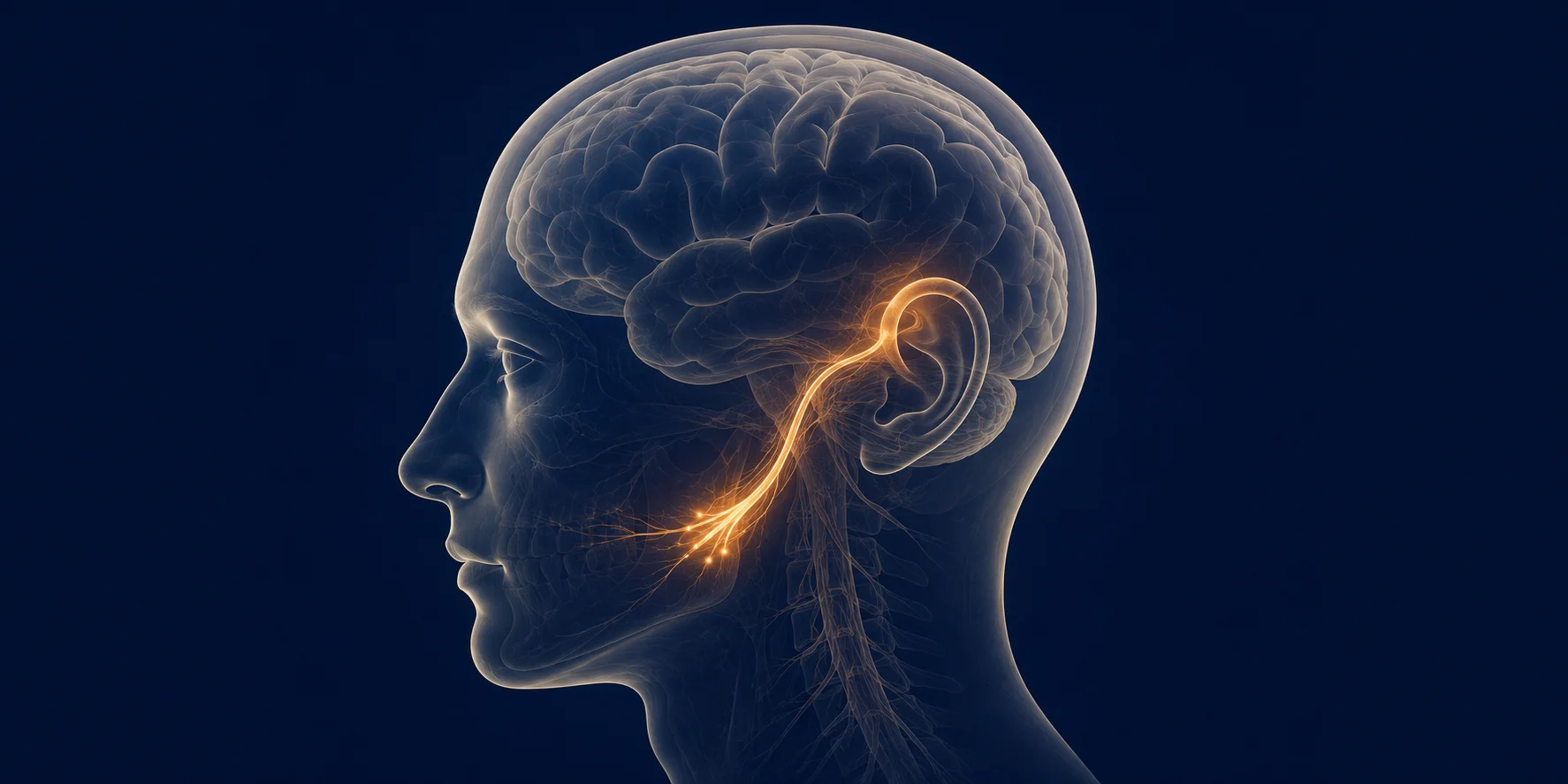
The result: activating those serotonin neurons switched on activity in the auditory region of the brain, and the mice began behaving as though they were hearing a phantom sound. When the researchers turned that same circuit off, the tinnitus-like behavior eased significantly.
This builds on a 2017 OHSU study that first showed serotonin could make certain neurons in the dorsal cochlear nucleus, the part of the brainstem where sound signals get processed, hyperactive and overly sensitive to stimulation. The new paper takes that earlier finding a step further by identifying an actual circuit, not just an effect.
Why This Points at SSRIs
Selective serotonin reuptake inhibitors work by increasing how much serotonin is available in the brain. That’s the whole point of the drug class. Millions of people take them for depression and anxiety, often with real benefit.
The problem the new research highlights is that more serotonin doesn’t act only on mood circuits. If it also revs up the exact auditory pathway this study identified, an SSRI prescribed to help someone’s depression could, in some patients, make their tinnitus louder or more distressing at the same time.
Trussell put it directly in OHSU’s announcement of the findings: prescribing physicians should try to find a balance between relieving psychiatric symptoms and minimizing tinnitus, and clinicians should take patient reports of medication-linked tinnitus increases seriously rather than dismissing them.
What Human Studies Show, and Why It’s Messier
Mouse circuitry is one piece of the picture. What actually happens in people taking SSRIs is less tidy, and it’s worth sitting with that instead of smoothing it over.
A retrospective study of 56 tinnitus patients treated with paroxetine, an SSRI, found something that looks like it contradicts the mouse findings on the surface: tinnitus severity, measured with the Tinnitus Handicap Inventory, actually improved in many patients over six months. But the improvement wasn’t uniform. Patients who had both depression and anxiety alongside their tinnitus saw the biggest gains, and their tinnitus improvement tracked closely with their mood improvement. Patients with anxiety alone, or without either condition, didn’t show the same pattern.
Other trials complicate things further. A three-arm study comparing fluoxetine alone, fluoxetine plus an anti-anxiety medication, and placebo found real improvement in tinnitus severity scores for both treatment groups. But other researchers testing different SSRIs, and different tinnitus measures, have reported no significant benefit over placebo at all.
Put together, the human data doesn’t say SSRIs reliably help or reliably hurt tinnitus. It suggests the effect depends heavily on who’s taking the drug, what’s driving their tinnitus, and whether depression or anxiety is part of the picture. The new mouse research offers a biological reason why some people might get worse rather than better: it identifies a specific pathway where the same neurotransmitter that’s treating their mood could also be aggravating their auditory symptoms, even while it helps other patients.
What This Means If You’re on an SSRI and Have Tinnitus
A few things worth knowing, without turning this into medical advice you should be getting from your own doctor instead:
This isn’t a reason to stop a medication on your own. Stopping an SSRI abruptly carries its own risks, including withdrawal effects and a return of depression or anxiety symptoms. If your tinnitus has changed since starting or adjusting a medication, that’s a conversation to have with the prescribing physician, not a decision to make solo.
Report the change specifically. Trussell’s comment about clinicians validating patient reports is a real gap in some care right now. If you tell your doctor your tinnitus got louder after starting an SSRI, that’s useful clinical information, not a side detail.
The field is moving toward more targeted options. Trussell described the goal as developing drugs that could raise serotonin in mood-related brain regions without doing the same in auditory circuits, essentially separating the antidepressant benefit from the hearing-related cost. That kind of drug doesn’t exist yet. It’s a research direction, not a treatment you can ask for today.
Tinnitus severity has more than one driver. The Zhejiang University study on sleep, anxiety, and depression found that anxiety itself partially explains why poor sleep and depression make tinnitus feel worse. So even where an SSRI is genuinely helping someone’s anxiety, isolating its exact effect on their tinnitus from everything else going on isn’t always straightforward.
The Bottom Line
The OHSU and Anhui University team has done something genuinely useful here: they didn’t just observe that serotonin and tinnitus are connected, they found the wiring. Turning that circuit on produced tinnitus-like symptoms in mice, and turning it off relieved them.
What it doesn’t do is settle the question of what any individual person should do about their own SSRI. Human trials show mixed results, and the clearest pattern in the paroxetine data is that people being treated for depression and anxiety alongside their tinnitus tend to do best, not that the drug itself is straightforwardly good or bad for ear-ringing.
If there’s one practical takeaway, it’s Trussell’s own framing: this is a balance to manage with a physician, not a switch to flip alone. The research at least explains why that balance exists in the first place.