If you have sudden, severe scrotal pain, especially with nausea, vomiting, or a groin bulge that’s turned hard and won’t push back in, go to an emergency room or call your local emergency number right away. This can signal a strangulated hernia or testicular torsion, and both are time-sensitive surgical emergencies. Torsion in particular can cost you the testicle if it’s not treated within about six hours of symptom onset. Don’t wait to see if it passes, and don’t try to diagnose yourself from an article, including this one.
With that out of the way: if you’re dealing with a dull ache, heaviness, or intermittent pain in the scrotum and you suspect a hernia is behind it, here’s what’s actually going on, how doctors sort a hernia from the other things that cause similar pain, and what treatment usually looks like.
How a Hernia Ends Up Causing Scrotal Pain
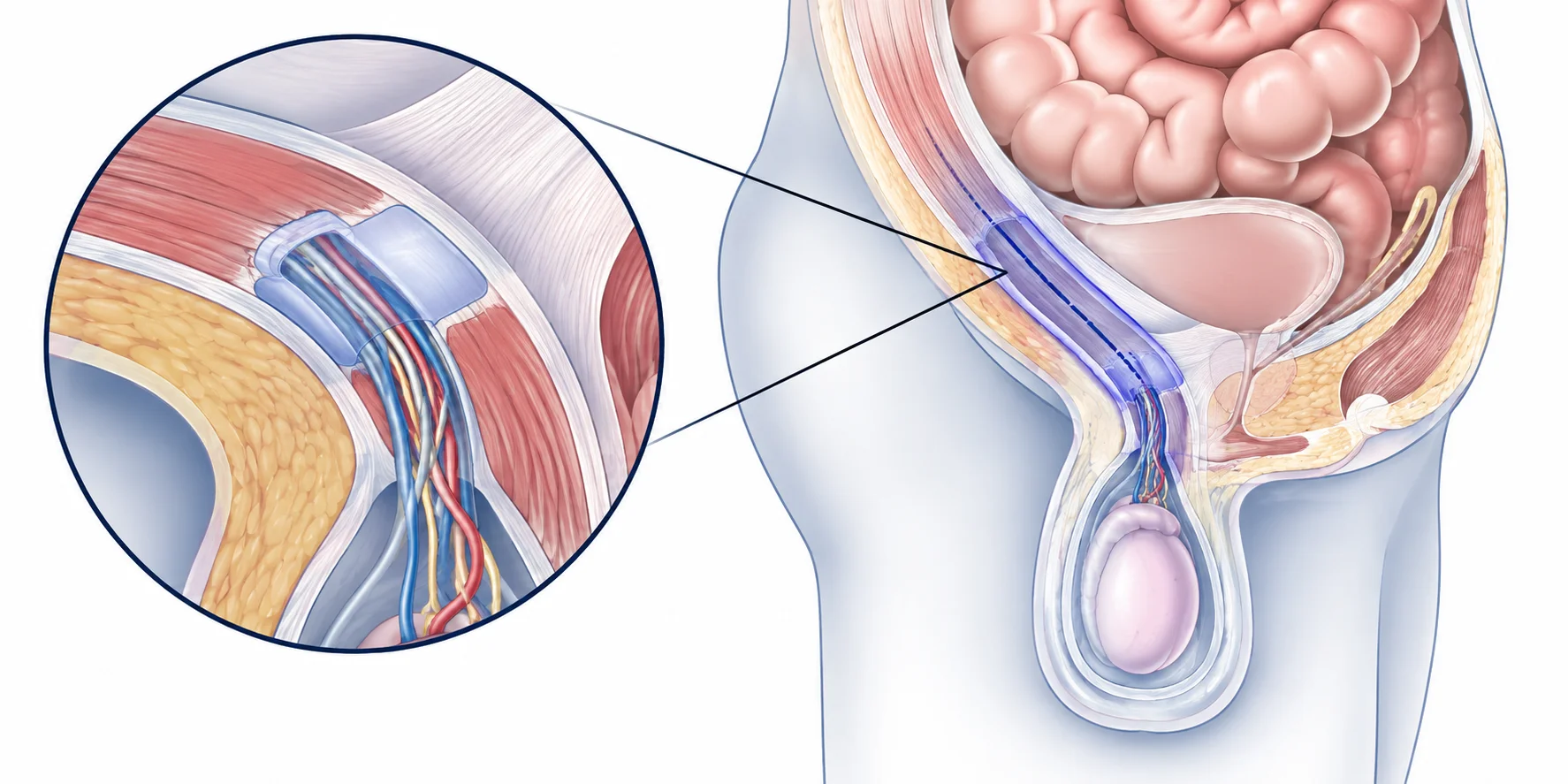
An inguinal hernia happens when part of your intestine, or sometimes fatty tissue, pushes through a weak point in the lower abdominal wall. That weak point sits along the inguinal canal, the same pathway your testicles traveled through before birth. Because that canal runs straight down into the scrotum, a hernia that’s large enough doesn’t always stop at the groin. It can extend all the way into the scrotum itself, and that’s when groin symptoms turn into scrotal ones.
Pain Itself Usually Isn’t From The Hernia Touching
The pain itself usually isn’t from the hernia touching the testicle directly. It’s more often pressure and irritation from the herniated tissue as it stretches or crowds the structures around it, or tension on the spermatic cord, the bundle of vessels and tissue that suspends the testicle and connects it back into the abdomen. That’s a meaningful distinction, because it means “hernia causing scrotal pain” and “hernia damaging the testicle” are two different situations with very different urgency.
A few patterns are worth knowing:
- The pain typically builds through the day and eases when you lie down. Standing and activity increase abdominal pressure, which pushes more tissue into the hernia; lying down lets gravity and reduced pressure ease it back.
- Straining makes it worse. Coughing, lifting, or bearing down (the same motion as a bowel movement) are classic triggers, because they all raise pressure inside the abdomen.
- Not every hernia hurts. Only a portion of hernias cause pain at all, and it’s common for a hernia to be found on exam long before it causes any real discomfort.
- A bulge that won’t push back in is different from one that comes and goes. That’s the line between a routine hernia and one that’s become incarcerated, discussed below.
Why Scrotal Pain Isn’t Automatically a Hernia
This is the part that matters most if you’re trying to figure out what’s happening to you: a lot of conditions cause scrotal pain, and several of them look similar to a hernia early on, while carrying much higher stakes. Testicular torsion is the one doctors worry about most, because it’s the condition most likely to be mistaken for something less urgent and most likely to cause permanent damage if it’s missed.
The Spermatic Cord and Cuts off Its Own Blood Supply
It happens when the testicle twists on the spermatic cord and cuts off its own blood supply. It tends to come on suddenly and severely, often with nausea or vomiting, and it’s most common in adolescents and young men, though it isn’t limited to that group. Torsion and a hernia aren’t mutually exclusive either; case reports describe patients who had both at once, which is exactly why a physical exam and ultrasound, not guesswork, are how this gets sorted out.
Other common causes include:
- Epididymitis, inflammation of the coiled tube behind the testicle, usually infection-related, which tends to build up more gradually and often comes with urinary symptoms or fever
- A hydrocele, a fluid-filled sac around the testicle that’s usually painless but can cause a dull heaviness as it enlarges
- A varicocele, enlarged veins in the scrotum, often described as a dull ache that worsens with standing
- Kidney stones, which can refer pain down into the groin and testicle as they move
- Muscle strain in the groin, common in athletes, which mimics hernia pain closely
The overlap between these conditions is exactly why self-diagnosis is risky here. A doctor will typically start with a physical exam, feel for a bulge, ask you to cough or bear down, and check whether any swelling can be pushed back in. Ultrasound is the usual next step when the picture isn’t clear, since it can distinguish a hernia from torsion, a hydrocele, or a mass, often in the same visit.
When Hernia-Related Scrotal Pain Becomes an Emergency
Most inguinal hernias are uncomfortable rather than dangerous. The danger shows up when a hernia becomes incarcerated, meaning the protruding tissue gets stuck and can’t be pushed back into the abdomen. From there, it can progress to strangulation, where the trapped tissue’s blood supply is cut off. Strangulated tissue can become non-viable within hours, which makes this a true surgical emergency rather than something to schedule around.
Signs That Point
Signs that point toward incarceration or strangulation, and warrant emergency care rather than a routine appointment, include:
- A bulge that’s suddenly firm, tender, or discolored, and doesn’t reduce (push back in) the way it used to
- Severe, sudden pain, rather than the usual dull ache
- Nausea or vomiting alongside the pain
- Fever
- Redness or skin changes over the swelling
None of these require you to be certain it’s a hernia and not torsion or something else. The point of the emergency visit is to let a clinician sort that out with an exam and imaging, while there’s still time for it to matter.
Living With It Before Surgery, and What Repair Involves
Surgical repair, whether open or laparoscopic, is the definitive fix, and it’s one of the most commonly performed operations there is. It’s worth knowing going in that chronic pain after hernia repair is a real and fairly common outcome, not a rare complication. Studies looking at chronic postoperative inguinal pain.
Defined as Pain Lasting More Than Six Months
generally defined as pain lasting more than six months, find it in roughly 10 to 14% of adult patients overall, and a smaller subset of those cases involve pain specifically felt in the testicle, known as orchialgia, which shows up in around 10% of the chronic pain group. Nerve involvement during surgery, and how much pain a person had going into the operation, both appear to raise the odds of chronic pain afterward.
Pain Persists For Months After Repair
If pain persists for months after repair, that’s a conversation to have with your surgeon or a urologist, not something to assume you have to live with. Management ranges from nerve blocks and medication to, in persistent cases, further surgery aimed at the specific nerve or tissue involved. Persistent post-repair pain is its own diagnostic puzzle, and it typically benefits from being seen by someone with specific experience in it.
See Our Latest Blogs.