Quick answer: For most sensitive skin, Aveeno’s dedicated sensitive and eczema lines are the safer starting point, built around fragrance-free formulas and colloidal oatmeal, an ingredient the FDA specifically recognizes for calming irritation. Nivea isn’t automatically wrong; its classic creams are thick, occlusive, and genuinely effective at stopping moisture loss. They just weren’t designed with reactive skin as the priority. The right pick depends on what “sensitive” means for you, and which specific product you’re actually looking at.
“Nivea” and “Aveeno” aren’t single formulas; comparing them by brand name alone is like comparing “cereal” to “cereal.” You have to look at the box.
What “Sensitive Skin” Actually Means
Sensitive skin isn’t one condition; it’s a description of how your barrier behaves. A healthy barrier keeps water in and irritants out. When it’s thinner or inflamed, things that normally cause no trouble, a mild fragrance, a preservative, start to. That’s why the same cream can feel fine on your arms and sting on your face: the barrier’s tolerance differs by location, so the real question isn’t “which brand is gentler,” it’s “which formula matches my specific trigger.”
Nivea’s Approach: Rich Occlusion, Not Built for Reactivity
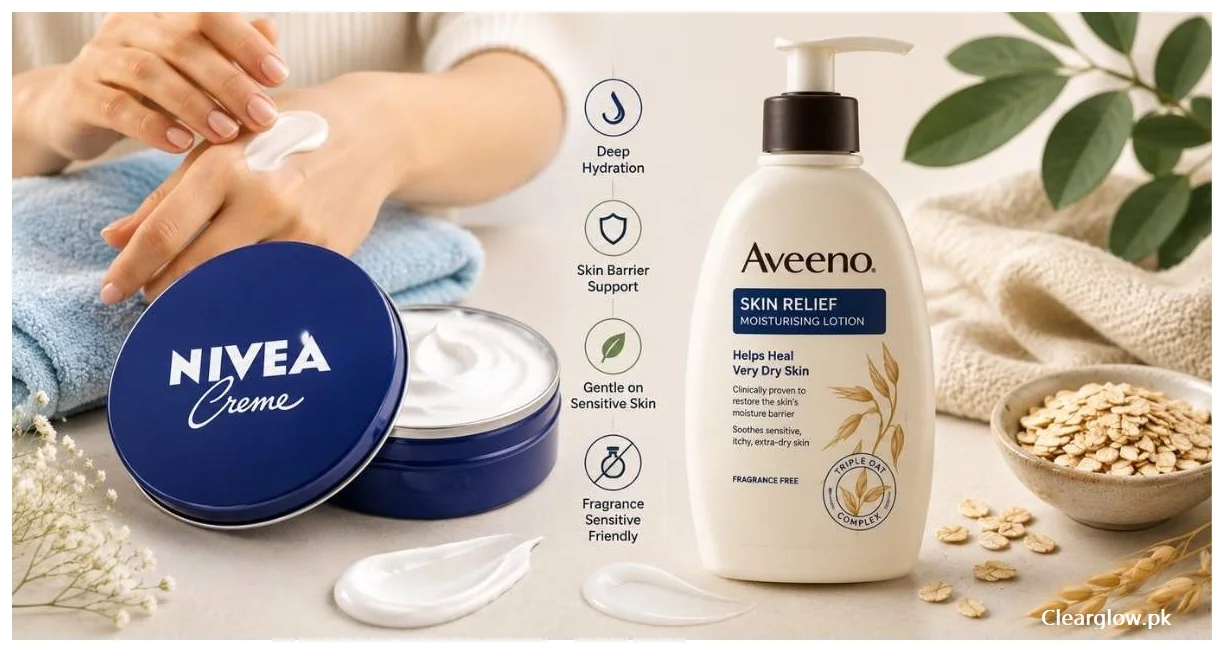
The original Nivea Creme, the blue tin, runs on water, mineral oil, petrolatum, glycerin, microcrystalline wax, and lanolin alcohol. Petrolatum and mineral oil are occlusives that sit on skin and block water from evaporating out, while glycerin pulls moisture in from the air and lower skin layers. Together they explain why the cream feels heavy and works so well on genuinely parched elbows, heels, and hands.
The catch for sensitive skin is fragrance and lanolin alcohol. The classic formula includes added fragrance, and lanolin, while a solid emollient, is a known contact allergen for a meaningful subset of people, particularly anyone with a history of eczema or contact dermatitis. If your skin reacts to scent or wool-derived ingredients, this specific product is the wrong pick no matter how well-reviewed it is.
Nivea does make sensitive-labeled lines that pull fragrance out, often built around chamomile extract and panthenol instead. These are genuinely different products from the classic tin, if you wrote off Nivea after a bad experience with the original, check whether you tried one of these.
One caveat: Nivea’s formulations vary by country more than Aveeno’s do. A “sensitive” label in one market isn’t a guarantee of the same ingredient list elsewhere, so check the label in front of you rather than the brand’s reputation.
Aveeno’s Approach: Built Around Colloidal Oatmeal
Aveeno’s core differentiator is colloidal oatmeal, oat kernels ground fine enough to suspend evenly in a cream rather than settling out. This isn’t a marketing flourish: it’s the only single ingredient the FDA’s OTC Skin Protectant monograph recognizes as being allowed to claim it “temporarily protects and helps relieve minor skin irritation and itching” related to eczema, backed by more than 30 clinical studies covering over 3,000 patients with compromised skin barriers.
Oat contains avenanthramides, polyphenols with anti-inflammatory activity, plus beta-glucans that form a protective film on skin. In a randomized, double-blind trial in children with mild-to-moderate atopic dermatitis, a 1% colloidal oatmeal cream produced measurable improvement in eczema severity within one week, comparable to a standard barrier cream, a controlled trial result, not a testimonial.
This shows up directly in the product lines: Aveeno’s Eczema Therapy Daily Moisturizing Cream lists colloidal oatmeal at 1% as its active ingredient, alongside glycerin, panthenol, petrolatum, and ceramide NP, all barrier-supporting, with no added fragrance, confirmed against the product’s FDA drug listing on DailyMed, the actual regulatory disclosure. Aveeno’s regular sensitive-skin cream runs a simpler version of the same idea, again with no added fragrance.
The Distinction Almost Every Comparison Gets Wrong
“Fragrance-free” and “unscented” are not the same claim. Fragrance-free means no fragrance ingredients were added, full stop. Unscented can mean a masking fragrance was added to cancel out the base smell of other ingredients, so fragrance chemicals may still be present even though you can’t smell them, meaning an “unscented” product can still trigger chemical fragrance reactions.
Aveeno’s dedicated eczema and sensitive lines are consistently true fragrance-free, verifiable against the DailyMed filing. Nivea’s sensitive-labeled products generally aim for the same, but consistency is less guaranteed given how much formulations shift by market.
Texture, Location, and How to Decide
Nivea Creme’s thickness is a genuine asset on the body: dry, cracked hands, feet, and elbows tolerate, and often benefit from, a heavier occlusive layer. That same thickness on reactive facial skin can feel smothering and contribute to a stuffy, irritated feeling that has nothing to do with fragrance at all. Aveeno’s sensitive and eczema formulas tend to run lighter, part of why they’re recommended for facial use more often, though lighter isn’t automatically better: genuinely dry, cracked body skin in winter may need more staying power than a light lotion offers.
Put simply: if your main problem is dryness without fragrance sensitivity, Nivea’s classic creams work well, especially on the body. If your main problem is reactivity, redness, itching, or a diagnosed condition like eczema, start with Aveeno’s dedicated lines and check the ingredient list against products you already tolerate.
Either way, patch test first. Apply a small amount to the inner forearm, wait 24 to 48 hours, and check for redness or bumps before putting anything new on your face. That’s a better predictor of your reaction than any comparison article, including this one.
Frequently Asked Questions
Is Aveeno actually better than Nivea for sensitive skin, or is that just marketing? For fragrance-reactive or eczema-prone skin, the FDA’s OTC monograph recognition of colloidal oatmeal, combined with Aveeno’s fragrance-free formulation, gives it a genuine, verifiable edge. For general dryness without reactivity, the gap narrows.
Does Nivea contain fragrance in all its products? No. The original Nivea Creme does, but the brand also makes sensitive-labeled lines with reduced or no fragrance. Formulations vary by market, so check the specific ingredient list rather than assuming based on the brand.
Can I use Nivea Creme on my face if I have sensitive skin? It depends on your trigger. If your sensitivity is fragrance-related, the classic formula is a poor match for facial use. If you’re simply dry without a fragrance reaction, some tolerate it fine on the face, though it suits body skin better for most.
What makes colloidal oatmeal different from regular oats in skincare? It’s oat kernel ground fine enough to stay suspended in water, letting it form an even film on skin. Regular ground oats or a DIY oatmeal bath don’t deliver the same film, part of why the FDA’s recognition is specific to the colloidal, processed form.
Should I see a dermatologist instead of choosing between these two? If symptoms include persistent redness, cracking, oozing, or itching that disrupts sleep, yes, that’s beyond what an over-the-counter comparison can address. A diagnosed condition like eczema or rosacea benefits from a dermatologist’s input on top of ingredient choice.
Sources:
- FDA OTC Skin Protectant Monograph recognition of colloidal oatmeal, via Next Steps in Dermatology clinical reference
- DailyMed (U.S. National Library of Medicine): Aveeno Eczema Therapy Daily Moisturizing Cream and Aveeno Eczema Therapy Rescue Relief Treatment ingredient filings
- Randomized controlled trial of 1% colloidal oatmeal cream in pediatric atopic dermatitis, published in Journal of Dermatological Treatment