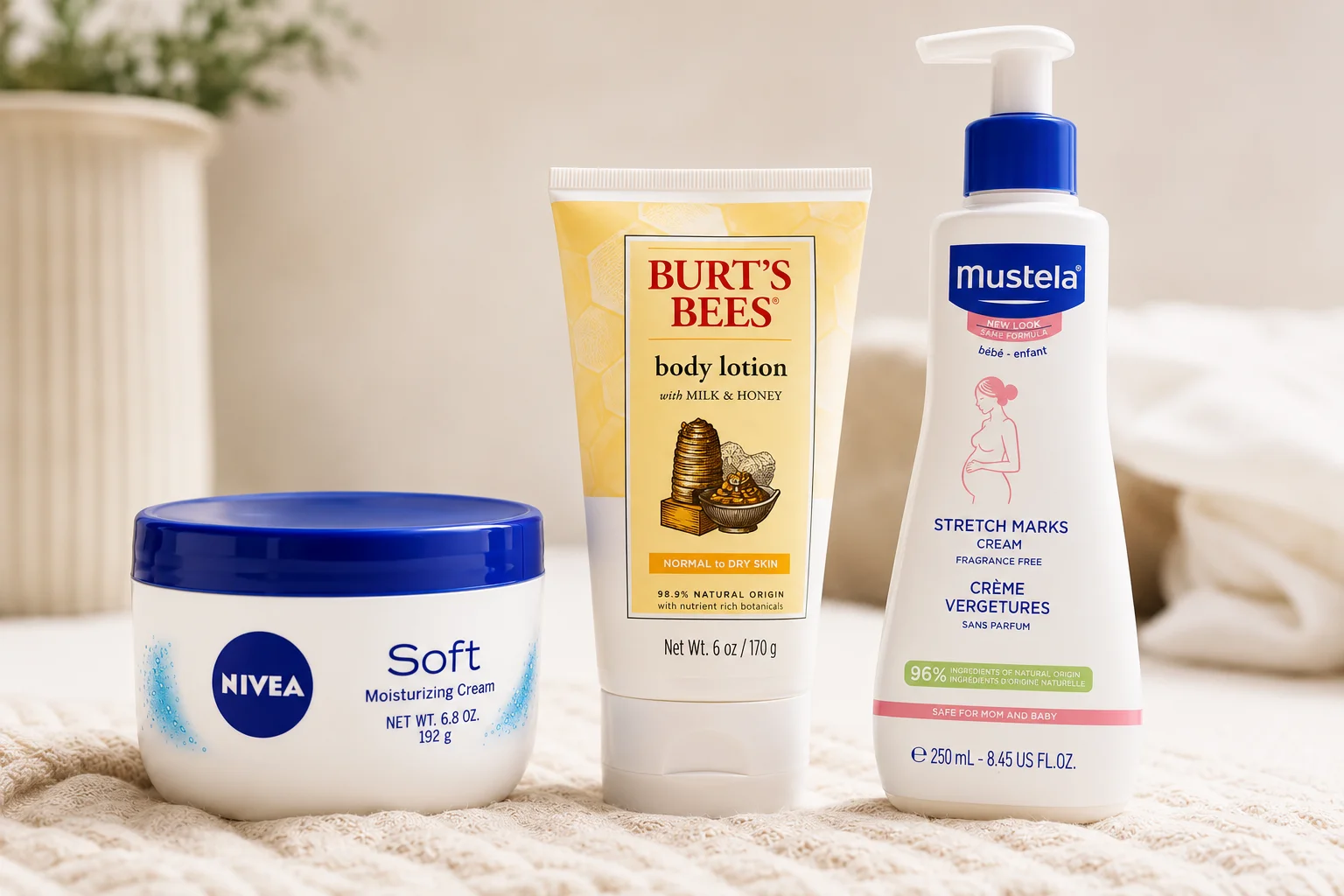
Your skin starts absorbing more attention than usual the moment you’re expecting. Suddenly you’re flipping over every tube in your bathroom cabinet, squinting at ingredient lists you’ve never once read before. So here’s the honest answer: brand name matters far less than what’s actually in the bottle.
I’m a pregnant woman. Are Nivea products safe compared to Burt’s Bees or Mustela? Mostly yes, with some caveats, and the same goes for the other two. None of these three brands is universally “safe” or “unsafe.” Each sells dozens of products, and safety depends on the specific formula in your hand, not the logo on the front.
What Actually Matters During Pregnancy
Before comparing brands, it helps to know what you’re screening for. The American College of Obstetricians and Gynecologists (ACOG) recommends reading ingredient lists on personal care products and choosing ones labeled “fragrance free” over “unscented,” since unscented products can still contain masking scent chemicals that aren’t broken out on the label. ACOG’s guidance also calls out parabens and phthalates as chemicals worth limiting where you reasonably can, while noting that research on exactly how much exposure matters is still developing.
Beyond that, dermatologists and OBs generally agree on a short list: skip retinoids (retinol, tretinoin, retinyl palmitate), skip hydroquinone, go easy on high-strength salicylic acid, and watch for a handful of essential oils, clary sage and rosemary in particular, in concentrated amounts. Everyday moisturizing ingredients like glycerin, shea butter, and hyaluronic acid aren’t on anyone’s avoid list.
Nivea: Fine for Basics, Check the Anti-Aging Line
Nivea’s everyday lineup, the blue tin Creme, Soft Moisturizing Creme, Cocoa Butter body lotions, is built around glycerin, mineral oil, and petrolatum. None of that raises flags. Where you need to slow down is Nivea’s anti-aging and brightening ranges, since those sometimes list retinol or retinyl palmitate higher up the ingredient panel. Same brand, different shelf, so it’s worth reading the specific tube rather than assuming the whole line is one thing.
Fragrance shows up in a lot of Nivea’s core products too. That’s not automatically unsafe, ACOG’s guidance is really about unlisted or masked scent chemicals, but if your skin has gotten more reactive lately, a fragrance-free version is the gentler pick.
Burt’s Bees: Natural Doesn’t Mean Automatically Cleared
Burt’s Bees leans on its “naturally derived” reputation, and its Mama Bee line was built specifically for pregnancy. The Nourishing Body Oil is a good example: sweet almond oil, lemon peel oil, vitamin E, no phthalates or parabens listed. That’s a reasonable pick.
Here’s the catch worth knowing. Some Burt’s Bees formulas, including a few in the Mama Bee range, contain essential oils like rosemary leaf extract or, in older facial products, clary sage, the same oils that come up on pregnancy caution lists in higher concentrations. The amounts in a lotion are small, and most sources treat that as low risk, but “plant-based” isn’t a safety guarantee on its own. It just means you’re reading a different kind of label.
Mustela: Built Around the Pregnancy Restriction List From the Start
Mustela is the one brand here that designs specifically for this. Its fragrance-free Stretch Marks Cream is formulated without parabens, phthalates, or phenoxyethanol, and Mustela markets it as tested under dermatological and gynecological supervision. If you want a product where someone already did the ingredient screening for you, this is the closest to that.
Worth noting: not every Mustela product is fragrance-free. Some versions of the stretch mark cream do list parfum on the label, so if scent-free is your priority, check the specific SKU rather than assuming “Mustela” always means fragrance-free.
So Which One Should You Actually Use?
Honestly, all three can work, depending on which specific product you pick. A rough way to think about it: Nivea wins on price and simplicity if you stick to the classic moisturizers. Mustela wins if you want a brand that already built its formulas around pregnancy exclusion lists. Burt’s Bees sits in between, good options, plus a few worth double-checking if you’re avoiding essential oils specifically.
The one move that actually protects you, regardless of brand, is reading the ingredient list every time and asking your OB-GYN or dermatologist about anything you’re unsure of, especially prescription-strength actives or anything marketed for anti-aging or acne treatment.
FAQ
Is Nivea Creme safe to use during pregnancy? Yes, the classic blue tin formula is mainly glycerin, mineral oil, and petrolatum, none of which are on pregnancy avoid lists.
Can I use Burt’s Bees Mama Bee products every day? Most people do without issue. If you’re avoiding essential oils specifically, scan for rosemary or clary sage on the label first.
Is Mustela stretch mark cream fragrance-free? The dedicated fragrance-free version is. Some other Mustela formulas do list fragrance, so check the individual product.
Do I need to switch brands entirely once I’m pregnant? Not necessarily. Checking your current products against the retinoid, hydroquinone, and heavy-fragrance list is usually enough.
What should I ask my doctor about skin care during pregnancy? Bring up any prescription-strength products, acne treatments, or anti-aging actives. Basic moisturizers rarely need a conversation.