
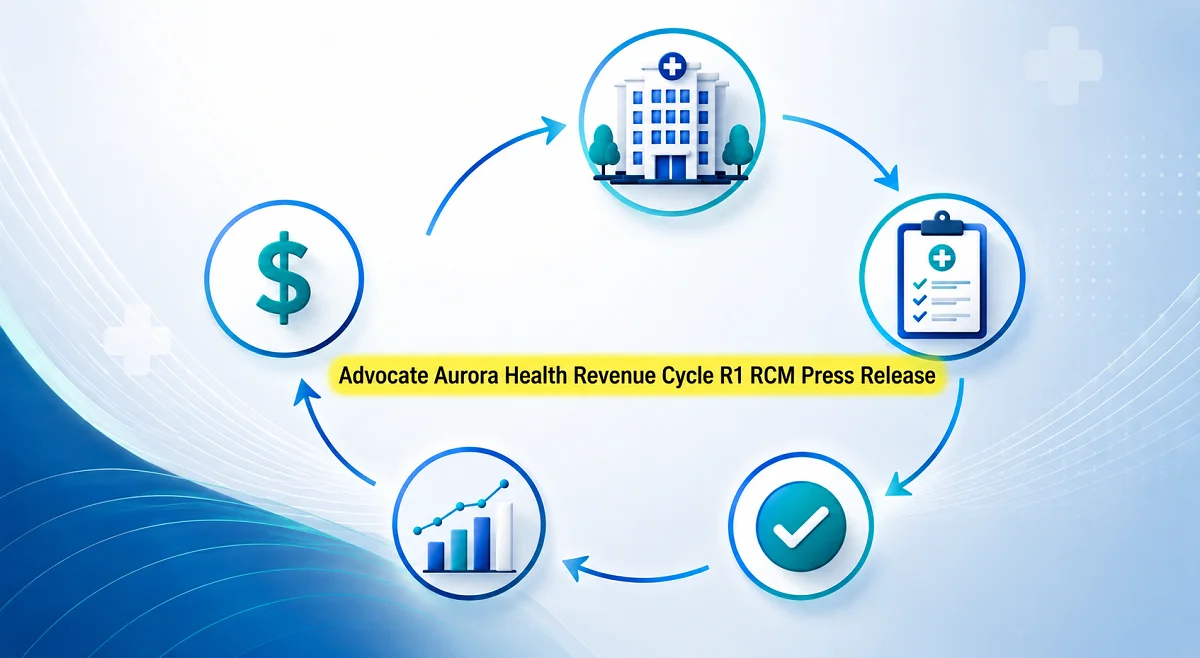
If you searched for an advocate aurora health revenue cycle r1 rcm press release, you’re not alone, and you’re not wrong to be confused. Search results for this exact phrase turn up a tangle of similarly named but unrelated companies, and no actual press release confirming that Advocate Aurora Health (now part of Advocate Health) has partnered with R1 RCM. Below, we clear up that confusion, then walk through everything you need to know about revenue cycle management in healthcare, why it matters, and where companies like R1 RCM actually fit into the picture.
Is There Really an Advocate Aurora Health and R1 RCM Partnership?
As of this writing, there is no confirmed press release announcing a revenue cycle management partnership between Advocate Aurora Health and R1 RCM. Advocate Aurora Health, the system formed in 2018 when Advocate Health Care and Aurora Health Care merged, went on to merge again in 2022 with Atrium Health to become Advocate Health, one of the largest nonprofit health systems in the country. Neither Advocate Aurora Health nor the current Advocate Health has publicly announced R1 RCM as its revenue cycle management partner.
Here’s where the confusion likely comes from. Several similarly named but entirely separate companies operate in the RCM space:
- R1 RCM Inc. is a publicly traded (NASDAQ: RCM) revenue cycle management company based in Murray, Utah. It provides technology enabled RCM services to large hospitals and health systems, and it has announced numerous 10 year, end to end RCM partnerships, but not with Advocate Aurora Health or Advocate Health, based on available public records.
- AuroraRCM is an unrelated RCM software provider offering AI enabled tools like Aurora Align and Aurora Intel. It has no corporate connection to R1 RCM or to Advocate Aurora Health.
- Aurora Healthcare (sometimes styled as a separate entity from AuroraRCM) partnered with a company called LGI in 2025 on an AI driven revenue cycle intelligence platform. This, too, is unrelated to R1 RCM or to the Advocate hospital system.
If you’re researching this topic for business, journalism, or investment purposes, the safest move is to check R1 RCM’s official newsroom and Advocate Health’s official press page directly, since company partnerships can be announced at any time and this article reflects the most recent publicly available information as of publication.
What we can tell you with confidence is how R1 RCM actually operates, and what revenue cycle management means for the healthcare industry as a whole. That’s genuinely useful context whether or not this specific partnership ever materializes.
What Is RCM in Healthcare?
RCM stands for revenue cycle management. In healthcare, it refers to the entire financial process a provider uses to track patient care from the moment someone schedules an appointment to the moment the provider collects final payment for services rendered.
Think of it as the financial mirror of the clinical journey. While doctors and nurses focus on diagnosis and treatment, the revenue cycle exists to make sure the organization actually gets paid for that care, accurately, on time, and in full compliance with payer rules and healthcare regulations.
Revenue cycle management touches nearly every department in a hospital or medical practice: scheduling, registration, insurance verification, coding, billing, claims submission, denial management, and patient collections all fall under its umbrella.
What Is RCM in Medical Billing?
Medical billing is one piece of the larger revenue cycle, not a synonym for it. RCM in medical billing specifically refers to the billing related stages of the cycle: translating clinical documentation into billing codes, submitting claims to insurance payers, following up on unpaid or denied claims, and posting payments once they arrive.
In smaller practices, “RCM” and “medical billing” sometimes get used interchangeably because one person or a small team may handle both. In larger health systems, they’re distinct functions. Billing is the mechanical process of generating and submitting a claim. Revenue cycle management is the strategic oversight of the entire financial process that billing sits inside of, including the steps before a claim is generated (like eligibility checks) and after it’s submitted (like denial appeals and patient collections).
What Is the Revenue Cycle in Healthcare? Breaking Down the Stages
The healthcare revenue cycle typically includes the following stages, in roughly this order:
1. Pre-registration and scheduling The cycle begins before the patient even walks in. Staff collect demographic and insurance information, often verifying coverage in advance to reduce the chance of a claim denial later.
2. Registration On arrival, staff confirm and update the patient’s information, collect co-pays or deposits where applicable, and finalize insurance details.
3. Charge capture Clinical staff document the services provided, which then get translated into billable charges. Missed or delayed charge capture is a common source of lost revenue.
4. Medical coding Trained coders convert clinical documentation into standardized codes (like ICD-10 and CPT codes) that payers use to determine what they’ll reimburse.
5. Claims submission The coded claim is submitted to the patient’s insurance company, either electronically or on paper, depending on the payer.
6. Denial management Not every claim gets paid on the first try. Denials get reviewed, corrected, and resubmitted or appealed. This stage is often where health systems lose the most potential revenue if it’s not managed well.
7. Payment posting Once a payer remits payment, staff record it against the patient’s account and reconcile any difference between what was billed and what was paid.
8. Patient collections Any remaining balance, deductibles, co-insurance, or self-pay amounts, gets billed directly to the patient.
9. Reporting and analytics Ongoing analysis of the cycle’s performance (days in accounts receivable, denial rates, collection rates) helps organizations identify where the process is breaking down and needs improvement.
Why Revenue Cycle Management Matters
A poorly managed revenue cycle doesn’t just cost money, it can threaten a healthcare organization’s ability to function. Hospitals operate on thin margins, and delays or errors anywhere in the cycle, a missed prior authorization, a miscoded claim, a slow appeal, can mean the difference between a healthy cash flow and a serious financial shortfall.
That’s part of why revenue cycle management has become its own specialized industry. Rather than building and maintaining this expertise entirely in house, many health systems now outsource all or part of their revenue cycle to specialized vendors.
R1 RCM and the Outsourced RCM Model
R1 RCM is one of the most prominent names in this space. According to the company’s own public statements, it manages revenue cycle operations for a significant share of the largest health systems in the country, and has structured many of its client relationships as long term, exclusive, end to end partnerships, often spanning 10 years.
Some of R1 RCM’s publicly confirmed partnerships include agreements with Sutter Health, ScionHealth, St. Clair Health, LifePoint Health, and Providence (through its 2023 acquisition of Acclara). These deals typically follow a similar pattern: R1 takes over some or all of a health system’s revenue cycle functions, existing revenue cycle employees often transition to R1 with comparable roles, and the health system gains access to R1’s technology platform and standardized processes in exchange for a long term service agreement.
R1 RCM’s revenue model is built on this kind of enterprise scale, technology enabled outsourcing. The company has also grown through acquisition, buying companies like SCI Solutions and Acclara to expand its capabilities across scheduling, patient access, and claims management.
Whether Advocate Health or its predecessor Advocate Aurora Health has ever entered a formal agreement with R1 RCM is not something we can confirm from current public sources. If you’re specifically researching this relationship for business purposes, check R1 RCM’s investor relations page and press releases directly, since new partnerships are announced there first.
Revenue Cycle Management Jobs
RCM has grown into a substantial career field in its own right. Common roles include:
- Revenue cycle specialists, who handle day to day billing, coding, or claims work
- Denial management analysts, who investigate and appeal rejected claims
- Medical coders, who translate clinical documentation into billing codes
- Patient access representatives, who manage scheduling, registration, and insurance verification
- Revenue cycle managers or directors, who oversee the entire process at a departmental or organizational level
Large RCM vendors like R1 RCM, along with hospital systems that manage their revenue cycles in house, are major employers in this space. Given the scale of outsourcing in the industry, it’s common for revenue cycle employees to transition between a health system and its RCM vendor when a new partnership agreement is signed, as has happened in several of R1 RCM’s publicly announced deals.
Latest: Jamie Lovejoy Arrested After Dog Left Outside Sustained Frostbite
The Bottom Line
If you came here looking for confirmation of an Advocate Aurora Health revenue cycle R1 RCM press release, the honest answer is that no such partnership has been publicly confirmed as of this writing. What does exist is a genuinely complex and important industry, revenue cycle management, that keeps healthcare organizations financially viable, and a set of real, well documented partnerships that show how companies like R1 RCM operate at scale.
Understanding the revenue cycle, from scheduling through final collection, gives you a clearer picture of why these partnerships matter so much to hospitals, and why getting them right (or wrong) can have such a large financial impact.