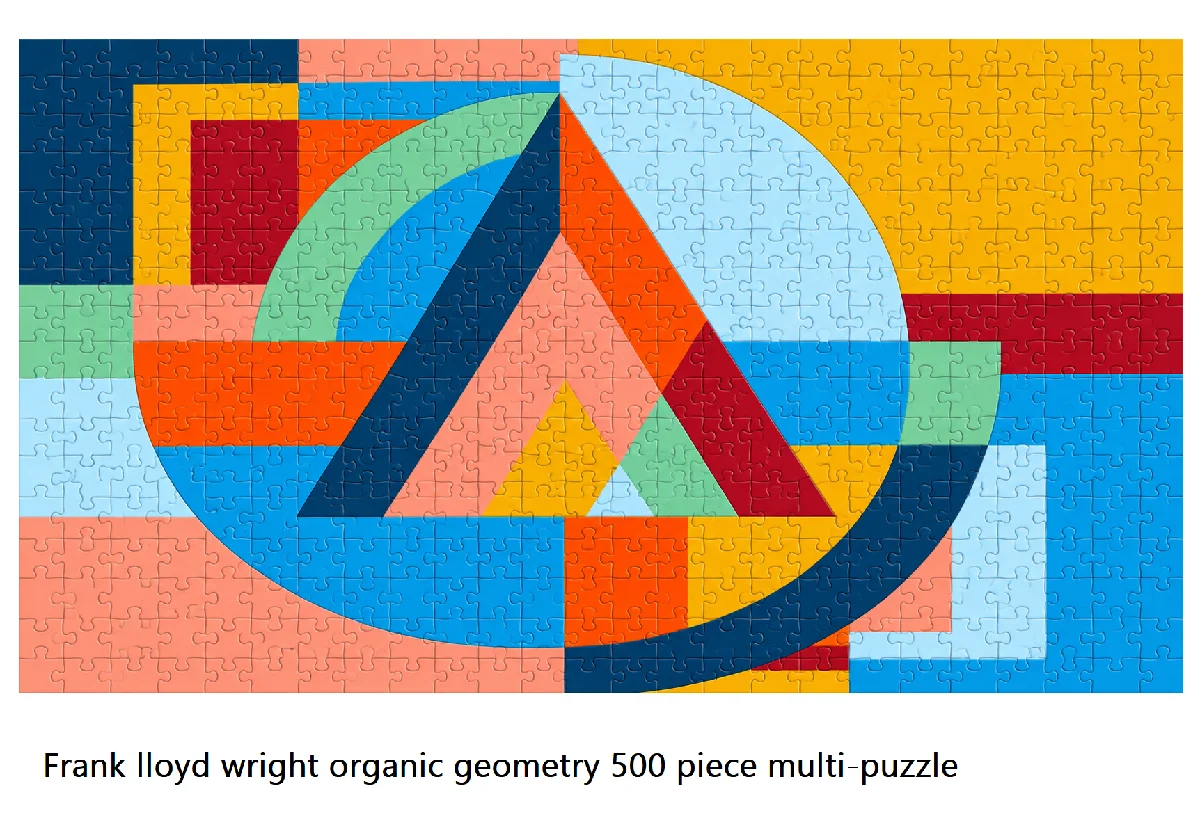
You’ve probably seen this one before you knew its name. The Frank Lloyd Wright Organic Geometry 500 Piece Multi-Puzzle, Galison’s take on Wright’s architecturally-inspired artwork with three mini shaped puzzles tucked inside, has become one of those boxes people spot on a coffee table and immediately ask about. It’s a good-looking product. But “does this puzzle sharpen your mind” is a different question than “is this puzzle nice,” and it deserves a real answer instead of a marketing one.
So here’s the honest version. Puzzling has a real evidence base behind it, and it’s more interesting, and more limited, than most puzzle blogs let on.
What’s actually in the box
Quick grounding before the science: this is a Galison-made puzzle featuring Wright’s geometric, architecturally-inspired artwork, 500 pieces, finishing at 20×20 inches. The twist is the three mini shaped puzzles embedded within the larger image, so you get variety within one box instead of one flat 500-piece grind. It’s rated for ages 11 and up, runs about $20, and the box is built from mostly recycled material, which matters if you care about that kind of thing when you’re buying gifts.
None of that is cognitive science. But it does shape what kind of mental workout you’re actually getting, which I’ll get to.
What the research actually says
I want to be upfront about something: a lot of what gets cited in puzzle-and-brain articles doesn’t hold up when you go looking for the original source. I checked, and I’m only using studies I could verify directly.
The strongest evidence comes from a randomized controlled trial run out of Ulm University in Germany, registered publicly under the name PACE, Puzzles As Cognitive Enrichment. The results showed that jigsaw puzzling strongly engages multiple cognitive abilities, and that long-term puzzling experience, but not short-term experience, could meaningfully benefit cognition. That’s worth sitting with for a second, because it’s not the triumphant headline most sites run with.
The puzzle group in that trial connected an average of 3,589 pieces over 49 hours, and while they got measurably better at puzzling itself, they didn’t show a significant edge over a counseling control group on the broader cognitive test used in the study. What did show up was a dose-response pattern: the amount of jigsaw puzzling was related to changes in visuospatial cognition within the puzzle group, once you accounted for where people started. More puzzling, tracked over time, correlated with more benefit. One box over a weekend didn’t.
That’s the honest picture. Puzzling looks like something that compounds rather than something that fixes anything in a single sitting.
There’s supporting research pointing in a similar direction. A separate paper from the same research group notes that jigsaw puzzling may work through two active ingredients: the specific cognitive demands of the activity itself, which could build brain reserve over time, and the way puzzling helps regulate stress, since chronic stress has its own negative effects on cognitive aging.
The researchers also flagged something I hadn’t seen mentioned elsewhere, that jigsaw puzzling performance in cognitively healthy children correlates fairly strongly with other established visuospatial intelligence tests. That doesn’t prove puzzles build the skill, since it’s a correlation, but it does confirm puzzling taps something real rather than being a mentally empty activity.
On dementia specifically, there’s a smaller but genuinely interesting study using a digital jigsaw-puzzle intervention with older adults who had mild to moderate cognitive impairment. Researchers measured cognition before and after a six-week, twice-weekly program using the Montreal Cognitive Assessment. Nine participants is a small sample, so I wouldn’t lean on it too hard, but it’s a real, ongoing area of study rather than a settled claim, and it fits the broader theme: puzzling as something clinicians are actively researching, not something already proven as treatment.
I’ll say plainly what I won’t cite. You’ll see a “2018 Journal of Neuroscience” study floating around puzzle blogs claiming a precise 4-6% memory improvement in two weeks. I looked for it and couldn’t verify it exists. I’m leaving it out, and I’d treat any site that leads with that stat a little skeptically.
So what does this actually mean for you?
Here’s where I’ll be direct instead of hedging. A single afternoon with this puzzle isn’t going to sharpen your mind in any measurable way, and nobody credible is claiming that. What the research supports is something slower and, honestly, more useful: puzzling as a repeated habit is associated with visuospatial benefits that build over time, the same way going for a walk once doesn’t make you fit, but walking regularly does.
Where the Organic Geometry puzzle specifically fits into that picture comes down to two things.
First, it’s genuinely visuospatial work. Wright’s geometric style, tight repeating shapes, subtle color gradients, isn’t a landscape with obvious sky-versus-ground zones to sort by. You’re constantly rotating pieces mentally and holding “where did I last see something like this” in working memory, which is precisely the kind of demand the PACE trial researchers were measuring.
Second, the three embedded shaped puzzles change the texture of the session. Instead of one long 500-piece push, you get natural stopping points and small wins along the way. I don’t have a study that says shaped sub-puzzles specifically boost the effect, so I won’t claim that, but from a plain “will you actually keep doing this” standpoint, having built-in variety probably matters more for whether the habit sticks than any single design feature of the puzzle itself.
The honest takeaway
If you’re buying this puzzle hoping one box will noticeably sharpen your thinking, that’s not what the evidence supports, and I’d rather tell you that than oversell it. If you’re looking for something to build into a regular habit, an evening a week, a standing thing with a partner or a parent, the research is genuinely on your side. That’s not nothing. It’s also not magic.
What I can say without any hedging: it’s a well-made, visually striking puzzle that gives you real cognitive work to do, not busywork. Whether it does anything for your brain long-term depends less on this specific box and more on whether you pick up another one after it.