
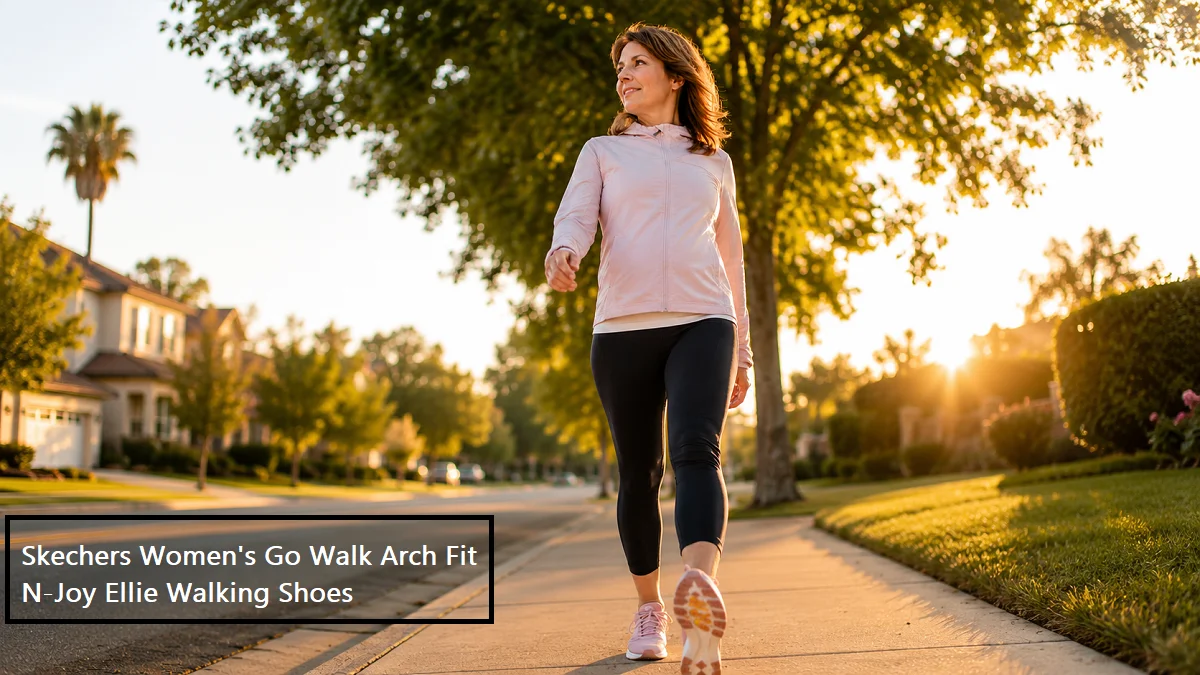
If your feet ache by 3 p.m. and you’re not sure why, the answer might be simpler than you think. It’s often not about how far you walked. It’s about what was on your feet while you did it.
That’s the gap the Skechers Women’s Go Walk Arch Fit N-Joy Ellie Walking Shoes are built to close. This guide breaks down why arch support matters for women who walk regularly, what’s actually going on inside this shoe, and who it makes sense for, so you’re not guessing.
Why Arch Support Actually Matters When You Walk
Every time your foot hits the ground, it absorbs force, roughly one and a half times your body weight with each step. Multiply that by a few thousand steps a day, and you start to see why unsupported feet get tired, sore, or worse.
A peer-reviewed study published through the National Institutes of Health found that arch-support insoles measurably change how that force moves through the foot. According to the research, arch-support insoles can lower the peak vertical ground reaction force at the heel while improving side-to-side control of the foot’s center of pressure, which adds up to better stability throughout the walking motion. In plain terms: proper support helps your foot land and push off more efficiently, so the impact doesn’t just pile up in one spot.
Podiatrists back this up in practice, not just in lab data. As one board-certified podiatrist explained to CNN Underscored, arch support helps absorb shock and distributes body weight more evenly, and even people with normal, healthy arches can benefit through reduced fatigue and better alignment. So this isn’t only a fix for existing foot pain. It’s preventive, too.
Here’s what that looks like day to day: less burning across the ball of your foot after a long shift, less tightness in your calves after a weekend of errands, and less of that end-of-day “I need to sit down immediately” feeling.
What’s Actually Inside the Arch Fit N-Joy Ellie
Skechers didn’t just slap a footbed label on this shoe and call it support. The Arch Fit insole system is patented, and according to the brand, it was developed using two decades of data and over 120,000 unweighted foot scans. That’s a genuinely large dataset for a mainstream walking shoe, and it shows in how the insole is shaped: it’s contoured to follow the natural curve of the arch rather than just padding it.
A few features work together here:
- Removable, molding insole. The polyurethane footbed helps mold to your foot shape over time, which helps reduce shock and spread your weight more evenly across the sole.
- Breathable mesh upper. Lightweight and flexible, so the shoe moves with your foot instead of fighting it.
- Elastic bungee laces. These function like a slip-on. No re-tying every time you put them on, though it does mean less ability to fine-tune tightness compared to traditional laces.
- Vegan, machine-washable construction. Made without animal-derived materials, and easy to keep clean if you’re on your feet in less-than-pristine environments.
This particular style has earned the American Podiatric Medical Association’s Seal of Acceptance. Worth being precise about what that actually means: APMA itself is clear that the seal is a recognition granted to products found beneficial to foot health, not a formal endorsement. To earn it, podiatrists who specialize in foot and ankle health review the footwear’s support, structure, cushioning, and overall design before it qualifies. So it’s a real, third-party review process, just not a guarantee that this exact shoe will solve your exact foot issue. No shoe can promise that.
Who These Shoes Are Genuinely Good For
Based on what’s built into this design, the Ellie makes the most sense for:
Women who walk for exercise or general fitness.
If you’re doing a daily 20-minute loop around the neighborhood or logging steps on a treadmill, the lightweight build and shock-dispersing insole are made for exactly that kind of repetitive, moderate-impact movement.
Anyone on their feet most of the day.
Retail workers, nurses, teachers, people who stand at a counter or walk a sales floor for hours. That’s arguably where arch support earns its keep the most, since the fatigue compounds hour over hour.
People who want convenience without giving up support.
The slip-on lacing means you’re not bending down and fumbling with knots every time you head out the door, but you’re still getting a structured footbed underneath, which is a real trade-off compared to a basic slip-on that skips the support altogether.
Travelers.
Lightweight, easy to pack, easy to slip on and off at security. If you’ve ever regretted your shoe choice halfway through an airport terminal, this is the kind of shoe built to prevent that regret.
Who it’s probably not for: if you have a diagnosed foot condition like severe plantar fasciitis or need a custom orthotic fit, this is a good everyday shoe, not a substitute for a podiatrist-prescribed insert. And if you strongly prefer adjustable, traditional lacing so you can tighten or loosen your fit precisely, the elastic bungee laces here will feel like a limitation rather than a convenience.
What Reviewers Say in Practice
Owner feedback lines up closely with what the design promises. Verified buyer reviews on retailer sites repeatedly describe the shoe as very comfortable for walking and standing throughout the day, calling out the arch support by name as a standout feature. That kind of real-world, all-day feedback matters more than a single test walk, since foot fatigue usually shows up hours in, not minutes in.
The main complaints in reviews center on two things: the elastic laces (some walkers wanted a true lace-up option instead) and sizing, with a handful of reviewers noting they sized up for extra toe room but found the fit ran a little wide as a result. Worth trying a half size down if you have narrower feet, or sticking with your usual size if you’re not sure.
How to Get the Most Out of Them
A few honestly practical tips, not marketing points:
- Break them in gradually. Like most structured insoles, the Arch Fit footbed needs a few wears to fully mold to your foot. Don’t judge comfort on day one alone.
- Wear them for their actual purpose. These are built for walking and all-day wear, not high-impact running or trail terrain. Match the shoe to the activity.
- Replace the insole if it wears out before the shoe. Since the footbed is removable, you don’t have to retire the whole shoe just because the cushioning has flattened.
- Pair with the right socks. Moisture-wicking socks help the mesh upper do its job and reduce friction over long walks.
Read our latest blog here.
Conclusion
The Skechers Women’s Go Walk Arch Fit N-Joy Ellie Walking Shoes aren’t trying to be a performance running shoe or a medical device. They’re trying to solve a much more common problem: making everyday walking, standing, and errands more comfortable without asking you to sacrifice convenience. Between the research-backed insole design, the third-party podiatric review behind the APMA seal, and consistent real-world feedback from people wearing them all day, they hold up as a genuinely practical option for women who spend a lot of time on their feet.
If you’re deciding between this and a plain, unsupported walking shoe, the arch support is the real differentiator. It’s not a gimmick. It’s the part of the shoe doing the actual work while you walk.