If you’ve ever watched your fingers turn white, then blue, then red after a walk in the cold, you’ve probably typed some version of this question into Google. Here’s the honest, short answer: there isn’t one single main cause of Raynaud’s disease. There are two different explanations, depending on which type you have.
For most people with Raynaud’s, doctors don’t know exactly why it happens. That’s called primary Raynaud’s, and it’s the more common form. For a smaller group, Raynaud’s shows up as a side effect of a separate disease, usually one that affects the immune system. That’s called secondary Raynaud’s, and it does have an identifiable cause.
That distinction matters more than any other fact in this article. So let’s slow down and go through it properly.
What Actually Happens in a Raynaud’s Attack
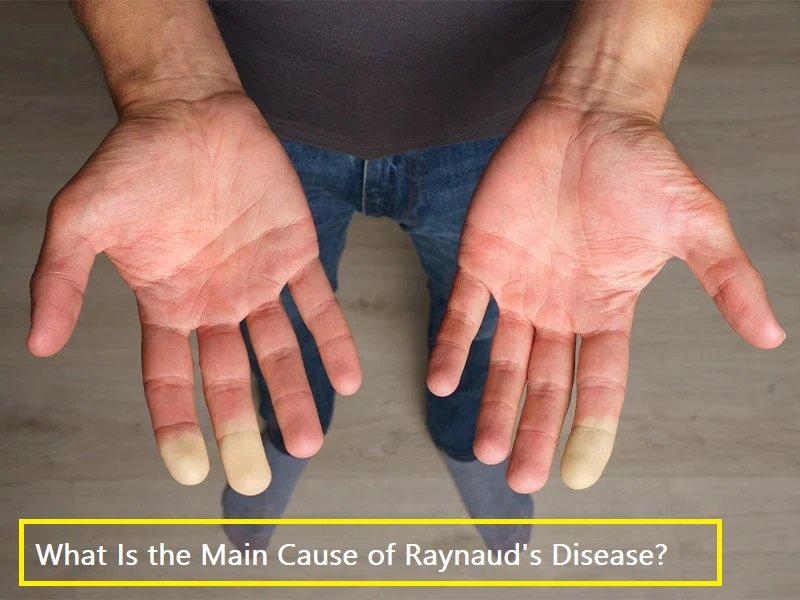
Before getting into causes, it helps to know what’s physically going on. Raynaud’s affects the small blood vessels in your fingers and toes, and occasionally your nose, ears, or lips. During an attack, these vessels narrow suddenly, cutting off most of the normal blood flow. Doctors call this vasospasm, and it’s why skin turns pale, then blue as leftover oxygen gets used up, then red as blood rushes back once the vessels relax.
Cold is the most common trigger. Stress is second. Neither is the “cause” exactly, they’re just what sets off an attack once the underlying condition is already there.
Primary Raynaud’s: No Known Cause
Here’s the part that surprises a lot of people. According to the National Institute of Arthritis and Musculoskeletal and Skin Diseases (NIAMS), primary Raynaud’s phenomenon has no known cause, and it’s the more common form of the condition.
That’s not a gap in the research, it’s simply where the science currently stands. Researchers understand the mechanics of an attack (the vasospasm process described above) but not why some people’s blood vessels overreact to cold or stress in the first place while others’ don’t.
A few things raise the odds of developing primary Raynaud’s without explaining the root cause: being female, being under 30 when symptoms start, living in a colder climate, or having a close relative with it. These are risk factors, patterns researchers have noticed, not confirmed mechanisms. If you have primary Raynaud’s, the honest answer to “why me” is still “nobody knows yet.” It’s also usually the milder version, often manageable, and for some people it fades on its own over time.
Secondary Raynaud’s: The Cases With a Real Answer
Secondary Raynaud’s is a different story, and it’s the one place where “main cause” is a fair question with a real answer. As UCSF’s Department of Surgery puts it, secondary Raynaud’s is caused by an underlying disease, condition, or other factor, and this type tends to be more serious than primary Raynaud’s.
So what’s actually underneath it? Overwhelmingly, autoimmune and connective tissue diseases. Most cases of secondary Raynaud’s are linked to autoimmune diseases, conditions where the immune system mistakenly attacks the body’s own tissue.
One condition stands out well above the rest: scleroderma, specifically a form called systemic sclerosis. The connection here is strikingly strong. More than 9 out of 10 people with systemic sclerosis also have Raynaud’s. Flip that around, though, and the risk runs the other way: someone who has Raynaud’s has only a small chance of developing scleroderma, thought to be under 2 in 100 women and under 6 in 100 men with Raynaud’s. Having Raynaud’s doesn’t mean scleroderma is coming, it just means the two conditions are closely linked in one direction.
Other diseases linked to secondary Raynaud’s include:
- Lupus
- Rheumatoid arthritis
- Sjögren’s syndrome
- Certain blood disorders that thicken or change the blood
- Thyroid conditions
- A form of high blood pressure that affects the lungs (pulmonary hypertension)
Beyond disease, a few other factors can trigger or worsen secondary Raynaud’s: repetitive strain from typing or vibrating tools, smoking (nicotine narrows blood vessels on its own), certain medications like beta blockers and some migraine drugs, past injuries such as frostbite or hand surgery, and carpal tunnel syndrome. In each case, treating or removing the underlying factor often improves the Raynaud’s symptoms too, another sign that secondary Raynaud’s really is a symptom of something else rather than a standalone problem.
How Doctors Tell the Two Apart
You might be wondering how anyone actually knows which type they have. The main tool is a simple, painless test called nailfold capillaroscopy, where a doctor examines the skin at the base of your fingernail under a microscope. Abnormal-looking capillaries there point toward secondary Raynaud’s; normal-looking ones point toward the primary type. Doctors also weigh timing (secondary symptoms tend to start later, often around age 40) and blood tests for autoimmune markers.
New, severe, one-sided, or later-onset symptoms are generally worth getting checked, rather than assuming it’s the primary, no-known-cause type.
Why This Distinction Actually Matters
I know “we don’t fully know” isn’t the satisfying answer most people want. But the primary/secondary split isn’t just a technicality, it changes what happens next. Primary Raynaud’s usually just means avoiding triggers: dressing warmly, managing stress, medication if attacks are frequent. Secondary Raynaud’s means there’s a disease underneath, and for conditions like scleroderma and lupus, catching that early tends to lead to better long-term outcomes. That’s why doctors care about the label. Not for its own sake, but because it points toward two genuinely different paths.
Conclusion
There’s no single main cause of Raynaud’s disease, because there are two different types with two different answers. Primary Raynaud’s, the more common form, has no known cause, though cold exposure and stress reliably trigger attacks once you have it. Secondary Raynaud’s does have an identifiable cause: an underlying disease, most often an autoimmune or connective tissue condition like scleroderma, lupus, or rheumatoid arthritis, though medications, smoking, and repetitive strain can also play a role.