If you’ve ever woken up at 2 a.m. with a burning feeling crawling up your chest, you already know why people search for gastroesophageal reflux disease treatments at 3 a.m. instead of waiting for a normal appointment slot. GERD is common, genuinely uncomfortable, and treatable in most cases. It’s also more layered than “just take an antacid,” because what works depends heavily on how often symptoms happen, how severe they are, and whether they’re already causing damage to the esophagus.
This guide walks through the real treatment options in the order most doctors actually use them: lifestyle changes first, then medications, then procedures or surgery for the smaller group of people who need them. Nothing here replaces a conversation with your own doctor, especially if you’re dealing with new or severe symptoms, but it should give you a clear, accurate picture of what’s out there before that conversation happens.
What Is Gastroesophageal, Exactly?
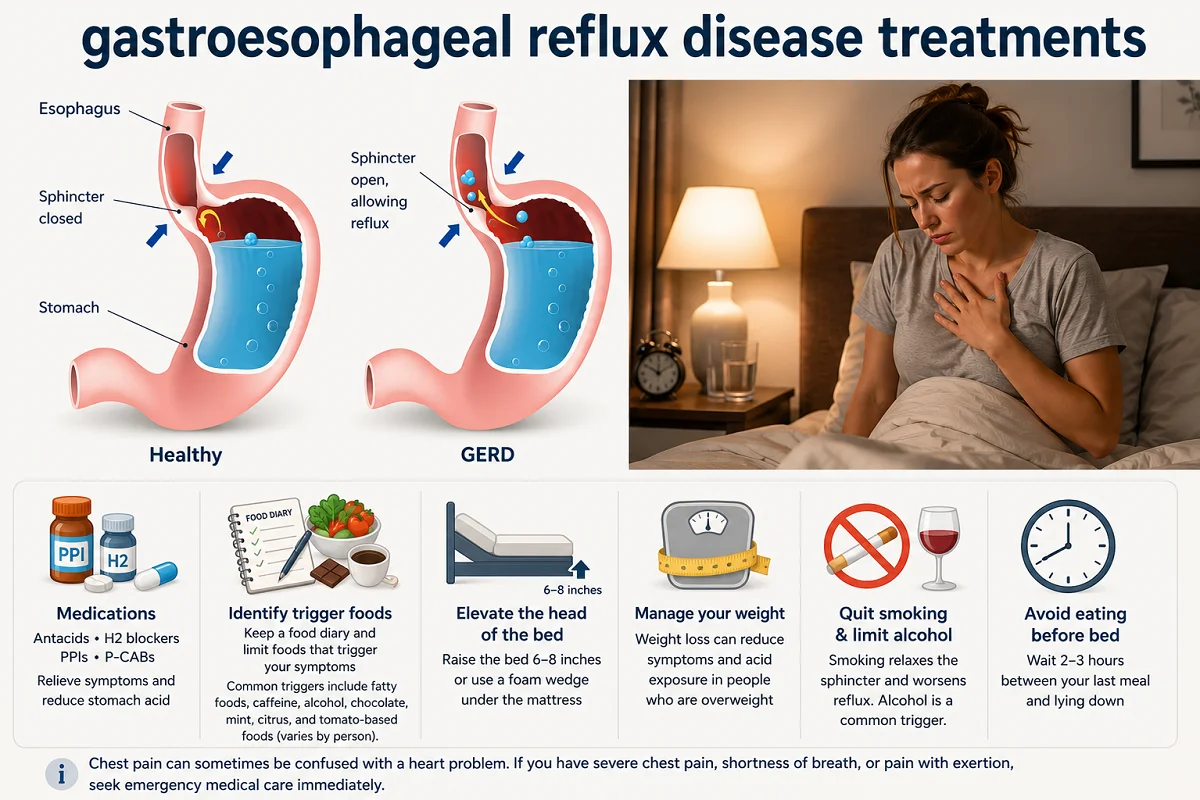
Gastroesophageal reflux disease happens when the lower esophageal sphincter, the ring of muscle that’s supposed to keep stomach contents where they belong, relaxes at the wrong times or weakens over time. Stomach acid then flows backward into the esophagus, which doesn’t have the same protective lining as the stomach. That’s what produces heartburn, regurgitation, and in some people, a chronic cough or hoarseness that has nothing obviously to do with digestion.
Occasional reflux is normal. Nearly everyone gets it after a big meal or too much coffee. GERD is the chronic version: symptoms that show up at least twice a week, or reflux frequent enough to start damaging the esophagus even without classic heartburn. That distinction matters for treatment, because a single bad night doesn’t call for the same response as a pattern that’s been going on for months.
Doctors also split GERD into two broad types. Non-erosive GERD, sometimes called NERD, is the more common form: real symptoms, but no visible damage to the esophageal lining on endoscopy. Erosive GERD involves actual erosions or inflammation, and it’s the type more closely tied to complications like strictures or Barrett’s esophagus if left untreated. GERD affects about 1 in 5 people in the United States, so if this feels like it applies to you, you’re in very ordinary company.
Lifestyle and Dietary Changes: Where Treatment Starts
Every major guideline puts lifestyle changes first, not because they’re a lesser option, but because they genuinely move the needle for a lot of people and carry essentially no risk. A systematic review of lifestyle modifications for GERD found that weight loss was associated with a decrease in GERD symptoms and acid exposure time, along with improvement in reflux disease questionnaire scores. Of everything on this list, weight loss has the strongest evidence behind it, and Johns Hopkins Medicine notes it as the most effective of all the lifestyle changes for people who are overweight.
Beyond weight, a few changes come up again and again in the research and in clinical guidance:
- Elevate the head of your bed. Not with extra pillows stacked under your head, which mostly just bends your neck, but by raising the actual head of the bed frame 6 to 8 inches, or using a foam wedge under the mattress. This inclines the whole body and raises the head off the bed, which helps keep stomach contents where they belong overnight.
- Watch your trigger foods, but know they’re personal. Common culprits include fatty or fried foods, caffeine, alcohol, chocolate, mint, citrus, and tomato-based dishes. Foods that decrease pressure in the lower esophagus, such as fatty foods, alcohol, and peppermint, are worth limiting. That said, triggers vary quite a bit from person to person, so a food diary for a couple of weeks is often more useful than any generic list.
- Don’t eat right before lying down. Give yourself at least 2 to 3 hours between your last meal and bedtime.
- Quit smoking, if you smoke. Tobacco relaxes the same sphincter muscle that’s already the problem in GERD, which makes reflux worse on top of everything else smoking does.
- Loosen tight clothing and watch your posture after eating. Extra pressure on the abdomen, from tight waistbands or bending forward, can push acid upward.
Here’s the honest limitation: lifestyle changes help a lot of people, but they don’t fully control moderate to severe GERD on their own for everyone. If you’ve made these changes consistently for a few weeks and symptoms are still showing up twice a week or more, that’s the point where medication usually enters the picture, not a sign that you did something wrong.
Over-the-Counter and Prescription Medications
This is where most people spend the bulk of their treatment time, and it’s also where the options have genuinely expanded in the last couple of years. There are four main drug categories, and they work in different ways.
Antacids
Antacids like calcium carbonate, and combination products such as Tums, Rolaids, or Maalox, neutralize acid that’s already there. They may relieve mild symptoms of GERD, and they work fast, often within minutes. Their downside is that the relief is short-lived and they don’t do anything to prevent the next episode. Think of antacids as putting out a small fire, not preventing the next one from starting.
H2 Blockers
Histamine-2 receptor antagonists, or H2 blockers, include famotidine (Pepcid), cimetidine (Tagamet), and nizatidine (Axid). These agents are reversible competitive blockers of histamine at the H2 receptors, particularly those in the gastric parietal cells, where they inhibit acid secretion. They take longer to kick in than antacids, usually 30 to 90 minutes, but the effect lasts several hours. They’re effective for healing mild esophagitis in about 70 to 80 percent of GERD patients and for providing maintenance therapy to prevent relapse. Worth knowing: H2 blockers aren’t appropriate for treating GERD complications like esophagitis, esophageal stricture, or Barrett’s esophagus. They’re a good fit for milder, intermittent symptoms, less so for anything that’s already causing visible damage.
Proton Pump Inhibitors (PPIs)
PPIs, including omeprazole (Prilosec), lansoprazole (Prevacid), and esomeprazole (Nexium), have been the standard prescription treatment for GERD for roughly three decades. They inhibit gastric acid secretion by blocking the H+/K+ ATPase enzyme system in the gastric parietal cells, and they’re the most powerful medications available for treating GERD. Current clinical guidance still reflects this. The American College of Gastroenterology’s guidelines recommend an 8-week trial of once-daily, premeal PPI therapy for people with classic GERD symptoms who don’t have any alarm symptoms.
PPIs are effective, but they’re not without controversy. There’s been increasing awareness among physicians and patients about the side effects associated with long-term PPI use, which is part of why the next category has gotten so much attention lately.
Potassium-Competitive Acid Blockers (P-CABs)
This is genuinely the newest development in GERD medication, and it’s worth understanding even though it’s newer than a lot of what you’ll find elsewhere. Vonoprazan, sold as Voquezna, is a P-CAB that works differently from PPIs. It was first approved for erosive GERD, then for maintenance of healing, and as of mid-2024, for non-erosive GERD as well, which covers the largest share of people with this condition. Non-erosive GERD is the largest category of GERD, affecting an estimated 45 million US adults.
Potassium-competitive acid blockers effectively suppress gastric acid secretion and represent a newer approach, particularly relevant for patients whose symptoms don’t respond adequately to optimal PPI therapy. In trial data comparing it directly against a standard PPI, vonoprazan at 20 mg met the primary endpoint of non-inferiority for full healing by week 8 in patients with all grades of erosive GERD, with a 93 percent healing rate compared to 85 percent for lansoprazole. It’s not a first-line default for everyone, and it costs more than generic PPIs, but if you’ve tried a PPI and still aren’t getting relief, it’s a reasonable option to bring up with your doctor.
Prokinetics and Other Agents
Prokinetic agents help the stomach empty faster, which reduces the amount of content available to reflux upward. In patients with residual reflux despite PPI therapy, medications like H2 blockers, prokinetics, and baclofen may be used. These aren’t typically first-line, partly because of side-effect profiles, and they tend to come up specifically for people whose symptoms persist after other approaches.
One honest caveat on the medication side overall: what works varies a fair amount by individual, and “refractory GERD,” meaning symptoms that don’t respond to a standard PPI trial, is common enough that gastroenterologists have a whole separate diagnostic process for it. If a first medication doesn’t fully resolve things, that’s a normal part of figuring out the right regimen, not a dead end.
Endoscopic and Surgical Procedures
For the smaller group of people whose symptoms aren’t well controlled by lifestyle changes and medication, or who’d rather not stay on medication indefinitely, procedural options exist. These aren’t first-line, and they involve real tradeoffs, but they’re worth understanding.
Endoscopic procedures are less invasive than surgery and are done through an endoscope rather than an incision. Procedures like TIF, Stretta, and Endocinch work by improving the function of the lower esophageal sphincter, reducing reflux, and preventing further damage to the esophagus. Transoral incisionless fundoplication, or TIF, can mean a shorter treatment time, less pain, and faster recovery compared to laparoscopic surgery, which makes it a middle-ground option for some patients.
Surgical fundoplication, most often the Nissen procedure, involves wrapping the top of the stomach around the lower esophagus to reinforce the sphincter. The goal of surgery for reflux disease is to strengthen the anti-reflux barrier, and it’s generally considered for people with severe GERD, a hiatal hernia, or symptoms that haven’t responded adequately to medication. Worth knowing: the rate of surgical fundoplication has been markedly decreasing in recent years as medication options have improved, though it’s still an appropriate choice for the right patient.
There’s also the LINX device, a ring of magnetic beads placed around the lower esophagus that keeps it closed to reflux while still allowing food through when you swallow. It’s a less commonly discussed option but comes up as an alternative to traditional fundoplication for some candidates.
Recent professional guidelines reflect how much this space has evolved. A 2023 multi-society consensus guideline on the surgical and endoscopic treatment of GERD provided 13 evidence-based recommendations and proposed an algorithm to help guide treatment decisions, covering everything from preoperative evaluation to the choice between complete and partial fundoplication. If a procedure is on the table for you, this is the kind of guideline your surgeon or gastroenterologist is likely drawing from.
When to See a Doctor
Most GERD is manageable with the steps above, but a few signs mean it’s time to get evaluated rather than keep self-treating:
- Heartburn more than twice a week, even with lifestyle changes
- Difficulty or pain swallowing
- Unintentional weight loss
- Vomiting blood or passing dark, tarry stools
- Symptoms that don’t improve after using over-the-counter medication as directed for two weeks
- Chest pain that could be confused with a heart problem, which always warrants urgent evaluation rather than a wait-and-see approach
Roughly 80 percent of people have a recurrent but non-progressive form of GERD that responds well to medication, while identifying the smaller group with a progressive form matters because they’re the ones more likely to develop complications like strictures or Barrett’s esophagus. An endoscopy is often how that distinction gets made, and it’s a reasonable next step if symptoms are persistent or if you’re in a higher-risk group.
Conclusion
GERD treatment isn’t one-size-fits-all, and that’s actually good news: there’s a real range of options between “live with the burning” and “go straight to surgery.” For most people, it starts with weight management, elevating the head of the bed, and identifying personal trigger foods. From there, medication options have genuinely expanded, from antacids and H2 blockers through PPIs to the newer P-CAB class, giving more room to find something that works if the first approach doesn’t. Procedures and surgery remain there for the smaller group who need them.
If you’re dealing with frequent symptoms, the most useful thing you can do is talk to a doctor about which category fits your situation, rather than guessing. This article covers general treatment information and isn’t a substitute for medical advice about your specific case.