
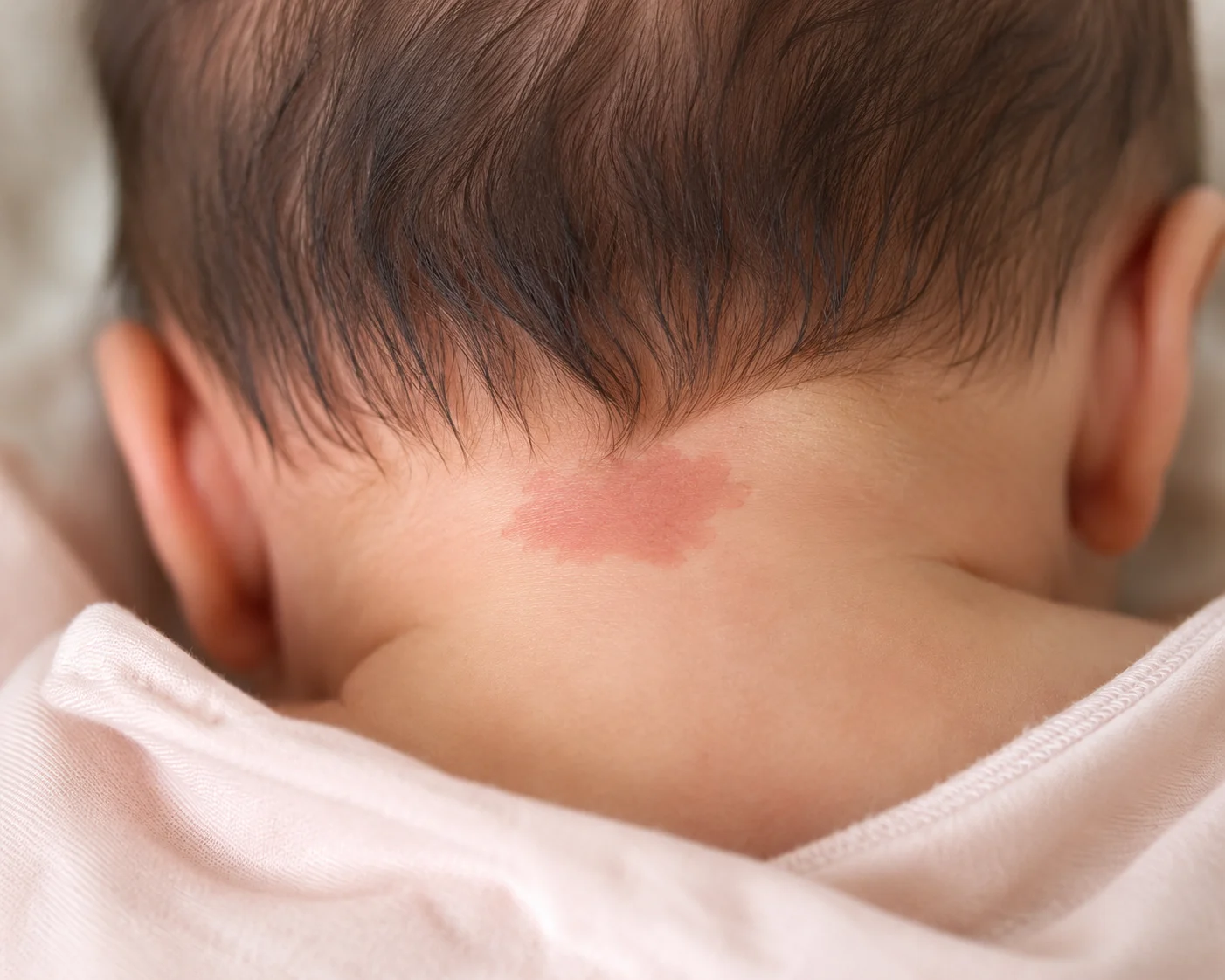
If you spotted a pink or reddish patch on your newborn’s eyelids, forehead, or the back of their neck, you’re probably not looking at anything unusual. That mark almost certainly has a name: a stork bite. And despite the slightly alarming name, it’s one of the most common, most harmless things a baby’s skin can do.
Here’s everything you actually need to know: what it is, why it shows up, and how to tell the difference between “totally normal” and “worth a call to the pediatrician.”
What Is a Stork Bite?
A stork bite is a flat, pink-to-red birthmark caused by a cluster of small blood vessels sitting close to the surface of the skin. The medical name is nevus simplex, though you’ll also hear it called a salmon patch or, when it shows up on the eyelids or between the eyebrows, an angel’s kiss. All three names describe the same thing, just at different locations on the body.
It’s genuinely common. Nevus simplex shows up in roughly 30 to 40 percent of all newborns according to pediatric hospital data, and some broader estimates put the figure as high as 70 percent depending on how the studies counted milder cases. Either way, if your baby has one, they’re in good company.
Where the name comes from: it’s folklore, not medicine. The idea traces back to old stories about storks delivering babies by carrying them in their beak, gripped at the back of the neck, which happens to be one of the most common spots for these marks to appear. Cute origin story, zero connection to what’s actually happening under your baby’s skin.
What Causes a Stork Bite?
Stork bites form before birth, during fetal development. Small blood vessels called capillaries stretch, or dilate, and because a newborn’s skin is so thin and delicate, the extra blood flow shows through as a visible pink, red, or purplish mark.
That’s really it. There’s no known cause tied to anything the pregnant parent did or didn’t do. It’s simply a normal quirk of how blood vessels develop, and it happens whether the baby is full-term, early, big, small, or anything in between.
Where Do Stork Bites Show Up?
They favor a few specific spots. One clinical review found that 81 percent occur on the nape of the neck, 45 percent on the eyelids, and 33 percent between the eyebrows, with a single baby often having more than one patch at once. Less commonly, they turn up on the back of the scalp or lower back.
Where the mark sits actually determines what people call it:
- Back of the neck or nape → the classic “stork bite”
- Eyelids or between the eyebrows → “angel’s kiss”
- Forehead, nose, or upper lip → often just called a salmon patch
Some providers use these names interchangeably no matter the location, so don’t worry if you hear “stork bite” applied to a mark on your baby’s forehead. It’s all the same condition.
What Does a Stork Bite Look Like?
A few features set it apart from other newborn skin marks:
- Flat. It doesn’t raise up or feel different from the surrounding skin.
- Pink to reddish-purple. The color contrasts with the baby’s regular skin tone.
- Irregular edges. Instead of a clean outline, the borders look soft, feathery, or undefined.
- Changes with activity. It often gets more visible when the baby cries, strains, or gets warm, since more blood is flowing to the area in those moments. Press a finger against it and it may lighten briefly before returning to its usual shade.
None of this means the mark is growing or getting worse. It’s just blood vessels responding to normal, everyday triggers.
How Long Do Stork Bites Last?
Most fade substantially within the first one to two years. Marks on the eyelids and forehead tend to go first, often within several months. The ones on the back of the neck are the stubborn ones. Stork bites in that location are less likely to disappear completely, and some persist into adulthood, though by then they’re usually faint and easy to miss under hair.
Here’s a genuinely reassuring detail: a stork bite on the back of the neck isn’t considered a real cosmetic concern even if it sticks around, simply because hair covers it. Nobody’s grading your baby’s neck.
Is a Stork Bite Something to Worry About?
For the overwhelming majority of babies, no. Stork bites aren’t usually a sign of any underlying medical condition, and they don’t hurt or bother the baby at all. They’re purely a skin appearance thing, not a health issue.
There is one rare exception worth knowing about. Very rarely, and only when a baby has other physical differences alongside it, a stork bite can be associated with Beckwith-Wiedemann syndrome, a genetic condition affecting growth. If your baby’s provider notices other signs during their newborn exam, they may look a little closer. But this is the exception, not the expectation. For the vast majority of babies, a stork bite is just a stork bite.
When to actually call your pediatrician:
Reach out if the mark:
- Gets noticeably larger over time
- Changes color in a way that seems permanent (not just temporary flushing)
- Becomes raised, swollen, or thickened
- Appears alongside other symptoms you’re unsure about
Your baby’s provider will typically spot and note any stork bite during the newborn exam anyway, so it’s already on their radar. Diagnosis is made just by looking at the mark, no tests required.
Stork Bite vs. Port-Wine Stain: What’s the Difference?
This is the comparison most new parents actually want, because the two can look similar at a glance.
| Stork Bite (Nevus Simplex) | Port-Wine Stain | |
|---|---|---|
| Color | Pink to light red | Darker red to purple |
| Texture | Flat, often with soft/feathery edges | Flat at birth, may thicken or darken over years |
| Changes over time | Usually fades significantly by age 1-2 | Permanent, doesn’t fade on its own |
| Common locations | Neck, eyelids, forehead, between eyebrows | Can appear anywhere, often one side of the face or body |
| Size | Typically smaller | Usually larger than a typical nevus simplex |
Even experienced providers sometimes find it tricky to tell the two apart just by looking, especially in a newborn’s first days. If there’s any doubt, your pediatrician can monitor how the mark behaves over the following months. A stork bite that’s fading by six months to a year is doing exactly what it’s supposed to do.
Do Stork Bites Need Treatment?
No, and that’s genuinely good news for parents dreading another to-do item. Because these marks are harmless and typically fade on their own, standard medical advice is that they don’t require any treatment.
If a mark persists well past early childhood and a family wants it addressed for cosmetic reasons, laser treatment can lighten or remove a lingering nevus simplex. This is a personal choice, though, not a medical necessity. Most families never pursue it.