
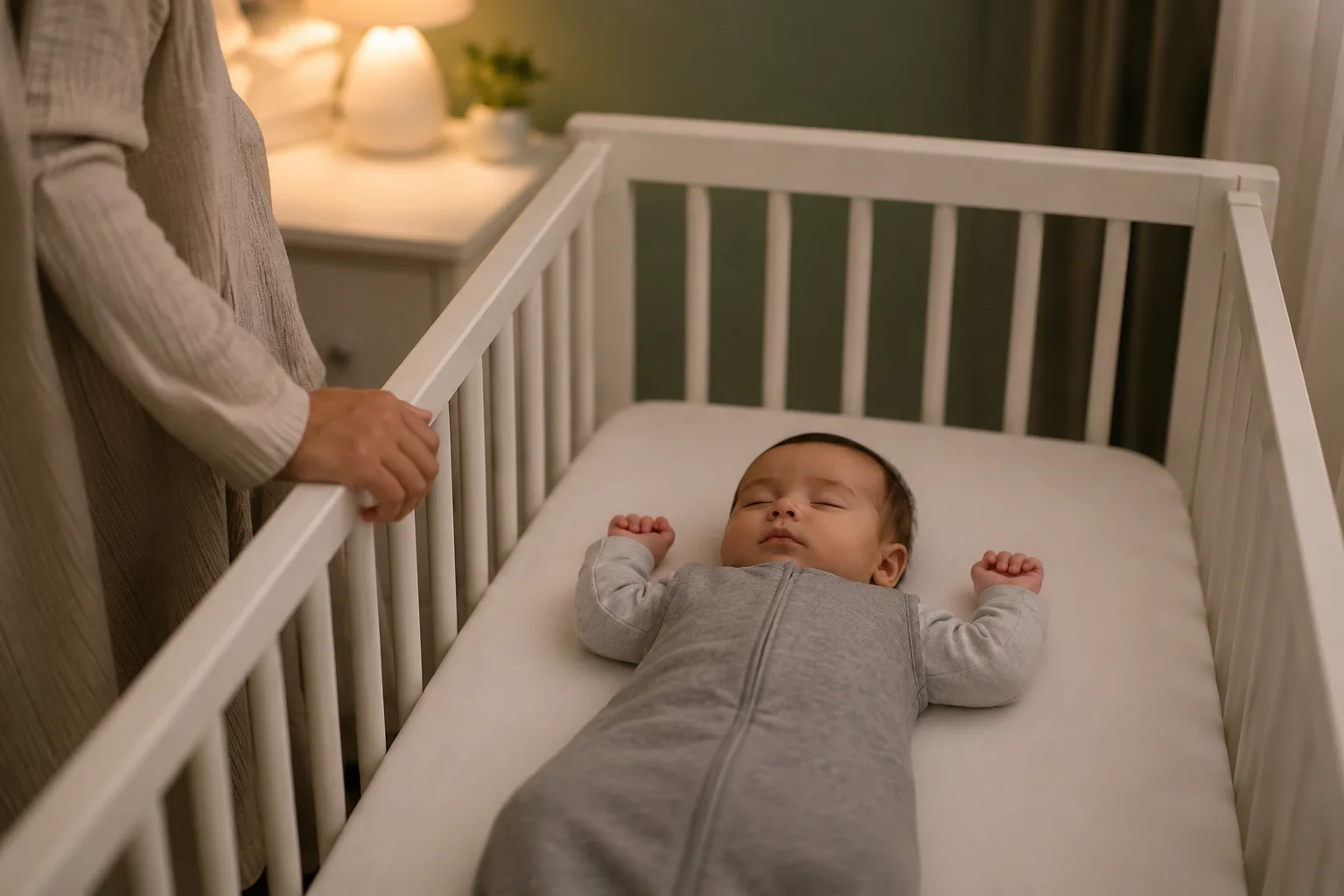
A congested baby who won’t settle is exhausting for everyone in the house. It’s tempting to prop them up, tilt the mattress, or let them sleep on their side “just this once” so they can breathe easier. Don’t. Every major pediatric authority, including the American Academy of Pediatrics, is clear on this: the safest position is flat on the back, every sleep, congested or not.
That answer surprises a lot of parents. It seems counterintuitive that a stuffy nose wouldn’t call for an exception. This guide explains why back sleeping stays the rule even during a cold, what actually helps clear a baby’s nose, and which “solutions” you’ll see marketed online that pediatricians specifically warn against.
Why Back Sleeping Is Still Best, Even With Congestion
Newborns and young infants breathe primarily through their noses, which is exactly why a stuffy nose feels like such a crisis at 2 a.m. But a baby’s airway is actually better protected on their back than in any other position. Lying flat keeps the airway straight, similar to a straw that hasn’t been bent. When a baby is propped up, reclined, or turned on their side, their chin can drop toward their chest or their neck can curve, narrowing that airway right when it’s already partially blocked by mucus.
Side sleeping isn’t a safer middle ground, either. It’s an unstable position: babies roll from their side onto their stomach easily, and stomach sleeping is linked to a meaningfully higher risk of Sudden Infant Death Syndrome. Pediatricians who study SIDS, including researchers affiliated with the AAP’s Task Force, point out that a stomach-sleeping infant may actually have a harder time clearing an airway obstruction than one lying on their back.
So the instinct to elevate or angle a sick baby, while understandable, works against the goal. A flat back position keeps the airway open and gives your baby the best chance of breathing, and sleeping, well.
What NOT to Do When Your Baby Is Congested
A lot of well-meaning advice circulating online, and even some baby products sold specifically for reflux or congestion, contradict current safety guidance. Skip these:
- Don’t prop the baby on a pillow, rolled towel, or wedge. It can bend the neck and restrict the airway rather than open it.
- Don’t incline the crib mattress or use a sleep positioner. The Consumer Product Safety Commission has banned inclined infant sleep products for exactly this reason: any incline over 10 degrees increases suffocation risk.
- Don’t let your baby sleep in a car seat, swing, or bouncer as a substitute crib. These devices don’t support a flat sleep surface, congested or not.
- Don’t add blankets, stuffed animals, or bumper pads “just for comfort.” Soft bedding is a suffocation hazard regardless of the reason you’re tempted to add it.
- Don’t sleep with your baby in your bed to keep a closer eye on their breathing. Bed-sharing raises the risk of accidental suffocation and is not recommended even during illness.
If your baby has fallen asleep upright in your arms or in a carrier because that’s the only way they’ll settle, that’s a normal part of a rough night. Just move them to their own flat, firm sleep space as soon as it’s safe to do so.
Safe Ways to Ease a Stuffy Nose Before Sleep
None of this means you have to sit back and watch your baby struggle. Several approaches are both effective and considered safe by pediatricians.
Saline drops and a nasal aspirator. A few saline drops loosen dried mucus, and a bulb syringe or nasal aspirator clears it out. Doing this 10 to 15 minutes before a nap or bedtime, and again before feeding, tends to help the most.
A cool-mist humidifier in the room. Dry air thickens mucus and makes congestion worse. Running a cool-mist humidifier near the crib, not directly next to your baby’s face, adds moisture to the air without the burn risk of a warm-mist model. Clean it regularly to prevent mold growth.
Elevate the head of the crib mattress from underneath, not the baby. Wait, isn’t that the same thing we just said not to do? Not quite; there’s a meaningful distinction. Some pediatricians note that a very slight incline of the entire mattress, achieved by placing something under the mattress itself, not under the baby or as a wedge on top, keeps the sleep surface flat relative to the baby while raising the whole setup a little. That said, this is a step to discuss with your pediatrician first, not something to try on your own, since the AAP’s default guidance is a flat, non-inclined surface, full stop.
See Our Latest Blogs.
Keep the room comfortably cool. Overheating is a separate SIDS risk factor, so aim for 68 to 72°F rather than bundling a sick baby in extra layers to “sweat it out.”
Offer extra feeds. Fluids help thin mucus, and frequent short feeds work better than one long one when a stuffy nose makes it hard to feed continuously.
Try steam from a bathroom, not the tub. Running a hot shower with the bathroom door closed and sitting with your baby in the steamy air for 10 minutes can loosen congestion before bedtime. Keep your baby away from the water itself.
When a Stuffy Nose Needs a Doctor
Most infant congestion is a minor cold that clears on its own within a week or two. Call your pediatrician, or seek emergency care, if you notice:
- Breathing that looks labored: flaring nostrils, a caved-in chest, or grunting with each breath
- A fever in a baby under 3 months old
- Bluish or grayish skin around the lips or face
- Refusal to feed or signs of dehydration, like fewer wet diapers
- Congestion lasting more than two weeks without improvement
- Your baby seeming unusually limp or difficult to wake
Trust your instincts here. You know your baby’s normal breathing and behavior better than any article can describe.