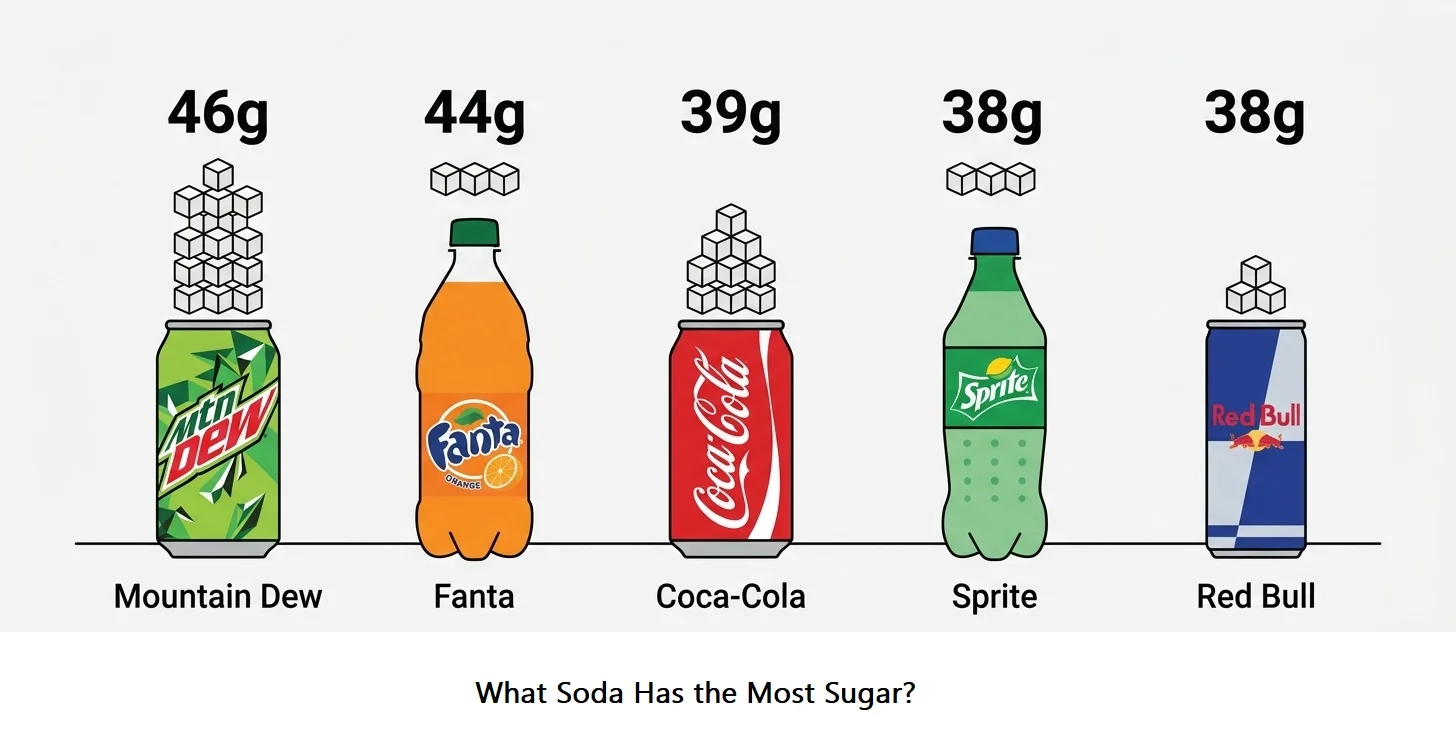
If you’ve got a kid begging for soda at the store, you’ve probably wondered what soda has the most sugar, and you’ve probably heard the answer is Mountain Dew. It’s not. A can of Mountain Dew has 46 grams of sugar, which is a lot, but it’s not even close to the top. That title actually belongs to fruit-flavored sodas most parents aren’t watching closely, and one of them, Crush Pineapple, carries 85 grams of sugar in a single 20-ounce bottle. That’s nearly double what’s in a can of Coke.
I spent an evening lining up nutrition labels from a dozen soda brands after my own kid asked for an orange soda instead of “the bad one,” assuming orange was automatically the safer pick. It wasn’t. Here’s what the numbers actually show, ranked from the drinks you’d expect to the ones that quietly beat them.
Why Mountain Dew Gets Blamed (But Isn’t the Real Answer)
Mountain Dew has a reputation problem. It’s caffeinated, it’s neon yellow, and it shows up on every “worst drinks for kids” list, so it’s become the go-to example whenever sugar in soda comes up. And to be fair, 46 grams per 12-ounce can is genuinely high. That’s more than the entire recommended daily added-sugar limit for an adult woman, in one drink.
But “high” and “highest” aren’t the same thing. Most of the articles that name Mountain Dew as the sugariest soda are only comparing it to other colas, Coke, Pepsi, Dr Pepper, Sprite. Once you widen the lineup to include fruit-flavored sodas, Mountain Dew drops out of the top ten entirely.
The Actual Sugar Rankings, From High to Highest
Here’s where things get interesting for anyone shopping with kids. Fruit-flavored sodas dominate the top of the list, not colas.
Crush Pineapple tops the chart at 85 grams of sugar per 20-ounce bottle. Crush Peach follows close behind at 81 grams, and Sunkist Fruit Punch and Fanta Pineapple both land at 80 grams. Even Mello Yello, a citrus soda that flies under the radar compared to Mountain Dew, packs 78 grams.
Mountain Dew itself, along with its Code Red and Voltage variants, sits around 76 to 77 grams per 20-ounce bottle. So does Sunkist Peach. Fanta Mango comes in at 76 grams too. Notice a pattern? Nearly every soda cracking 75+ grams is fruit-flavored, not a cola.
Classic colas actually rank lower than you’d guess once you’re comparing full bottle sizes. A 20-ounce Coke has 65 grams. Pepsi runs slightly higher at 69 grams. Dr Pepper lands around 65 to 70 grams as well.
Root beer deserves a mention too, since parents often assume it’s a gentler choice. It isn’t. Barq’s Root Beer has 74 grams per 12-ounce can, which is higher per ounce than almost anything else on this list.
Why This Matters More Than the Exact Number
Here’s the thing that actually matters for a parent standing in the soda aisle: serving size changes everything. Most of these sugar figures come from 20-ounce bottles, but kids’ cups, school vending machines, and gas station coolers rarely pour a modest 8-ounce serving. If your child finishes a full bottle, they’re getting the full number, not a fraction of it.
The American Heart Association recommends kids ages 2 to 18 keep added sugar under 25 grams a day. One bottle of Crush Pineapple is more than three times that limit. Even a “middle of the pack” soda like regular Coke blows past a full day’s recommended sugar in a single 20-ounce bottle.
I’ll admit I assumed clear sodas, like Sprite or 7-Up, would be the safest bet for my own kid. They’re lower than the fruit-flavored options, sure, at roughly 38 to 63 grams depending on bottle size, but they’re still nowhere near “low sugar.” There isn’t really a soda that qualifies as a light option here. It’s a matter of degree, not a genuine safe zone.
What This Looks Like for Kids Specifically
Kids process sugar differently than adults do, partly because their bodies are smaller and partly because habits formed early tend to stick. A single fruit-flavored soda can put a child well over their entire day’s added-sugar allowance before lunch, especially if it’s paired with cereal, juice, or a sweetened snack earlier in the day.
The Centers for Disease Control and Prevention notes that frequent sugary drink consumption in childhood is linked to a higher risk of obesity and tooth decay, and those risks compound over years of regular soda drinking, not just from one bottle. That’s worth knowing before assuming fruit soda is the “fun” option, and cola is the “serious” one.
If a swap feels manageable, sparkling water with a splash of real juice, unsweetened iced tea, or a smaller portion size can cut sugar intake substantially without cutting out the fizzy-drink experience entirely.
Research: Centers for Disease Control and Prevention, sugary drinks and childhood health (cdc.gov).
Conclusion
So, what soda has the most sugar? It’s not Mountain Dew. Fruit-flavored sodas like Crush Pineapple, Crush Peach, and Sunkist Fruit Punch all beat it, some by close to 10 grams per bottle. If you’re checking labels for your kids, don’t stop at the cola aisle. The orange, pineapple, and peach flavors are often the ones doing the most damage, and they’re usually the ones marketed as the “fun” choice for kids in the first place.
Next time you’re at the store, flip the bottle around before deciding based on color or flavor alone. The label tells you more than the marketing does.