

Getting up three times a night to pee gets old fast. If your doctor has brought up Flomax, you probably want to know what it does, how to take it, and whether the side effects are a big deal. This guide answers all of that in plain language. It’s general information, so your prescriber’s instructions always come first.
What Is Flomax and What Does It Treat?
Flomax is a capsule approved for the signs and symptoms of benign prostatic hyperplasia (BPH), and it isn’t approved for high blood pressure. BPH simply means the prostate has grown larger, which is common as men age. An enlarged prostate can squeeze the urethra, and that’s where the trouble starts.
Typical symptoms include trouble starting the stream, a weak flow, and a frequent or urgent need to go, including in the middle of the night. Sound familiar? Then you’re in the group this medicine was built for.
The active ingredient is tamsulosin hydrochloride. A generic version exists, so your pharmacy may hand you a bottle labeled tamsulosin instead. Same ingredient, same purpose. Doctors also sometimes prescribe it for kidney stones, which is a separate, off-label use.

How Flomax Works in Your Body
Flomax is an alpha-1 blocker. That sounds technical, but the idea is simple. Tamsulosin relaxes the muscle in the prostate and part of the bladder, and it does not make the prostate smaller.
Think of a clenched fist around a garden hose. Flomax doesn’t shrink the hose. It loosens the grip. Urine can pass more easily even though the prostate is still the same size. That’s why some doctors pair it with a different drug, such as finasteride or dutasteride, which does shrink the gland over time. Whether that combination makes sense for you is a conversation for your own doctor.
One more thing. It can control symptoms, but it won’t cure the condition, so keep taking it even when you feel fine.
How to Take Flomax: Dosage and Timing
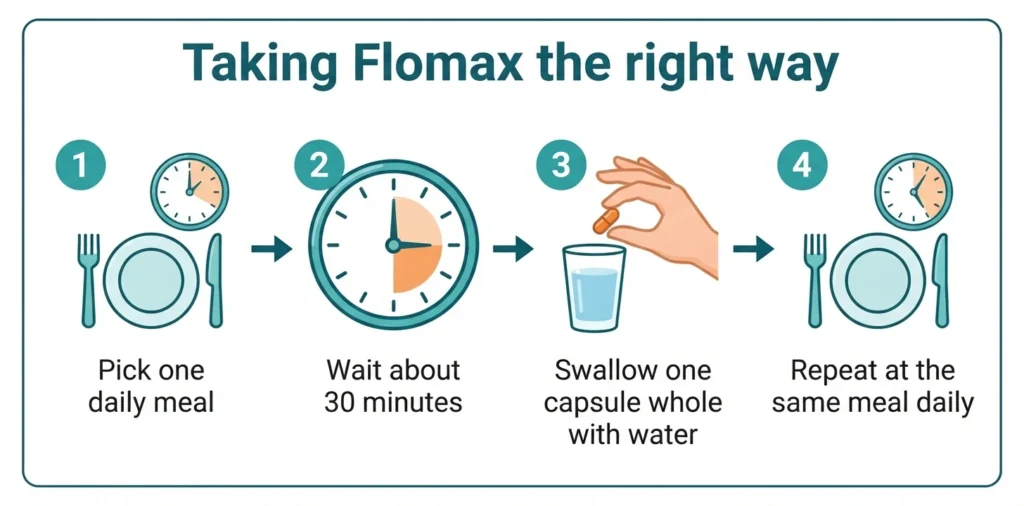
The FDA label is specific here. The usual dose is 0.4 mg once a day, about half an hour after the same meal each day. Pick a meal you never skip and stick with it. Breakfast is a common choice, though some people prefer dinner.
Swallow the capsule whole. Don’t split, chew, crush, or open it.
What if 0.4 mg doesn’t seem to help? If there’s no response after 2 to 4 weeks, the prescriber can raise the dose to 0.8 mg once daily. I can’t tell you which dose fits you, and no article can. That call belongs to the person who knows your history.
Two more label details are worth knowing. If you stop for several days, therapy should restart at the 0.4 mg dose rather than where you left off. And some guidance suggests taking the very first dose at bedtime to lower the chance of dizziness or fainting.
Missed a dose? Leaflets for tamsulosin products say you can take it later the same day, or just carry on the next day if you missed a whole day, and never double up. Check the leaflet in your own box, since instructions can differ slightly between products.
Flomax Side Effects: Common and Rare
Most people tolerate it fine. Still, side effects happen, and knowing them ahead of time makes them less alarming.
The common ones. Dizziness (especially when standing up fast), headache, a stuffy or runny nose, tiredness, and changes in ejaculation are the usual complaints. Retrograde ejaculation, where semen flows backward into the bladder, is one of the ejaculation changes. It isn’t dangerous, but it can be surprising, so mention it to your doctor if it bothers you.
Dizziness deserves a closer look. The label lists orthostasis, meaning a blood pressure drop on standing, and notes a potential risk of fainting. The first dose can leave you lightheaded for a few hours, and alcohol can make dizziness more likely. Stand up slowly. Be careful with driving until you know how it hits you.
The rare but serious ones. A painful erection, or one that lasts more than four hours, needs urgent medical care. The label puts the risk of this problem, called priapism, at probably less than 1 in 50,000 patients. Rare doesn’t mean you should wait it out. Swelling of the face, throat, or tongue with breathing trouble points to an allergic reaction, and you should stop the medicine and get help right away.
Cataract Surgery, Allergies, and Drug Interactions
Some safety issues have nothing to do with how you feel day to day.
Eye surgery. Tell your doctor if you have cataracts, and tell the eye surgeon you take (or have taken) tamsulosin before any procedure. Alpha-blockers are linked to a complication called intraoperative floppy iris syndrome, and surgeons can plan around it if they know ahead of time.
Other health conditions. Your doctor should also know about any prostate cancer, liver disease, or kidney disease. There’s a reason for the prostate cancer point. The label notes that prostate cancer and BPH often exist together, so symptom relief from this medicine doesn’t rule cancer out.
Allergies. Anyone with a known allergy to tamsulosin or any capsule ingredient shouldn’t take it. Past reactions have included rash, hives, itching, and swelling.
Drug interactions. The 0.4 mg capsule shouldn’t be combined with strong CYP3A4 inhibitors such as ketoconazole. The over-the-counter heartburn drug cimetidine can also interact. Other blood pressure medicines and erectile dysfunction drugs can add to the dizziness effect, so give your pharmacist your full list, supplements included.

Common Mistakes People Make With Flomax
Here are the ones worth avoiding.
- Opening or chewing the capsule. It’s designed to be swallowed whole, and the label is clear about it.
- Quitting when symptoms improve. You feel better because it’s working. Stopping early can bring the original symptoms back.
- Taking it at random times. Consistent timing after the same meal keeps things predictable.
- Skipping the cataract heads-up. This one is easy to forget and matters a lot.
- Treating it as a prostate fix. It relieves symptoms. It doesn’t shrink the gland or replace regular checkups.
When to Call Your Doctor
Some situations can’t wait. Get urgent care for an erection lasting over four hours, fainting, swelling of the face or throat, or being unable to pee at all. Call your prescriber soon if symptoms haven’t improved after several weeks, dizziness keeps interfering with daily life, or side effects make you want to stop. Don’t stop on your own. Ask first, because there may be a simple adjustment.
Conclusion
Flomax is a prescription alpha-blocker that eases BPH symptoms by relaxing muscle around the prostate and bladder outlet. It doesn’t shrink the prostate, and it isn’t a cure. Most people take one 0.4 mg capsule daily, about half an hour after the same meal, swallowed whole. Dizziness and ejaculation changes are the common side effects. Priapism, allergic reactions, and eye-surgery complications are rare but serious.
The practical takeaways are simple. Stay consistent with timing, tell every doctor and pharmacist what you take (eye surgeons especially), and never adjust the dose alone. If your symptoms are wearing you down, book the appointment. Relief is often easier to get than people expect.
Sources: FDA prescribing information for Flomax (via Drugs.com and DailyMed mirrors); MedlinePlus, “Tamsulosin” (medlineplus.gov/druginfo/meds/a698012.html).