
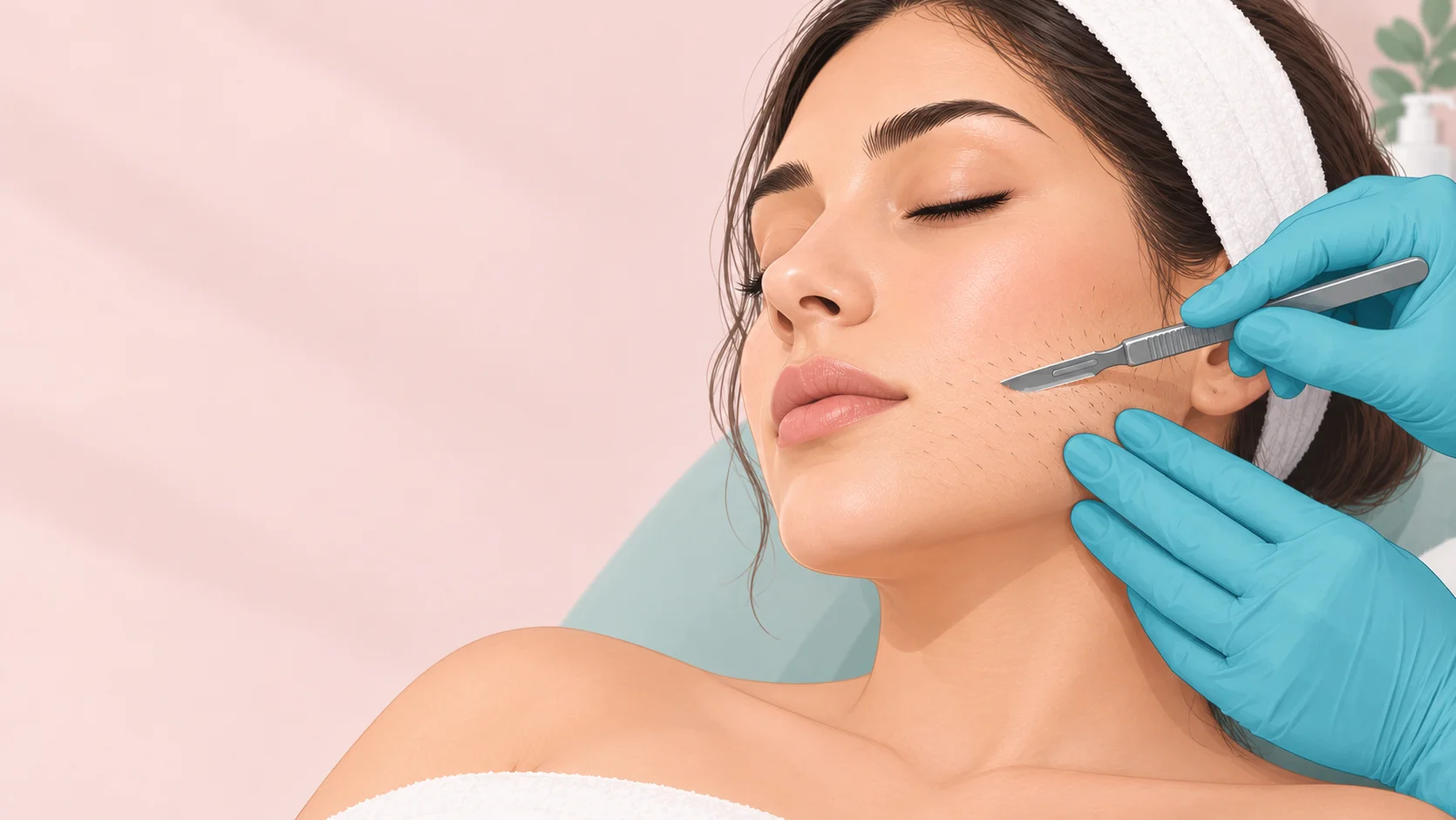
Dermaplaning is a noninvasive skin treatment in which a trained esthetician or dermatologist uses a sterile, handheld surgical scalpel to gently scrape away the outer layer of dead skin cells and fine facial hair, commonly called peach fuzz. The process leaves skin feeling smoother and looking brighter almost immediately, and it helps other skincare products absorb more effectively afterward.
How Dermaplaning Works
During a session, your provider starts by cleansing your face thoroughly to remove oil, makeup and debris. They hold your skin taut with one hand while using the other to guide the scalpel across your face at a shallow angle of about 45 degrees. Short, feathering strokes glide along the natural direction of hair growth, lifting away dead surface cells and vellus hair as they go.
Because the blade only works on the skin’s outermost layer, most people feel little more than a light scratching sensation, and numbing cream generally is not needed. A full facial treatment typically takes about 30 minutes from start to finish, and no recovery period is required afterward.
Benefits of Dermaplaning
- Smoother texture. Removing accumulated dead skin cells instantly softens rough or flaky patches.
- Brighter complexion. Lifting away the dull outer layer reveals fresher skin underneath, which often looks more radiant right away.
- Peach fuzz removal. Clearing vellus hair gives skin a cleaner, more even surface and helps makeup glide on smoothly.
- Better product absorption. Serums and moisturizers can penetrate more effectively once the barrier of dead cells and fine hair is gone.
- A useful prep step. Many providers perform dermaplaning right before a chemical peel or facial so active ingredients reach the skin more easily.
- Virtually no downtime. Unlike more aggressive resurfacing procedures, dermaplaning usually causes only mild redness that fades within a few hours.
What to Expect During a Treatment
- Consultation. Your provider examines your skin and discusses your goals and any conditions that might rule out treatment.
- Cleansing. Your face is washed and dried completely so the blade can glide smoothly.
- The treatment. Using short, controlled strokes, the provider works across your forehead, cheeks, jawline and any other area you want treated.
- Soothing finish. A calming serum, moisturizer or mask settles the skin, and sunscreen is essential if you are heading outside afterward.
- Immediate results. Most people leave with noticeably smoother, brighter skin and little to no visible redness.
Dermaplaning Aftercare
- Wear broad spectrum sunscreen every day for at least a week afterward, since freshly exposed skin burns more easily.
- Skip retinoids, exfoliating acids and other harsh actives for about 48 hours to let your skin recover.
- Avoid saunas, steam rooms and intense sweating for a day or two, since heat can irritate freshly treated skin.
- Keep makeup light for the first day if your skin feels sensitive.
- Expect fine facial hair to grow back within a few weeks, looking and feeling exactly as it did before treatment. Vellus hair does not grow back thicker, darker or coarser.
Who Should Avoid Dermaplaning
Dermaplaning is generally considered safe for most skin types, including sensitive skin, but it is not right for everyone. A qualified provider will typically recommend skipping or postponing treatment if you have:
- Active, inflamed acne breakouts
- Sunburned or recently irritated skin
- Eczema, psoriasis or another active inflammatory skin condition
- Cold sores or active herpes lesions in the treatment area
- Raised moles, warts or vascular lesions in the path of the blade
- A history of keloid or hypertrophic scarring
Because the procedure uses a surgical blade, it should only be performed by a trained, licensed esthetician or dermatologist in a medical spa or clinical setting. Dermaplaning tools made for home use do exist, but handling a scalpel on your own skin without training raises the risk of cuts, uneven results and infection. Always talk with a skincare professional before your first treatment, especially if you are pregnant, nursing or managing an underlying skin condition.
Dermaplaning vs Microdermabrasion vs Chemical Peels
If you are comparing exfoliation options, here is how dermaplaning stacks up against two other popular treatments.
Dermaplaning uses a surgical scalpel to physically shave away dead skin and vellus hair. It is painless, requires no downtime and is one of the only treatments that also removes peach fuzz.
Microdermabrasion uses a wand that sprays fine crystals or relies on a diamond tip to buff away dead skin cells through light abrasion and suction. It exfoliates the skin but does not remove hair, and it can feel more intense on sensitive skin than dermaplaning does.
Chemical peels use acids such as glycolic or salicylic acid to dissolve the bonds between dead skin cells. Peels can reach a bit deeper than dermaplaning and are often better suited to concerns like hyperpigmentation, but they typically involve some visible peeling or downtime afterward.
Many skincare professionals combine these treatments. Dermaplaning is often performed first, since removing surface hair and dead cells allows a peel or microdermabrasion to work more effectively on fresh skin.
How Much Does Dermaplaning Cost, and How Often Should You Get It?
Pricing varies by provider, location and whether the treatment is bundled with another facial, but many med spas start around $85 per session. Because dermaplaning only addresses the skin’s surface, results are not permanent. Skin naturally renews itself on a cycle of roughly three to four weeks, so most providers recommend scheduling your next session around that same timeframe to keep results consistent.