
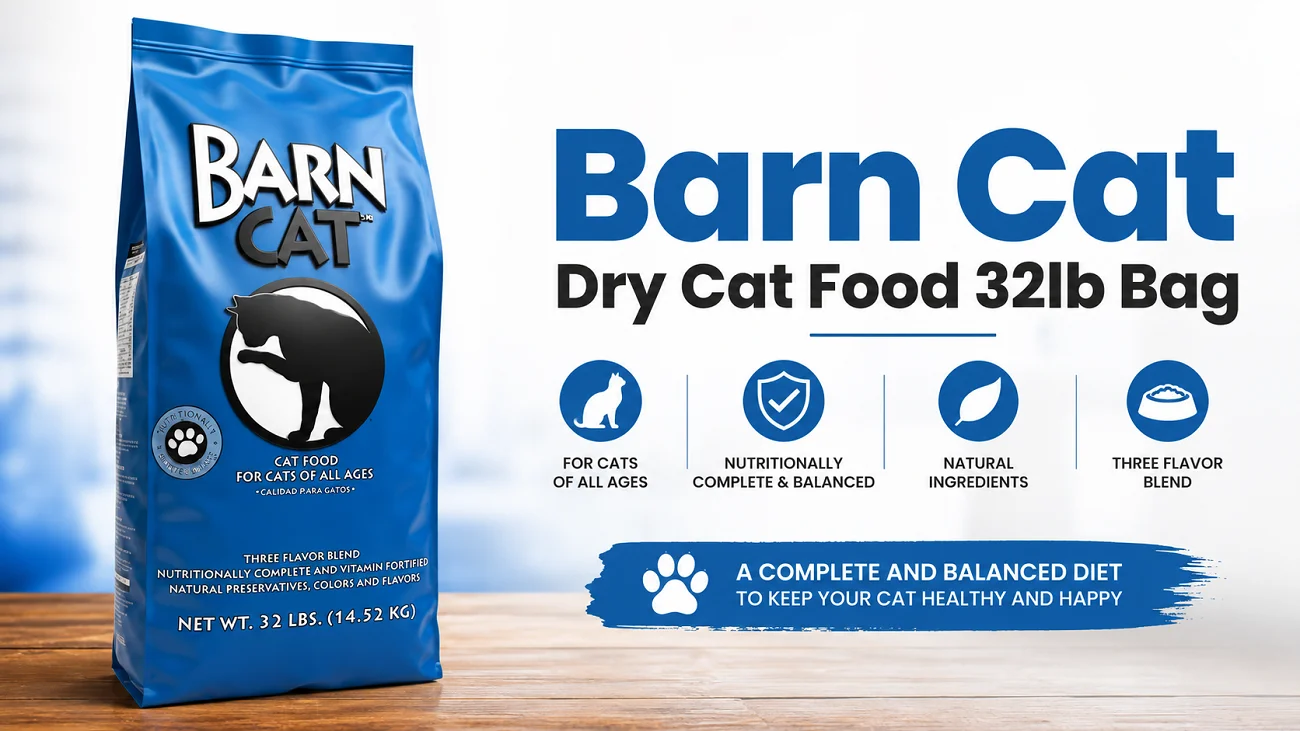
If you’re feeding several outdoor cats, a 32lb bag of dry food looks like the obvious move. Fewer trips to the feed store, lower cost per pound, one less thing to think about for a month or two. That part is true. What’s less obvious is that “barn cat” on the label doesn’t automatically mean the food inside is built any differently than the bag marked for indoor cats sitting one shelf over.
That distinction matters more than bag size does. So before you commit 32 pounds of pantry space and grocery budget to one product, here’s what’s actually worth checking, and what “barn cat” branding does and doesn’t tell you.
Is “Barn Cat” Food Actually Different?
Here’s the part most product pages skip: in most cases, no. The AAFCO nutrient profile, the government-recognized standard that defines what counts as a complete diet for a cat, doesn’t have a separate category for outdoor or barn cats. There’s a profile for growth and reproduction, and one for adult maintenance. That’s it. A bag labeled “barn cat” and a bag labeled “indoor formula” can both be formulated to the exact same adult maintenance profile.
So why does the labeling exist? Mostly positioning. “Barn cat” signals value and durability to a specific buyer, someone feeding multiple cats on a budget, often outdoors. Some barn-branded formulas do run slightly higher in protein or fat to suit more active cats, and that’s worth checking. But the name on the bag isn’t a nutritional guarantee by itself. The guaranteed analysis and the life stage statement are what actually tell you what’s inside, not the word “barn.”
That’s not a knock on barn cat food. It just means you’re shopping for the same things you’d check on any bag: the right label statements, in the right places.
What the Label Actually Needs to Say
Skip past the front of the bag and go straight to three things.
The nutritional adequacy statement. This is the sentence that tells you the food is “complete and balanced.” According to the FDA, that claim has to be backed one of two ways: the formula meets the AAFCO nutrient profile through lab analysis, or it passed an actual feeding trial. Either way, the label has to name a life stage. If it just says “cats” with no life stage attached, that’s a gap worth noticing.
The life stage. Adult maintenance food isn’t built for a nursing cat or a growing kitten. If you’ve got a barn colony with cats at different life stages, one bag may not cover everyone, no matter how big it is.
The guaranteed analysis. This is the block listing minimum crude protein, minimum crude fat, and maximum crude fiber and moisture. It’s a floor and ceiling, not a full nutrition summary, but it’s the fastest way to compare two bags side by side. Just don’t compare a dry food’s numbers directly to a wet food’s. Moisture content skews the math unless you convert to a dry matter basis first.
Everything else on the bag, the ingredient photos, the “protein-rich” callouts, the barn graphics, is marketing. These three items are the substance.
How Long Does a 32lb Bag Actually Stay Fresh?
This is where bag size stops being a pure win. A 32lb bag holds roughly 512 ounces of food. Divide that by how many ounces your cats eat per day combined, and you’ll get a rough timeline for how long it’ll last. For four adult cats eating a typical daily portion, that can stretch past two months.
Here’s the problem: dry food doesn’t stay at peak quality that whole time once it’s opened. The fat coating on kibble starts to oxidize as soon as it hits air, and that process doesn’t reverse. Most sources point to roughly four to six weeks as the practical window for full freshness after opening, faster in a hot barn or humid shed, slower in a cool, dry space. Past that point you’re not necessarily looking at spoiled food, but the fat can turn rancid, and cats notice that shift in smell before you do. A cat suddenly refusing food it used to eat without complaint is sometimes exactly that.
So the honest math isn’t just cost per pound. It’s whether the number of cats you’re feeding can realistically get through 32 pounds before the open bag passes that freshness window. Two or three cats, probably not a problem. One or two cats, or an inconsistent group where numbers shift, a smaller bag might actually save you money in the long run by cutting less into waste.
Storing a Bag This Size the Right Way
If the math works out, storage is what protects the value you’re paying for.
Leave the food in its original bag. It’s not just packaging, it’s a moisture and oxygen barrier the manufacturer engineered for that product, and it also holds the lot number and best-by date you’d want if something ever went wrong with the food. Then put the whole bag inside a separate sealed, rigid container. A barn or shed brings humidity, temperature swings, and rodents into the equation in a way a kitchen pantry doesn’t, and a loosely folded-over bag won’t hold up to any of that for long.
Keep the container off the floor if you can, away from direct sun, and somewhere temperature doesn’t spike, meaning not next to a heater or in a metal shed in July. And when the bag runs out, clean the container before the next one goes in. Oil residue from old kibble sitting in a dirty bin can go rancid faster and taint fresh food sitting right next to it.
When a Smaller Bag Makes More Sense
None of this means 32lb bags are the wrong call. For a stable group of four or more healthy adult cats already eating the same formula, the size makes sense on both cost and convenience.
Where it doesn’t: if you’re switching a colony to a new food for the first time. Cats can be genuinely picky, and a full diet change sometimes causes loose stool or an outright refusal to eat. Testing a new formula in a five or ten-pound bag first, then buying the 32lb size once you know it works, costs a little more up front but avoids losing an entire large bag to a food nobody will touch.
It’s also worth reconsidering size if your colony’s numbers change often. New cats show up, others move on, and a formula that worked for six cats a month ago might be feeding three now, which pushes your timeline past that freshness window without you planning for it.
Conclusion
A 32lb bag of barn cat food can be a genuinely good, cost-effective choice, but the size isn’t what makes it a good choice. What matters is the same as any bag of cat food: a proper complete and balanced statement, the right life stage, and a guaranteed analysis that fits your cats’ needs. Beyond that, it comes down to whether your group can realistically finish the bag within a few weeks of opening it, and whether you’re storing it somewhere that protects it until then.
Check the label first. Match the size to your situation second. Do that, and a 32lb bag earns its place in the barn.