If you’ve been dealing with a stuffy nose that never seems to clear, no matter how many allergy pills or nasal sprays you’ve tried, a doctor may have mentioned turbinoplasty as a next step. It’s a common procedure, but the name alone doesn’t tell you much. Here’s what turbinoplasty actually involves, who it’s typically recommended for, and what the weeks after surgery tend to look like.
What Is Turbinoplasty?
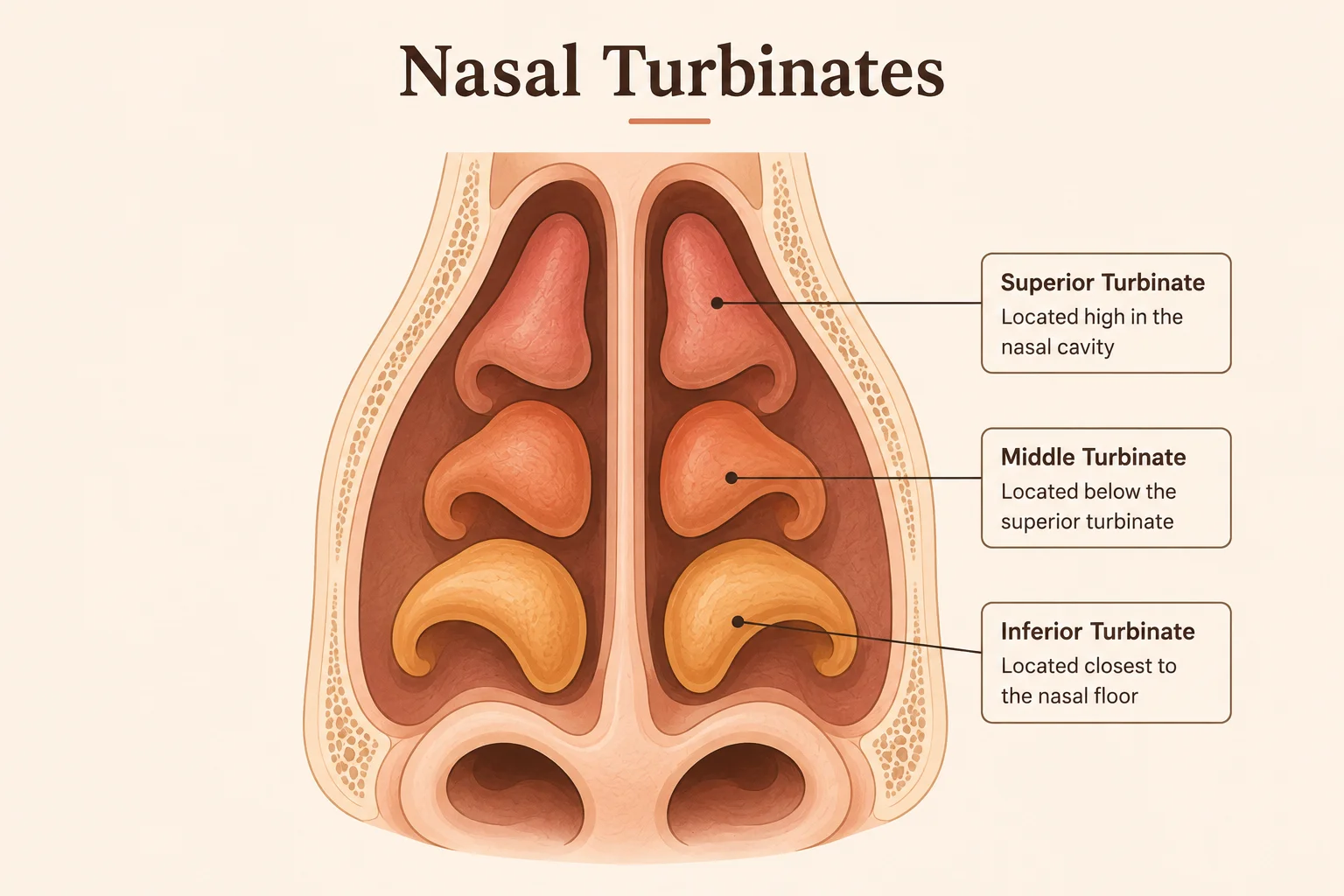
Turbinoplasty is a surgical procedure that reshapes and reduces the size of the turbinates, the small, shell-shaped structures inside your nose, to relieve chronic nasal obstruction. Most often it targets the inferior turbinates, the lowest and largest of the three sets, since these are the most common source of blocked airflow.
Turbinates aren’t just extra tissue taking up space. They’re covered in a mucous membrane that warms, filters, and humidifies the air you breathe before it reaches your lungs. When that tissue swells, whether from allergies, chronic irritation, or a structural issue like a deviated septum, it can significantly narrow the nasal passage and make breathing through your nose difficult.
What sets turbinoplasty apart from a full turbinectomy (which removes tissue outright) is that it’s designed to preserve function. The goal is to shrink the turbinate enough to open the airway while keeping the mucosal lining intact, so the tissue can keep doing its job. Surgeons and researchers generally describe this as a mucosal-sparing approach, and it’s now the preferred option over more aggressive tissue removal for exactly this reason: preserving that lining tends to mean fewer complications and a more predictable recovery.
How Does Turbinoplasty Work?
There isn’t one single technique called “turbinoplasty.” It’s more of a category, and a surgeon will choose the method based on the severity of the hypertrophy, whether other procedures (like septoplasty) are happening at the same time, and their own clinical judgment. Common approaches include:
- Microdebrider-assisted turbinoplasty. A small instrument creates an opening in the turbinate and removes tissue from underneath the lining, leaving the outer mucosa mostly untouched.
- Radiofrequency ablation. A thin probe delivers controlled heat energy into the turbinate, causing the tissue to scar and shrink over the following weeks. This can often be done in-office under local anesthesia.
- Coblation. Similar to radiofrequency in concept, but using lower temperatures, which some surgeons prefer for reducing damage to surrounding tissue.
- Submucosal resection. Bone and soft tissue are removed from inside the turbinate through a small incision, while the surface lining is preserved.
Turbinoplasty can be performed under general or local anesthesia, and it’s frequently done at the same time as septoplasty, since a deviated septum and turbinate hypertrophy often occur together and can both contribute to obstruction. When performed on its own under local anesthesia, it may be a same-day, in-office procedure. Combined with septoplasty or done under general anesthesia, it’s typically an outpatient surgical center or hospital procedure, though patients still usually go home the same day.
Who Is a Candidate for Turbinoplasty?
Turbinoplasty isn’t usually a first-line treatment. Most surgeons will only recommend it after nonsurgical options haven’t worked. That typically means a trial of:
- Intranasal corticosteroid sprays
- Antihistamines
- Allergen avoidance strategies
- Decongestants (short-term use only, since these carry their own risk of rebound congestion)
If congestion, mouth breathing, snoring, or disrupted sleep persist despite consistent use of these treatments, and a physical exam or nasal endoscopy confirms turbinate hypertrophy, surgery may be the next reasonable step. It’s often considered alongside other causes of nasal obstruction, since a deviated septum or nasal valve collapse can produce similar symptoms and may need to be addressed together for the best outcome.
Recovery Timeline: What to Expect Week by Week
Recovery varies by technique. An in-office radiofrequency procedure under local anesthesia tends to involve a shorter, milder recovery than a turbinoplasty performed under general anesthesia, especially if it’s combined with septoplasty. That said, most patients follow a broadly similar arc.
Days 1 to 3. This is typically when congestion and swelling are at their worst, which can feel counterintuitive right after a procedure meant to improve breathing. Some blood-tinged discharge is common. Sleeping with your head elevated and avoiding forceful nose-blowing are standard early instructions.
Days 4 to 7. Swelling gradually starts to ease. Crusting inside the nose becomes more noticeable as healing tissue sheds discharge; this is normal and can persist for up to a few weeks. Saline rinses, if your surgeon has approved them, are usually recommended multiple times a day during this window to help manage crusting and keep the nasal passage clear.
Week 2. Bleeding is usually minimal by this point, though crusting may still be present. Many people return to desk jobs or light activity around this time if their procedure was done under general anesthesia; in-office procedures often allow a return to normal routines within a day.
Weeks 3 to 4. Breathing often continues to improve, though it’s common for it to fluctuate rather than get steadily better in a straight line. Most people resume normal activity by this point, following their surgeon’s specific guidance on things like exercise and heavy lifting.
Weeks 4 to 6. This is when many patients report meaningful, noticeable improvement in nasal airflow. Cleveland Clinic notes that complete recovery from turbinate reduction can take up to six weeks, during which your provider will monitor healing.
Beyond 6 weeks. Visible healing is largely finished, but internal tissue remodeling can continue for months. It’s not unusual for subtle improvements in airflow to continue well past the point where you feel outwardly “recovered.”
Throughout recovery, most guidance points to avoiding a few specific things: swimming (often for around six weeks, to keep bacteria out of healing tissue), contact sports or activities with a risk of nasal trauma (often longer, around eight weeks), and air travel isn’t usually prohibited but may be more comfortable with a saline spray on hand for pressure changes.
Risks and Potential Complications
No turbinate surgery is risk-free, and it’s worth understanding the trade-offs before deciding whether to move forward.
Common, usually temporary issues include nosebleeds, crusting, and mild-to-moderate swelling that can itself cause obstruction in the short term. Scar tissue (synechiae) between the turbinate and septum has also been reported after turbinate reduction procedures.
Empty nose syndrome (ENS) is the complication most patients ask about, and it deserves an honest explanation rather than a simplified one. ENS is a rare but debilitating condition where someone feels like they can’t get enough air through their nose, despite the nasal passage being objectively open. It’s most strongly associated with aggressive tissue removal, particularly total or subtotal turbinectomy, which is part of why mucosal-sparing turbinoplasty techniques are generally preferred. But the research here is
genuinely more complicated than “remove less tissue, eliminate the risk.” ENS has also been reported after more conservative procedures, and researchers have not identified a way to reliably predict who will develop it based on how much tissue was removed. A 2025 computational modeling study found that even a full turbinectomy didn’t reliably reproduce the airflow patterns seen in ENS patients, suggesting the condition likely involves more than surgical extent alone. In short: preserving the mucosa lowers the risk relative to more aggressive resection, but it does not reduce it to zero, and the underlying mechanism is still not fully understood.
Other possible outcomes include chronic nasal dryness, and, like any surgery, the general risks associated with anesthesia and bleeding.
It’s also worth knowing that turbinate tissue can regrow or re-swell over time, particularly if the underlying cause (persistent allergies or irritants) isn’t managed. According to Cleveland Clinic, the overall success rate for turbinate reduction is about 82%, and while regrowth is possible, most people who undergo the procedure report satisfactory results.
Turbinoplasty vs. Turbinectomy: What’s the Real Difference?
These two terms get used interchangeably online, which causes a lot of confusion, so it’s worth being precise:
- Turbinoplasty reshapes and reduces the turbinate while preserving the mucosal lining and much of the underlying structure. The goal is to open the airway while keeping the tissue functional.
- Turbinectomy removes turbinate tissue, partially or, in more extensive cases, entirely. It can provide significant relief for severe hypertrophy that hasn’t responded to less invasive options, but it carries a meaningfully higher risk of empty nose syndrome and other complications, which is why it’s generally considered after more conservative approaches haven’t worked.
If your surgeon is recommending one over the other, it’s a reasonable and important question to ask why, given your specific anatomy and symptom severity.