
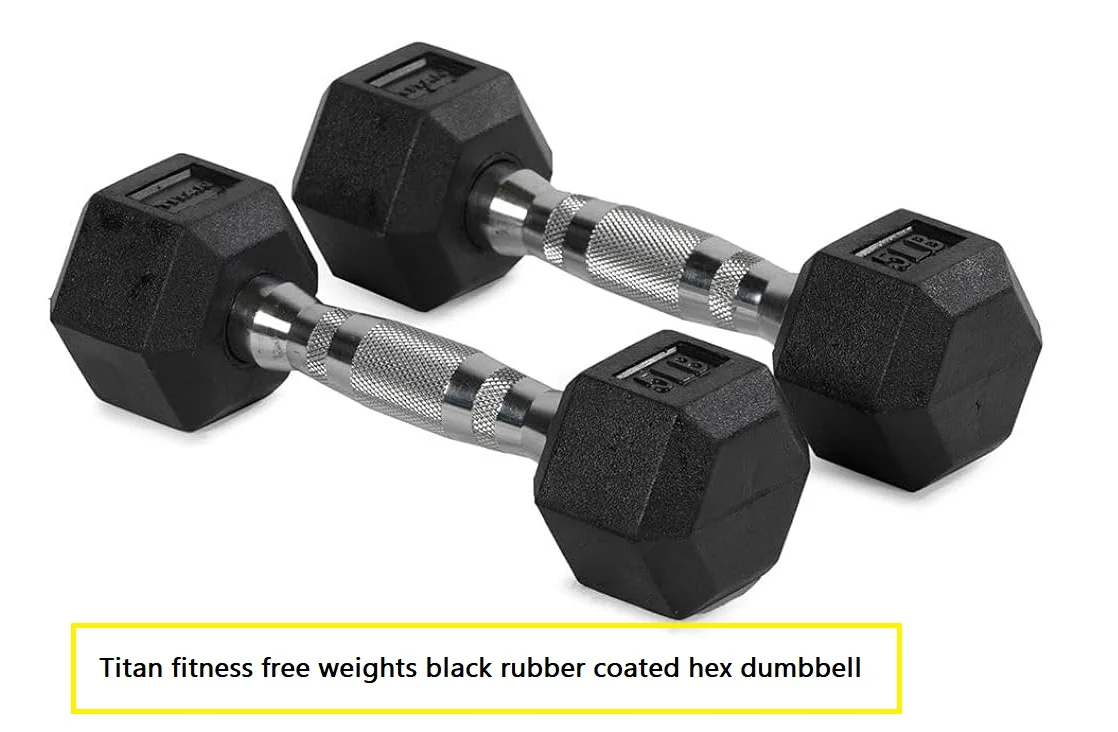
I’ve had a set of these sitting in my garage for a while now, and people ask about them more than almost anything else in my setup. So here’s the honest version: what they get right, where they fall short, and who should actually buy them.
What You’re Getting From Titan Fitness
Titan Fitness sells these black rubber coated hex dumbbells in 5-pound increments, from 5 pounds all the way up to 100 (some listings even go to 120). They come in pairs, and the pricing scales predictably: a 5-pound pair runs about $30, and a 100-pound pair lands around $300. That works out to roughly $1.50 per pound, which is competitive for this category.
The build is straightforward. A cast iron or steel core gets molded inside a hexagonal rubber shell, so the weight itself won’t dent your floor or crack if you set it down hard. The handle is chrome-plated, about 5.125 inches long, with medium knurling. It’s not aggressive knurling, but it’s enough to hold onto through sweaty sets. The hex shape means the dumbbell won’t roll away when you set it down, which matters more than people expect until they’ve chased a rolling dumbbell across a sloped garage floor.
Titan also offers a version with a straight stainless steel handle instead of chrome, and there’s a knurling difference between the two. If you chalk up before lifting, the steel handle version grips better. If you don’t, the standard chrome-plated hex dumbbell is the more common pick and what most people mean when they search for this product.
The Case For Buying Them
Price is the real draw. Comparable rubber hex dumbbells from Rogue or Eleiko cost close to double what Titan charges for the same weight and similar design. If you’re building a home gym on a budget and need a full rack of dumbbells rather than just a pair, that price gap adds up fast.
They hold up fine for home use. I’ve dropped mine, dragged them across concrete, and left them in a garage that swings from freezing to 95 degrees depending on the season. The rubber hasn’t cracked, and the weight embossing is still readable. For someone lifting a few times a week at home, that’s more durability than you’ll actually need.
The hex shape earns its keep. No rolling, easier stacking, and they work well for floor-based movements like renegade rows or push-up variations where a round dumbbell would just roll out from under you.
Shipping is included, and Titan’s return window is reasonable if something arrives damaged.
Where They Fall Short
I won’t pretend these are flawless, because they’re not.
The rubber smells strong out of the box. Mine did, and it’s a common complaint in reviews too. It fades over a few weeks, but if you’re sensitive to that kind of off-gassing smell, know it’s coming.
The rubber itself isn’t premium. Compared to Rogue’s rubber coating, Titan’s has a slightly oilier finish, and a few buyers report it picking up scuffs and marks more easily over time. It’s not a durability issue so much as a “doesn’t feel quite as refined” issue. If you’re the type who cares about your equipment looking showroom-fresh years later, this is where the savings show.
Packaging quality is hit or miss. Several reviewers, myself included, have gotten orders where one dumbbell in a pair arrived with minor cosmetic shipping damage. It’s rarely functional damage, just cosmetic, but it happens often enough to mention.
Weight tolerances are decent, not exact. Don’t expect competition-grade precision here. For general strength training that’s a non-issue. If you’re doing anything where exact loading matters, you’ll want a different product entirely.
Titan vs. Rep Fitness vs. Rogue
If you’re comparing across brands, here’s roughly how they stack up:
- Titan wins on price by a wide margin and is the easiest entry point for a full home dumbbell rack.
- Rep Fitness sits in the middle, with rubber quality that’s a step up from Titan but still budget-conscious.
- Rogue costs the most but the rubber coating holds up better cosmetically over years of use, and their customer service reputation is stronger.
None of these are bad choices. It genuinely comes down to whether you’re prioritizing cost or long-term finish quality.
Who Should Buy These
If you’re setting up a home gym and need a full range of dumbbells without spending Rogue money, this is a smart buy. They’re also a solid pick for a garage gym that sees moderate, regular use rather than commercial-level daily traffic.
If you want equipment that looks pristine five years from now, or you’re outfitting a commercial gym with heavy daily turnover, spend the extra money on Rogue or Eleiko instead. The rubber quality difference will matter more in that context.
FAQ
Do Titan Fitness hex dumbbells smell bad? Yes, especially when new. It’s the rubber off-gassing and it typically fades within a few weeks of regular use and airing out.
Are Titan hex dumbbells as good as Rogue? They’re built to a similar spec, but Rogue’s rubber coating is noticeably more refined and holds up better cosmetically over time. Titan is the better value; Rogue is the better long-term finish.
What handle length do Titan hex dumbbells have? The standard chrome-plated version has a 5.125-inch handle with medium knurling.
Do the dumbbells roll around on the floor? No. The hexagonal head shape is specifically designed to prevent rolling, which also makes them easier to store and safer to use for floor exercises.
Is there a difference between the chrome handle and steel handle versions? Yes. The steel handle grips better with chalk, while the chrome-plated version is the more common choice for lifters who don’t chalk up.