
Medically reviewed by: Dr. M Mujeeb Ur Rehman. Last updated: July 2026
Note: This article is for general information and isn’t a substitute for advice from your doctor or your child’s pediatrician.
Hiccups always seem to show up at the worst possible time: mid-sentence in a meeting, right after you’ve finally gotten a fussy baby to sleep, in the middle of a first date. They’re one of the most universal, oddly democratic things a body does. Newborns get them in the womb before they’ve taken a single breath of outside air. Grandparents get them after a big holiday meal. Basically everyone in between gets them too.
Most hiccups are harmless and gone within minutes. But if you’re dealing with a stubborn case (yours or your baby’s), you want options that actually have some logic behind them, not just hand-me-down folklore. Here’s what’s actually causing them, which techniques are worth trying first, what’s safe for babies (and what isn’t), and the specific signs that mean it’s time to call a doctor instead of trying one more home remedy.
Key takeaways:
- Most hiccups are harmless and pass on their own within minutes; only a small share ever become a real medical issue.
- Breathing techniques, cold water, and pressure-point tricks are the most commonly recommended fast fixes, though none work for 100% of people.
- Adult remedies like paper bags, blocking the nose, or dunking in water are not appropriate for infants, and a few carry real safety risks.
- See a doctor if hiccups last more than 2 days in an adult. Call your pediatrician if a baby’s hiccups come with distress, feeding trouble, or unusual duration.
What’s Actually Happening When You Hiccup
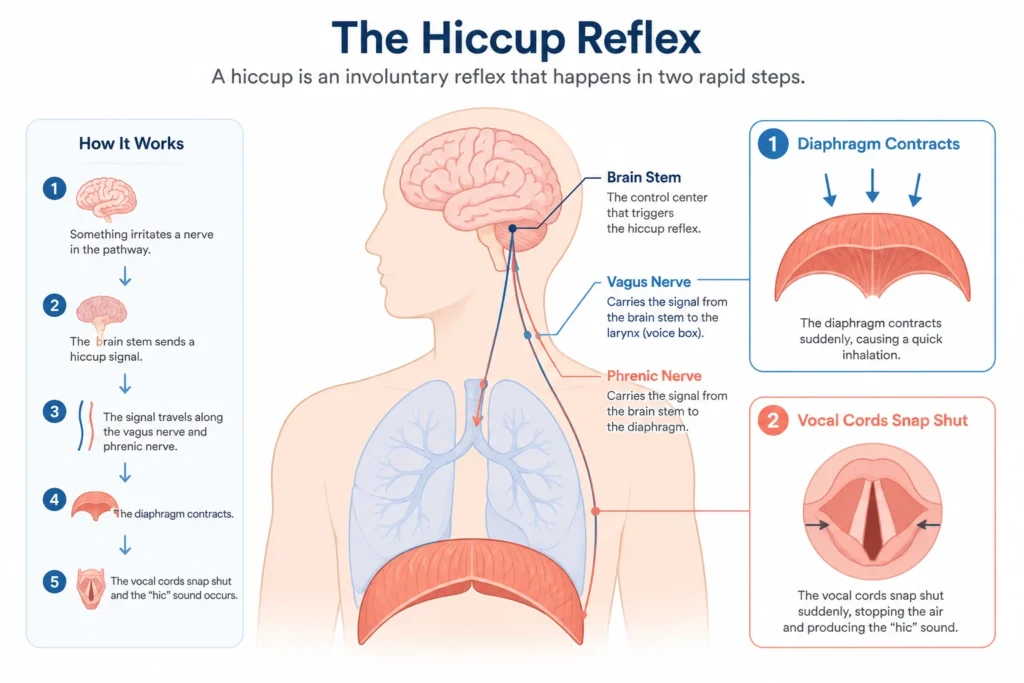
A hiccup is really two quick events stacked on top of each other. First, your diaphragm, the dome-shaped muscle separating your chest from your abdomen, contracts suddenly and pulls in a quick breath. A split second later, your vocal cords snap shut to stop that air from going any further. That snap is what makes the “hic” sound.
Doctors call the nerve pathway behind this the hiccup reflex arc. It runs through your vagus and phrenic nerves, connecting your brain stem to your diaphragm. Something irritates a nerve along that path, the arc fires, and you hiccup. It’s the same basic wiring whether you’re 8 days old or 80 years old, which is part of why hiccups show up at literally every age. Babies even get them before birth: many parents notice a rhythmic flutter in the belly during pregnancy that turns out to be fetal hiccups, and researchers think it may help a developing baby’s diaphragm and nervous system practice the coordination they’ll need for regular breathing after birth.
Fast Ways to Rid of Hiccups
There’s no single cure that works for everyone, and researchers admit as much. Most home remedies fall into one of three categories: they change your breathing enough to raise carbon dioxide in your blood, they stimulate the vagus nerve directly, or they do a bit of both. None are guaranteed, but they’re low-risk, so working through a few in a row is a reasonable approach.
Breathing and posture tricks
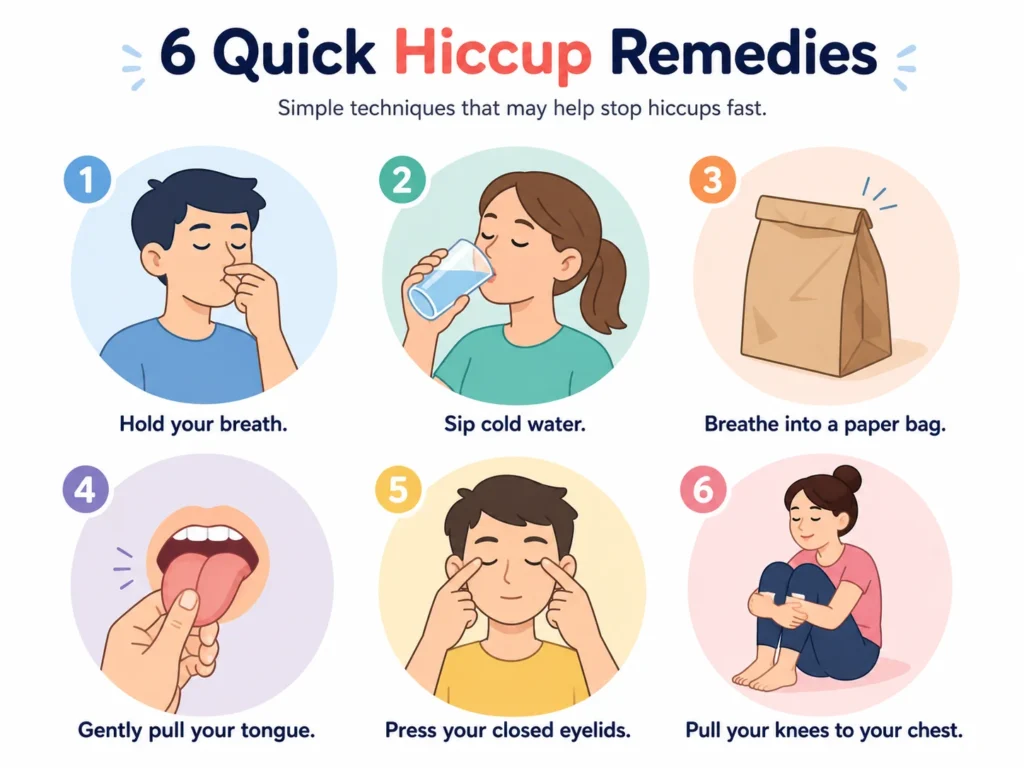
- Hold your breath for 10 to 20 seconds, then exhale slowly. Repeat once or twice if the first round doesn’t do it.
- Breathe into a paper bag (never plastic) for 10 to 30 seconds at a time, letting the bag inflate and deflate with your breath.
- Try the Valsalva maneuver. Pinch your nose shut, close your mouth, and gently bear down like you’re trying to pop your ears on a plane.
- Pull your knees to your chest and lean forward for 30 seconds to a minute. This compresses your chest and can interrupt the spasm.
- Try active prolonged inspiration. A 2024 case series published in the journal Cureus tested this technique: breathe in as deeply as you can, then keep straining to inhale for a full 30 seconds before slowly exhaling. All 21 patients in the small study reported their hiccups stopped right away. It’s not a large trial, but it’s one of the few hiccup remedies that’s actually been studied directly rather than just passed down as folklore.
Drink-and-swallow tricks
- Sip ice-cold water slowly, or gargle with it.
- Drink from the far rim of a glass, tilting it away from you rather than toward you, which changes your swallowing rhythm.
- Combine two tricks at once. One version that circulates widely online has you plug both ears with your fingers while sipping water through a straw. It sounds strange, but the logic holds up: blocking the ear canal may stimulate a branch of the vagus nerve while the straw forces slower, more deliberate swallows.
- Swallow a teaspoon of dry, granulated sugar.
- Bite into a lemon wedge, or take a small sip of vinegar.
Pressure-point tricks
- Close your eyes and press gently but firmly on your eyelids for a few seconds.
- Apply light pressure inside your ear canals with your fingertips. Gently do it; don’t push hard or use anything but a fingertip.
- Grab the tip of your tongue and pull it forward gently, once or twice.
- Try acupressure. This one comes from licensed acupuncturists rather than gastroenterologists. Three points worth trying: the small indent just behind your jawbone below your earlobe, the tender spots under your collarbones on either side of your breastbone, and the point between your upper lip and the base of your nose. Press each firmly for 20 to 30 seconds while breathing deeply. Skip this option if you have arthritis, a bone condition, varicose veins, or a recent injury or surgery in the area you’d be pressing.
What Not to Do When You Have Hiccups
A few habits make hiccups more likely, or harder to shake once they start:
- Carbonated or alcoholic drinks, which can irritate your stomach and esophagus
- A very hot drink followed immediately by something cold, or vice versa
- Eating quickly or overeating, both of which stretch your stomach
- Smoking or chewing gum, which makes you swallow extra air
- Spicy food, a common trigger for some people
When Hiccups Are More Than a Nuisance
Doctors sort hiccups by how long they stick around.
- Transient hiccups, the kind almost everyone gets, last seconds to minutes and need no treatment.
- Persistent hiccups last longer than 48 hours but less than a month.
- Intractable hiccups go on for more than a month.
- Recurrent hiccups are episodes that keep coming back, each one lasting more than just a few minutes.
That distinction matters because the likely causes change as duration increases. Short-lived hiccups rarely have an identifiable trigger beyond everyday stuff: eating fast, fizzy drinks, excitement, or stress. That last one is real; stress hormones can activate the same neural pathway that controls your diaphragm, which is why hiccups sometimes strike right when you’re anxious. Persistent and intractable hiccups are a different story.
They’ve been linked to acid reflux, nerve irritation, central nervous system conditions like stroke or multiple sclerosis, lung conditions such as pneumonia or a blood clot in the lung, tumors, certain infections, and side effects from medications, including some steroids, chemotherapy drugs, and antibiotics. They can also follow surgery, especially procedures involving general anesthesia. If you’re managing digestive conditions, you may also find our guide on foods to avoid with diverticulitis helpful.
Long-lasting hiccups aren’t just annoying. They can interfere with eating, drinking, speaking, and sleeping, and lead to real exhaustion and weight loss over time. Call your doctor if your hiccups last more than two days, or if you’re getting them far more often than seems normal for you. Seek emergency care if hiccups show up alongside signs of a stroke or blood clot, like sudden weakness, slurred speech, chest pain, or trouble breathing.
If a doctor can’t find a clear trigger, there are prescription options. Chlorpromazine is the medication most specifically studied for hiccups, and doctors sometimes use baclofen, gabapentin, or metoclopramide as well. These require a prescription and medical supervision; they aren’t something to try on your own.
Hiccups in Babies and Newborns

Hiccups in babies deserve their own section, partly because almost every new parent worries about them at some point, and partly because several of the adult remedies above are not appropriate to try on an infant.
Why babies get hiccups so often
Hiccups are extremely common before birth. Many pregnant women feel a rhythmic fluttering that turns out to be fetal hiccups, sometimes starting as early as the second trimester. One theory is that this helps a fetus’s diaphragm and nervous system practice the coordination needed for breathing after birth. Premature babies tend to hiccup even more than full-term babies, which fits with the idea that it’s tied to a still-developing nervous system.
There’s research behind why this might be more than just noise, too. A study that monitored newborns’ brain activity during hiccups found the reflex triggers patterns that may help infants learn to sense and eventually control their own breathing. Just as reassuring: the same research found that ordinary hiccups don’t change a baby’s breathing rate, heart rate, or oxygen levels. Forceful as they look, they aren’t straining your baby’s body the way they might seem to.
After birth, hiccups usually come down to feeding. A baby who eats a little too fast, swallows air during a feed, or simply ends up with a very full stomach can develop a distended belly that presses on the diaphragm. That’s typically all it takes. A single episode in a newborn can last anywhere from a few minutes to around half an hour, and however dramatic it looks, it almost never bothers the baby the way it bothers the parent watching. Hiccups tend to taper off as a baby’s nervous system matures, usually easing up somewhere between six months and a year old.
Safe ways to help your baby
If your baby’s hiccups don’t seem to bother them, the simplest option is to wait them out. If you’d like to help things along, a few gentle, baby-safe options include:
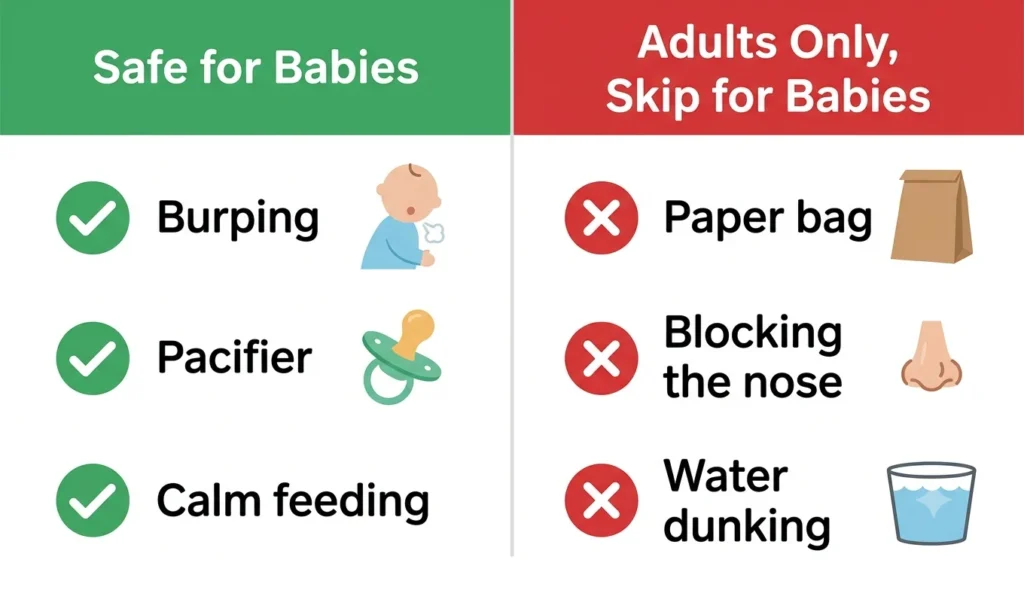
- Pausing partway through a feed to burp your baby, especially if you’re switching breasts or the bottle seems to be going down fast
- Checking that a bottle’s nipple flow isn’t too fast, since a fast flow can cause gulping and air swallowing
- Letting your baby settle and calm down before you start a feed, rather than feeding while they’re already worked up
- Offering a pacifier, which can help relax the diaphragm
- Simply holding and comforting your baby while the episode passes on its own
Don’t use adult remedies on a baby
It’s tempting to reach for the tricks that work on you, but pediatricians are clear that adult hiccup remedies don’t belong anywhere near an infant. Don’t have a baby breathe into a paper bag, block their nostrils to make them hold their breath, give them water to sip or dunk them in it, hold them upside down, try to startle or scare them, or pull on their tongue. None of these are shown to help a baby’s hiccups, and several, including blocking the airway, submerging in water, holding upside down, carry real safety risks that have nothing to do with hiccups at all.
When to call the pediatrician
Occasional hiccups in a baby under a year old are almost always normal and not a medical concern. Call your pediatrician if you notice:
- Hiccups that seem to cause real distress, like inconsolable crying or arching the back
- Hiccups that interfere with feeding or sleep
- Frequent, forceful spit-up alongside the hiccups, which can point to reflux
- Hiccups that last far longer than usual, such as a full day or two without any letup
- Poor weight gain alongside frequent hiccups
In most cases, your pediatrician will simply reassure you that this is normal newborn behavior. Occasionally, especially when hiccups come with other symptoms, they’ll want to check for reflux or another underlying cause.
Hiccup Questions People Ask Most
Is there a scientifically proven cure for hiccups?
Not exactly. Most home remedies have never been tested in real trials; they’re passed down because people say they work. A small 2024 study on the active prolonged inspiration technique is one of the few exceptions, and even that needs more research before anyone can call it a proven cure.
How long do hiccups usually last?
Most bouts last just a few minutes and stop on their own. Hiccups lasting more than 48 hours are considered persistent, and anything past a month is called intractable. Both are far less common and worth mentioning to a doctor.
Are hiccups in newborns normal?
Yes. They’re one of the most common things babies do, both before and after birth, and they’re rarely a sign of a problem on their own.
Do babies get hiccups in the womb?
Yes, and it’s completely normal. Many people describe feeling a rhythmic fluttering during pregnancy that turns out to be fetal hiccups, sometimes noticeable from the second trimester onward.
Can hiccups be a sign of something serious?
Occasionally, but usually only when they last more than two days or come back unusually often. In that case, conditions like acid reflux, nerve irritation, or a central nervous system issue can be behind them, which is why persistent hiccups are worth a doctor’s visit.
Should I try adult hiccup remedies on my baby?
No. Things like paper-bag breathing, blocking the nose, or giving water aren’t shown to help infants and can be unsafe. Stick to gentle, baby-specific options like burping, a pacifier, or simply letting the episode pass.
What’s the fastest way to stop hiccups?
There’s no single fastest fix, since what works varies by person. Breath-holding, the Valsalva maneuver, and sipping ice water are usually the quickest to try since they need no supplies and often work within a minute or two.
Does acupressure actually work for hiccups?
There’s no large body of hiccup-specific research on it, but acupressure is low-risk for most healthy adults, and some people find real relief from pressing the jaw, chest, or upper-lip points described above.
When should I go to the emergency room for hiccups?
Only if they show up alongside symptoms of a stroke or blood clot, such as sudden weakness, slurred speech, chest pain, or trouble breathing. Ordinary hiccups on their own are not an emergency.
The Bottom Line
Hiccups are almost always a passing annoyance, not a medical event, whether you’re the one hiccuping or you’re watching your baby do it for the fifth time this week. Try a technique or two, skip the ones that don’t apply to infants, and let time handle the rest. The one real trigger for concern is duration: past two days in an adult, or paired with genuine distress in a baby, is when it’s worth a call to your doctor or pediatrician instead of one more home remedy.
Sources
- MedlinePlus, National Library of Medicine. “Hiccups.”
- NHS. “Hiccups.”
- Cleveland Clinic Health Essentials. “Here’s What to Do When Your Baby Has the Hiccups.”
- OSF HealthCare. “Why Do Babies Get Hiccups?”