
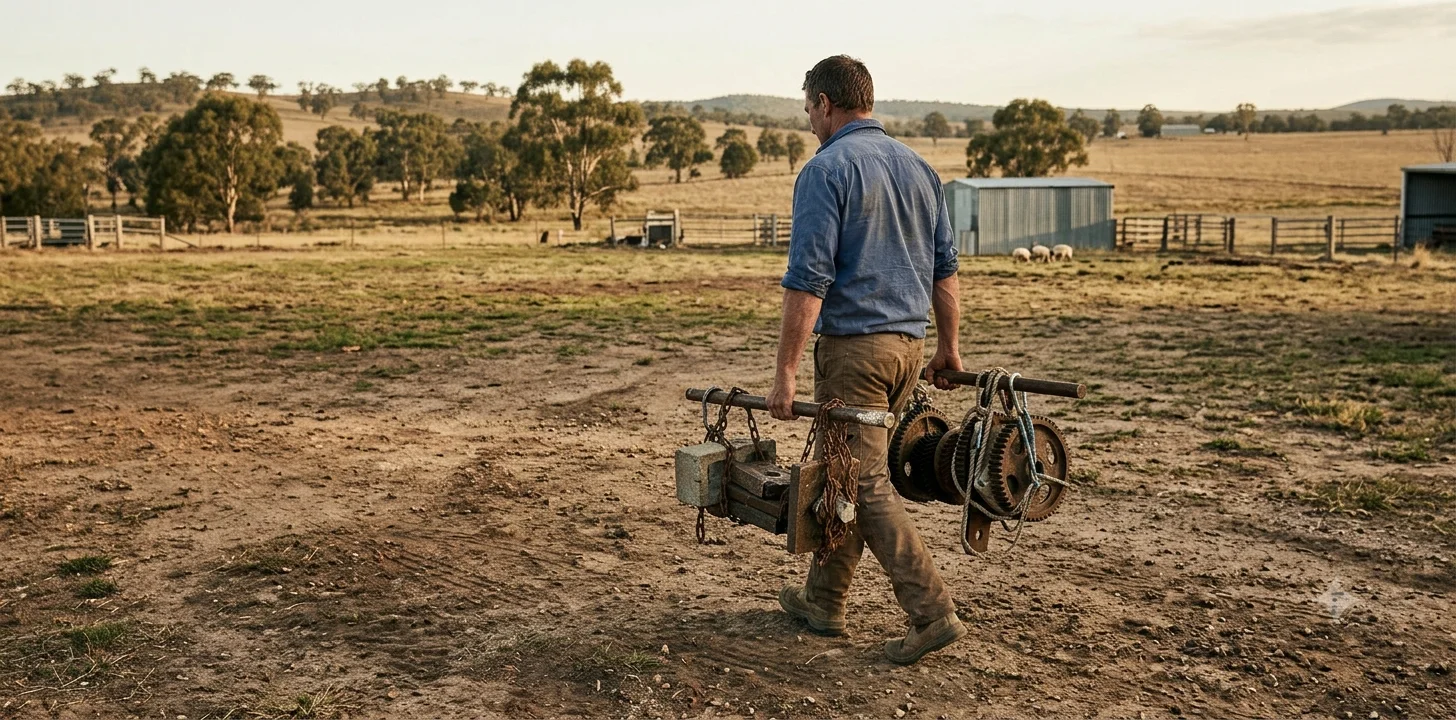
Somewhere on a farm in Queensland, Australia, a 6-foot-8-inch man in plain work clothes carries logs, drags loaded sleds, and locks out barbells nobody thinks he should be able to move, and he does it without ever showing his face to the camera. That’s Tom Haviland. He didn’t build his following through competitions, sponsorship deals, or a slick personal brand. He built it by posting raw footage of himself doing things that make professional strongmen stop and rewatch the clip twice.
If you’ve landed here after seeing one of his lifts, or after hearing Joe Rogan bring him up on a podcast, you probably have the same three questions everyone else does: who is this guy, is he actually as strong as people say, and why won’t he just compete already? Let’s get into it.
Who Is Tom Haviland?
Tom Haviland is an Australian strength athlete, currently in his late 30s, who has never entered a professional strongman competition, and yet routinely gets compared to the sport’s biggest names. He stands 6’8″ (203 cm) and typically sits somewhere around 330 to 350 pounds (150-159 kg), with a build that looks more like an NFL lineman than a stereotypical strongman. He lives on a property in the Sunshine Coast region of Queensland, and that farm setting is basically his entire training environment. No commercial gym, no coaching staff, no camera crew. Just him, open land, and equipment he built himself.
He grew up in a small town on the mid-north coast of New South Wales, and by his own account, spent most of his childhood outdoors, working, exploring, and lifting whatever heavy object was lying around. That’s not a marketing origin story he came up with later. It’s a pattern that shows up consistently in the little he’s actually said publicly, and it lines up with how he trains now: outside, with improvised loads, without much interest in a traditional gym setup.
What separates Haviland from the usual strongman-adjacent internet personality is how little he actually says. He rarely shows his face. He almost never discusses his personal life beyond the fact that he has a dog and a young son. There’s no tell-all interview, no docuseries, no big reveal. And somehow that absence of information has only made people more curious about him, not less.
The Numbers That Made People Pay Attention
Here’s where the skepticism usually turns into genuine interest. Haviland’s posted lifts include:
- Deadlift: Around 1,003 lbs (455 kg), pulled with straps from a slightly elevated start
- Squat: 811 lbs (368 kg) for three reps, which works out to roughly 860 lbs for a single
- Zercher squat: 750 lbs (340 kg), a lift where the bar sits in the crook of the elbows instead of on the back or front rack
- Yoke walk: 1,200 lbs (544 kg) across uneven farm ground with homemade equipment
- Bench press: Around 600 lbs, done raw with no spotter
- Seated shoulder press: 456 lbs (207 kg)
None of these were done in competition conditions, and that matters. There’s no judging, no strict form requirements, no standardized equipment. But even accounting for that, the numbers hold up against athletes who do compete at the top level.
Two-time World’s Strongest Man competitor Mitchell Hooper actually sat down and compared his own best lifts against Haviland’s, lift for lift, across seven categories. According to reporting on that comparison, Hooper walked away saying Haviland wasn’t just strong in one area, he was competitive across nearly everything, and that with proper preparation and access to real competition equipment, he thought Haviland could genuinely contend for the World’s Strongest Man title.
That’s not a throwaway compliment. Hooper is the reigning champion talking about someone who has never set foot in an official strongman event.
His Training Style Is Deliberately Unconventional
If you’re picturing a modern strongman gym, with rubber flooring, branded equipment, and a training partner filming every set, that’s not what Haviland’s setup looks like at all. His videos consistently show him training alone, outdoors, often in ordinary work clothes rather than gym gear.
A few things stand out about how he actually trains:
Grip strength is a priority, not an afterthought. Many of his heaviest carries and pulls are done without straps, which forces his forearms and hands to keep up with lifts that would otherwise be limited by his back and legs.
He uses homemade and improvised equipment. His yoke walks, for example, use equipment he built himself, on ground that isn’t level or padded. That actually makes some of his numbers more impressive, not less, since stabilizing an unstable load is its own skill.
He blends strongman movements with strict barbell work. It’s not just carries and static holds. He also posts controlled, paused reps on lifts like the Zercher squat and close-grip bench, the kind of strict execution that fitness coaches specifically point to as a sign of genuine strength rather than momentum-assisted internet stunts.
He trains for output, not aesthetics. He’s not chasing a stage-ready physique. His build is a byproduct of what the training demands, not the goal of the training itself.
One detail that keeps coming up from people who’ve broken down his form: he’ll pause at the bottom of heavy squats for a full two seconds before standing back up, which removes any elastic rebound and makes the lift purely a strength test. That’s a small thing, but it’s the kind of detail that separates someone showing off from someone who actually knows what they’re doing.
The Diet Detail Almost Nobody Talks About
Here’s something that gets buried in most coverage of Haviland: he’s reportedly an accredited, practicing dietitian. That’s not a small credential to have if you’re also the person eating enough to support a 330-plus-pound frame that’s built for strength rather than mass alone.
By some accounts, he consumes upwards of 8,500 calories a day to maintain his size and output. What’s notable isn’t just the number, it’s the discipline behind it. Reporting on his approach describes a structured eating plan with a defined allotment for “clean” whole foods, plus a smaller floating allowance of roughly 1,000 discretionary calories to help him actually hit that total without forcing down an unmanageable volume of plain food.
If the dietitian detail is accurate, it explains a lot. Most people assume someone his size just eats constantly without much thought. The reality, if the reporting holds up, looks closer to a professional applying his own field to himself: a large intentional foundation of whole food, with room built in so the plan is actually sustainable day after day.
Why Won’t He Just Compete?
This is the question that comes up in nearly every discussion about him, and the honest answer is: he doesn’t seem interested, and he’s said as much directly. In an interview, Haviland described himself as someone who’s spent most of his life actively avoiding attention rather than seeking it out, and said the interest his training has generated caught him off guard.
There’s also a practical wrinkle. Strongman is an age-curve sport, and by most tracking of the event, the average World’s Strongest Man winner has been around 29 years old. Haviland is closer to 38. That doesn’t make competing impossible. The oldest WSM winner on record was also 38. But it does mean the window, if he ever wanted it, isn’t getting wider.
There’s also a more interesting theory floating around strength circles: competing might actually work against him. Right now, he’s an enigma, a guy who does things people can’t believe without ever explaining himself. Stepping into a standardized competition, under lights, in a singlet, facing judges and strict event rules, would strip away a lot of what makes him compelling in the first place. One writer compared it to unmasking Batman at a detective convention. The mystery might be doing more for his reputation than a medal would.
For now, at least, he’s said there’s no current plan to enter a professional event.
What Made Him Go Viral in the First Place
Haviland’s rise wasn’t the product of a viral single moment. It built gradually, largely through platforms like Instagram and TikTok, where clips of him lifting absurd loads in plain work clothes started getting picked up and reposted by fitness accounts. His face is rarely if ever shown, which, instead of limiting his reach, seems to have deepened people’s curiosity about him.
The moment that pushed him into a wider audience came when Joe Rogan brought him up on his podcast, reportedly calling him “possibly the strongest man alive” and describing him as a genuine “freak” in the complimentary, strength-world sense of the word. That kind of mention, from a platform with Rogan’s reach, tends to send a wave of new attention toward whoever it’s about, and Haviland was no exception. Discussion of a potential podcast appearance has come up since, though nothing’s been confirmed.
Fitness commentators and exercise scientists have also weighed in publicly, breaking down his lifts and technique for their own audiences, which has added a layer of credibility beyond just “internet guy lifts heavy things.” When people who coach elite athletes for a living start analyzing your form and coming away impressed, that’s a different kind of validation than viral views alone.
What You Can Actually Learn From Him
You don’t need to be 6’8″ or eat 8,500 calories a day to take something useful from how Haviland trains. A few principles show up again and again in how people describe his approach:
- Strict range of motion beats momentum. Pausing at the bottom of a lift, avoiding bounce, and controlling the descent will humble your numbers fast, but it builds strength that actually transfers.
- Grip and postural strength are usually the limiting factor, not the big movers. Training carries and pulls without straps, at least some of the time, exposes weak links most people never address.
- You don’t need fancy equipment to get strong. Some of his most impressive lifts happen with homemade gear on uneven ground, which is arguably harder than a stable machine in a climate-controlled gym.
- Consistency without an audience is still consistency. He trained this way long before anyone was watching. The following came after the work, not the other way around.
Read our latest blog here.
Frequently Asked Questions
How tall is Tom Haviland? He’s 6’8″ (203 cm), which puts him well above the height of most competitive strongman athletes.
How much does Tom Haviland weigh? Reports place him between 330 and 350 pounds (roughly 150-159 kg), depending on the source and time of measurement.
Is Tom Haviland a professional strongman? No. He has never competed in an official strongman event and has said he has no current plans to do so.
What is Tom Haviland’s deadlift max? He’s posted a deadlift of around 1,003 lbs (455 kg), performed with straps from a slightly elevated starting position.
Is Tom Haviland really a dietitian? By multiple accounts, yes, he’s an accredited practicing dietitian, which reportedly shapes the structured, high-calorie eating plan he follows to support his size and training output.
Did Joe Rogan really call Tom Haviland the strongest man alive? He’s been widely reported as calling Haviland “possibly the strongest man alive” and describing him as a “freak” in a complimentary sense, which significantly boosted Haviland’s public profile.
Where does Tom Haviland live and train? He lives and trains on a property in the Sunshine Coast region of Queensland, Australia, using mostly homemade and improvised equipment outdoors.
Why does Tom Haviland hide his face? He hasn’t given a detailed public explanation, but he’s described himself as someone who avoids attention by nature, and keeping the focus on his training rather than his identity fits that pattern.
The Bottom Line
Tom Haviland occupies a strange spot in the strength world: unverified by competition, yet taken seriously by the people who’d actually know. No official title, no sanctioned meet total, just consistent video evidence and a growing list of respected voices in strongman and fitness who’ve looked at his lifts and come away convinced. Whether or not he ever steps onto a competition platform, he’s already proven something simpler and arguably more interesting: you don’t need a federation’s stamp of approval to be recognized as one of the strongest people alive.