
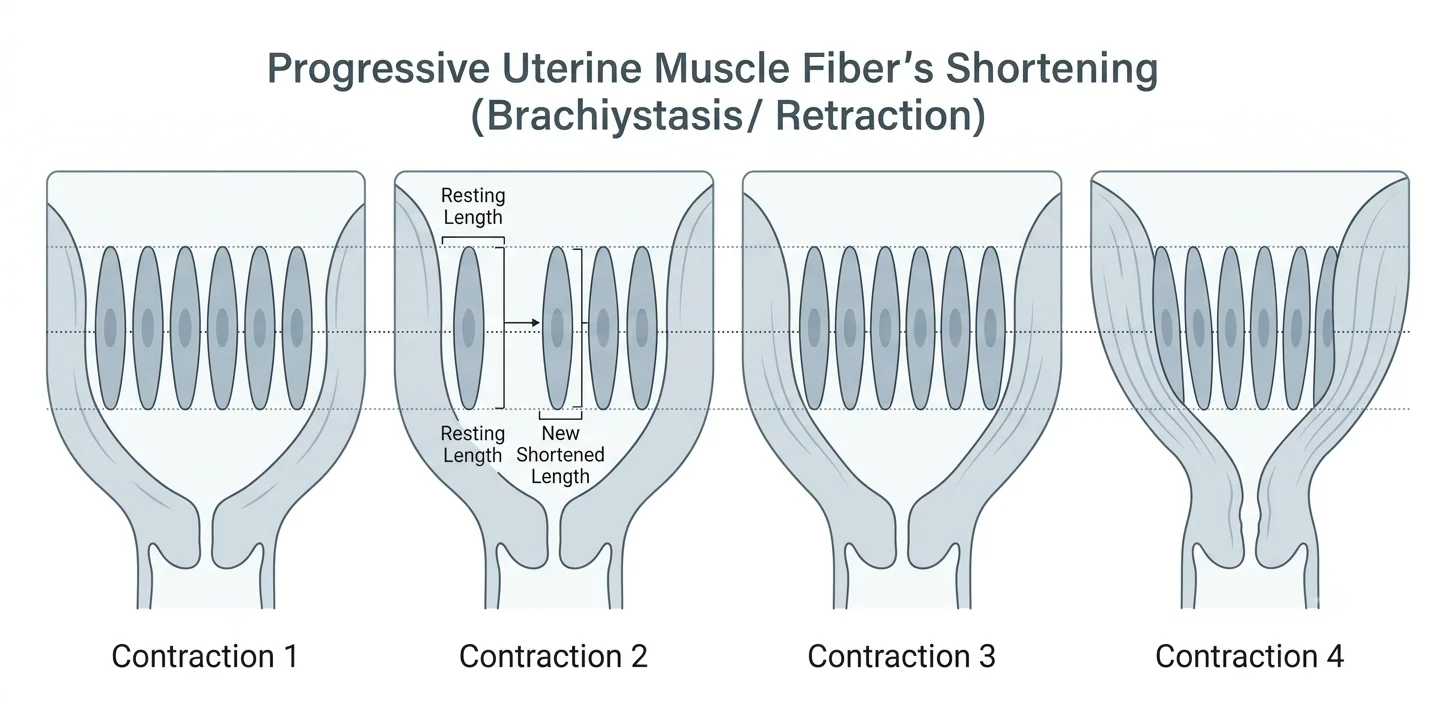
Brachystasis is the tendency of a muscle fiber to shorten during contraction and then settle into a new, shorter resting length rather than fully returning to its original length once it relaxes. In practice, most clinicians simply call this retraction, and that’s the term you’re far more likely to encounter in a textbook, a lecture, or a chart note.
Where the term actually shows up
The clearest example is the uterus during labor. As contractions repeat, the muscle fibers of the upper uterine segment shorten a little more each time and don’t fully lengthen back out between contractions. Over the course of labor this progressively thickens and shortens the upper segment, which:
- reduces the internal volume of the uterus as the baby descends, and
- helps draw up and thin out the lower segment and cervix, forming the birth canal.
This is a normal, necessary part of labor physiology, not a complication. It’s covered in some obstetric and veterinary anatomy references under this name, though even there it’s usually a footnote next to the more common term.
How it differs from ordinary muscle relaxation
In skeletal muscle, a fiber that contracts and then relaxes typically returns to close to its original resting length, that’s just standard muscle mechanics. Brachystasis describes the opposite pattern: each contraction leaves the fiber a bit shorter than before, so the shortening accumulates cycle over cycle. Smooth muscle in the uterus is the main tissue known to behave this way.
A note on usage
This is a genuinely obscure term. It appears in a small number of specialist dictionaries and veterinary anatomy resources, but it has essentially no presence in everyday clinical writing or general reference material, retraction is what you’ll see used almost everywhere instead. If you’re writing for a general audience, defining it briefly and pointing to “retraction” as the working term is usually more useful than trying to popularize brachystasis itself.