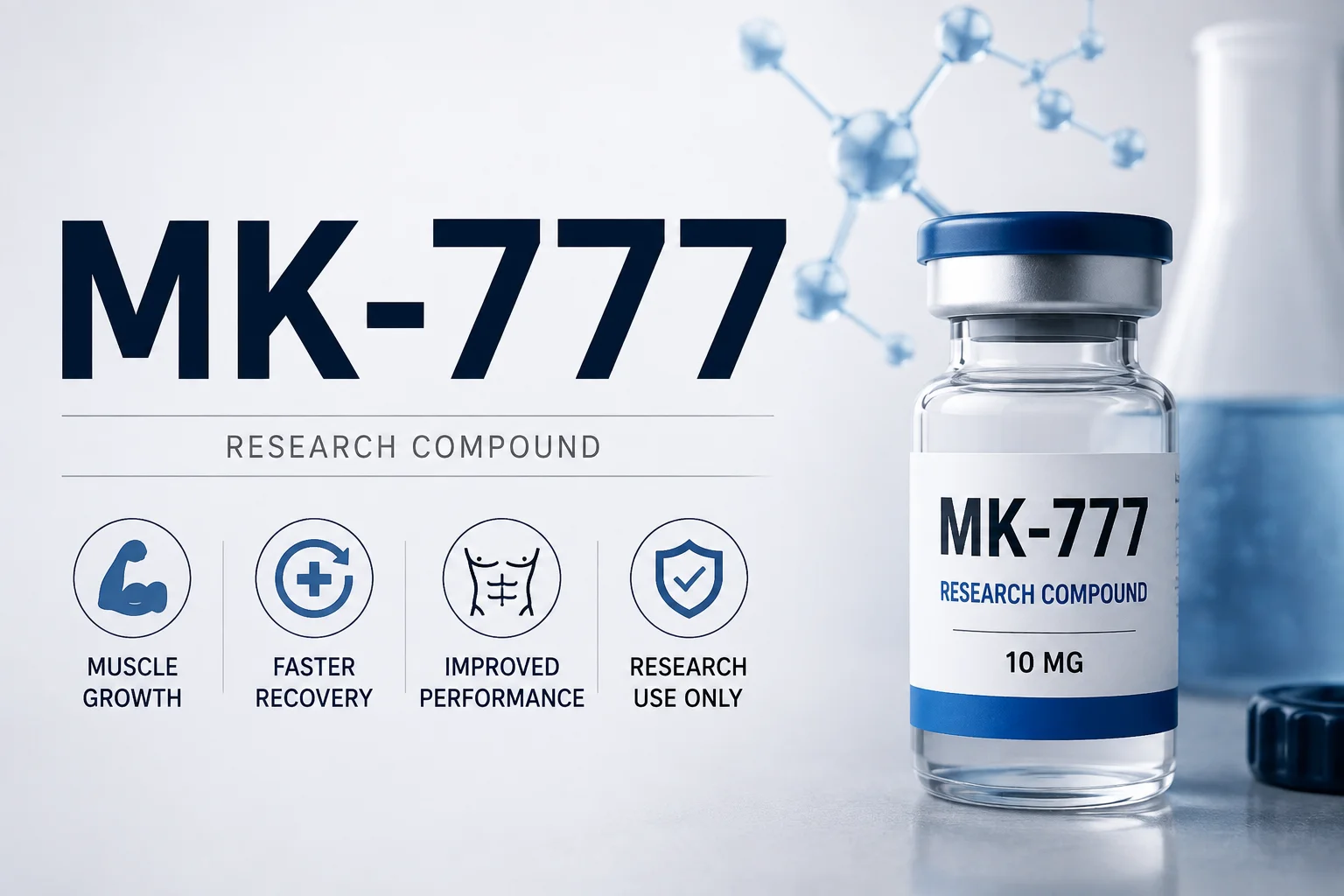
If you’ve come across “MK-777” in a fitness forum or a research-chemical storefront, it’s easy to assume it’s just another entry in the crowded world of muscle-building supplements. It isn’t. MK-777, also sold under the name Acetamoren, is an unapproved research chemical, not a dietary supplement or an approved medication, and understanding that distinction matters more than any list of claimed benefits.
What MK-777 Actually Is
MK-777 is the developmental name for a compound also marketed as Acetamoren. Chemically, it’s a synthetic, non-peptide small molecule designed to act on a specific receptor in the body: the growth hormone secretagogue receptor, or GHS-R1a. This is the same receptor that ghrelin, the hormone best known for driving hunger, naturally binds to.
Structurally, MK-777 belongs to a family of compounds related to MK-677 (Ibutamoren), an earlier and more widely discussed secretagogue. Vendors describe MK-777 as a next-generation analog, positioned as a refinement rather than a replacement. That framing comes entirely from commercial listings, though. There’s no independent body of published research confirming that MK-777 improves on its predecessor in any measurable way, because there’s very little published research on MK-777 at all.
It’s worth being precise about naming, too. “MK” series compounds get confused with each other constantly online, and product labeling isn’t always consistent. If you’re trying to figure out what a specific product actually contains, check for the CAS number or IUPAC chemical name rather than relying on the marketing name alone.
How the Receptor It Targets Works
To understand what MK-777 is designed to do, it helps to understand the receptor itself, since that part does have a real scientific record behind it.
GHS-R1a was identified in the mid-1990s, and its natural ligand, ghrelin, was isolated a few years later. The receptor is expressed widely across the body: in the brain, gut, pancreas, and cardiovascular system, among other places. Its best-known job is triggering the release of growth hormone from the pituitary gland, but researchers have also linked it to appetite regulation, sleep, glucose metabolism, and memory.
Because of that range of effects, GHS-R1a has been a genuine target of pharmaceutical interest for decades. A class of drugs called growth hormone secretagogues was developed specifically to act on this receptor, and some of those compounds have gone through actual randomized clinical trials, largely aimed at conditions like growth hormone deficiency, cachexia in cancer patients, and age-related muscle loss. That clinical history is real, and it’s part of why the broader compound class attracts scientific attention.
MK-777 is described by suppliers as another agonist targeting this same receptor, meaning it’s designed to activate it in a similar way. But belonging to a studied receptor class isn’t the same as being a studied compound. The clinical trial record belongs to specific molecules that made it through that process. MK-777 has not.
The Actual State of the Research
This is the part that gets glossed over in most of what’s written about MK-777, and it’s the most important part.
MK-777 has no published human clinical trials. The claims circulating about it, whether related to muscle preservation, recovery, fat metabolism, or sleep, come from supplier product descriptions and informal online discussion, not from peer-reviewed studies. Some of that language echoes findings from research on ghrelin and GHS-R1a generally, but general receptor biology doesn’t tell you how a specific untested molecule behaves in the human body, at what dose, or with what side effect profile.
Every commercial source selling MK-777 describes it the same way: a laboratory research chemical, sold explicitly for research purposes and not for human consumption. That’s not boilerplate legal caution. It reflects the actual state of the evidence. There is no dosing data, no safety data, and no efficacy data from human trials for this specific compound. Anything describing personal effects is, at best, an anecdote from an unregulated product with unconfirmed contents.
Regulatory and Legal Status
MK-777 has not been approved by the FDA for any medical use, and it is not classified as a dietary supplement. Products sold under this name are marketed as research chemicals, which is a distinct regulatory category from both approved drugs and legal supplements, and one that doesn’t require the same safety or manufacturing oversight.
Legal status varies by country and, in some cases, by state or region. Some jurisdictions permit sale for laboratory use only, while others restrict distribution more heavily. Regulations around research chemicals also change over time, so anything read online, including this article, should be checked against current local rules before drawing conclusions about legality.
Why This Distinction Matters
The gap between “research chemical” and “supplement” isn’t a technicality. Dietary supplements, even loosely regulated ones, are at least intended for human consumption and subject to some manufacturing standards. Research chemicals are explicitly not intended for that purpose. When a compound is sold this way, it means no regulatory body has evaluated it for human safety, no clinical trial has established a safe dose range, and no oversight body has verified that what’s in the product matches the label.
Read our latest Blogs.
That doesn’t mean every claim about MK-777 is necessarily false. It means those claims haven’t been tested in the way that would let anyone say so with confidence. The distinction between “this interacts with a receptor associated with growth hormone release” and “this compound does X in the human body” is exactly the gap that clinical research exists to close, and for MK-777, that gap hasn’t been closed.