Short answer: usually healing, but not always. Itching is one of the most common sensations as skin repairs itself, and in most cases it’s a good sign, not a bad one. The tricky part is that itching can also show up in the early stages of infection, so the itch by itself doesn’t tell you much. What matters is what’s happening around it.
Here’s how to actually tell the two apart.
Why wounds itch when they’re healing
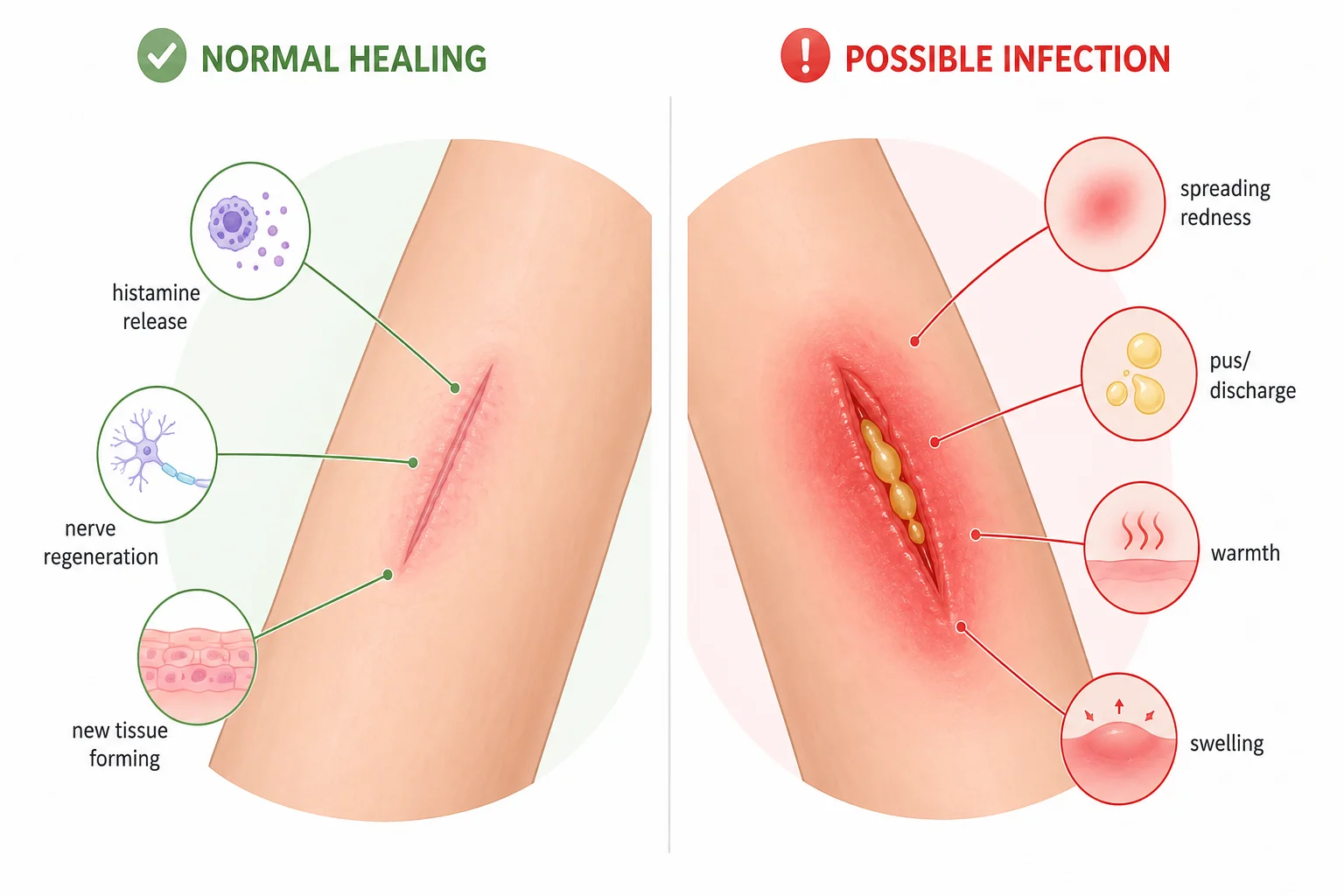
When skin is damaged, your body goes through a repair process that involves new tissue forming, blood vessels expanding, and nerve endings becoming more active. That nerve activity, combined with the release of histamine and a related compound called IL-31, is what produces the itch. It’s the same chemical pathway involved in allergic reactions, which is part of why the sensation can feel so intense even though nothing is actually wrong.
A few specific things tend to cause it:
- New tissue forming. As skin cells multiply and the wound starts to close, the surrounding nerves get stimulated.
- Scab tightening. As a scab dries and pulls slightly on the skin around it, that tension itself feels itchy.
- Dry skin. Healing skin often loses moisture, and dryness alone causes itching independent of anything else going on.
This kind of itch tends to be mild to moderate, comes and goes, and doesn’t get worse day over day. It often shows up more noticeably in the second week of healing, once the tissue-rebuilding phase is in full swing.
When itching might mean infection instead
Infection-related itching isn’t really a different type of itch. It’s the same mechanism, just triggered by something the body is fighting off instead of something it’s repairing. On its own, it’s genuinely hard to tell apart from normal healing itch. So instead of trying to judge the itch itself, look at what else is going on.
Signs that point toward infection rather than healing:
- Redness that’s spreading, rather than staying contained to the wound edge
- Warmth — the skin around the wound feels noticeably hot
- Increasing pain, especially if it’s getting worse instead of better after the first day or two
- Swelling that keeps growing rather than settling down
- Pus or discharge that’s thick, yellow, green, or bad-smelling (a little clear or slightly pink fluid early on is normal; cloudy or colored drainage is not)
- Fever, chills, or feeling generally unwell
One or two of these mixed in with itching is a reasonable signal to get it checked. The general pattern to watch for: a healthy wound gets a little better every day. An infected one tends to get worse, especially after day two or three.
If you have diabetes, poor circulation, or a weakened immune system
Infections can progress faster and be harder to spot in these cases, so it’s worth having a lower threshold for calling a doctor, even for something that looks minor.
The genuine emergency signs
Most wound infections are treatable with basic care and, if needed, antibiotics. But a small number can progress into something more serious, called sepsis, where the body’s infection response starts damaging its own organs. According to the CDC, this is rare, but it moves fast, so it’s worth knowing the signs rather than assuming a wound infection can only ever get moderately worse.
Get emergency care (call 911 or go to the ER) if you notice, alongside a wound that seems infected:
- Red streaks spreading out from the wound toward the rest of the body
- A racing heart, rapid breathing, or feeling faint
- Confusion or unusual drowsiness
- Fever with shaking chills
- Pain that feels far more severe than the wound looks like it should cause
- Skin around the wound turning gray, purple, or black, or going numb
These are not “wait and see” symptoms.
How to manage the itch without making things worse
Whether it’s a normal healing itch or something you’re keeping an eye on, scratching makes both worse. It can reopen the wound, introduce bacteria, and genuinely slow down healing. A few things that help instead:
- Keep the area clean with mild soap and water
- Apply a fragrance-free moisturizer around (not directly on) the wound, since dryness is a big driver of itch
- Use a cool compress for short stretches if it’s especially uncomfortable
- Keep it loosely covered with a breathable dressing, so you’re not tempted to scratch
Conclusion
Itching is usually a sign your body is doing exactly what it’s supposed to: rebuilding tissue and reactivating nerves. That’s true for most wounds, most of the time. The itch itself just isn’t a reliable way to tell healing apart from infection, because both involve the same underlying chemistry.
What actually tells you which one you’re dealing with is the pattern around it: is the area getting better day by day, or worse? Is there spreading redness, warmth, pus, or fever alongside the itch? If the wound is steadily improving, the itch is very likely just part of that. If it’s getting worse, especially after the first couple of days, that’s worth a call to a doctor rather than a guess.