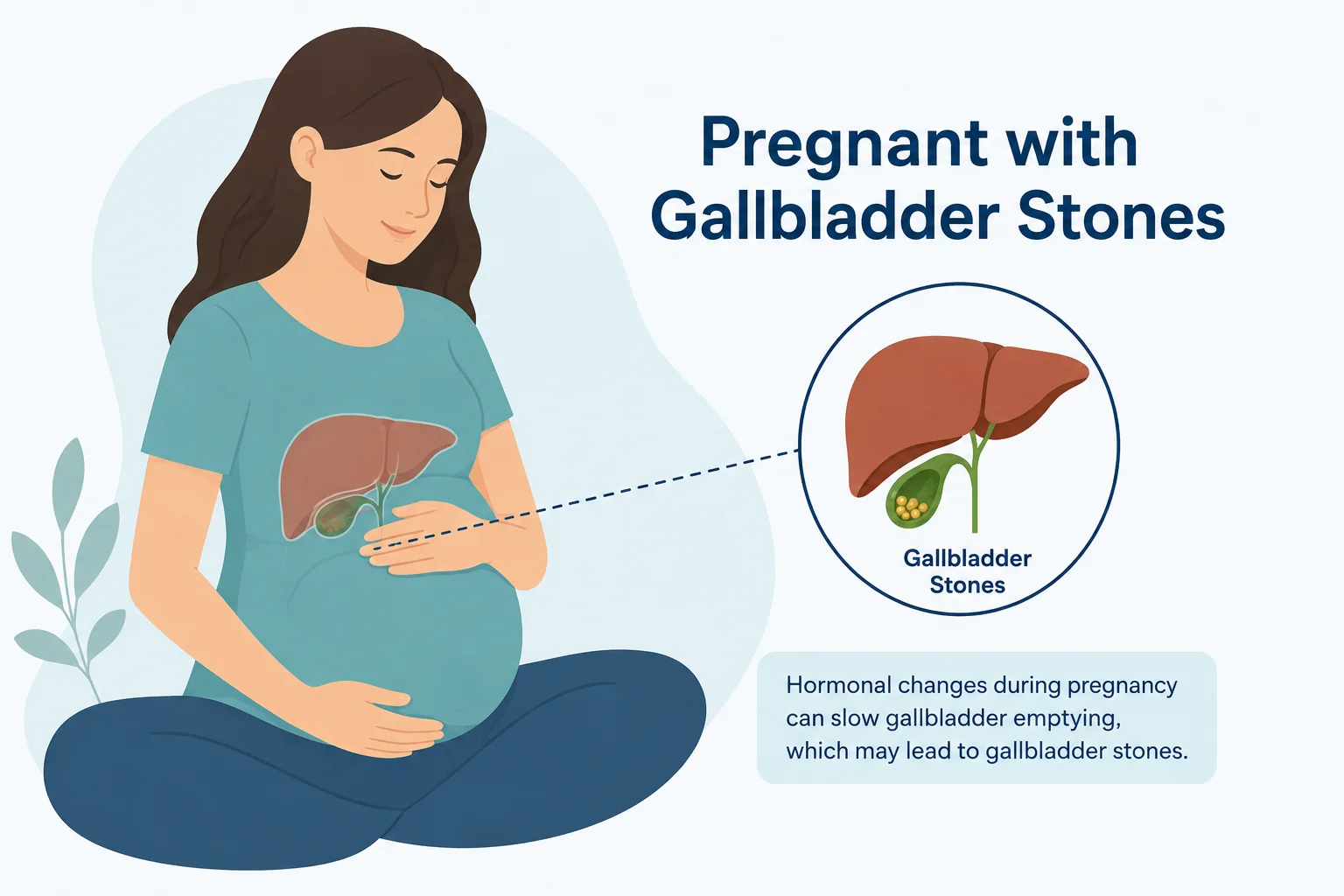
Pregnancy changes how your gallbladder works, and for a meaningful number of pregnant women, that change means gallstones. If you’ve just been told you have them, or you’re trying to figure out whether the pain under your right ribs is something to worry about, here’s what’s actually going on and what your options look like.
How Common Is This, Really?
More common than most people expect. Studies in the United States put gallstone prevalence at roughly 5% to 12% of pregnant women, and biliary sludge (a precursor that can turn into stones) shows up in as many as 30% of pregnancies by the third trimester. Most of it is asymptomatic. Somewhere between 1% and 3% of pregnant women end up needing gallbladder surgery for symptoms or complications within the first year postpartum.
Women are already about four times likely than men to develop gallstones, and pregnancy adds another layer of risk on top of that.
Why Pregnancy Triggers Gallstones
Two hormones are doing most of the work here: estrogen and progesterone.
Estrogen pushes your liver to put more cholesterol into bile. Progesterone relaxes smooth muscle throughout your body, including the gallbladder, which slows down how efficiently it empties. Put those together and you get bile that’s more concentrated with cholesterol, sitting in a gallbladder that’s not contracting as often as it should. That combination is exactly what lets cholesterol crystallize into stones.
This is also why gallstone risk climbs with each pregnancy. One Chilean study found gallstone prevalence jumped from 3.1% at the start of pregnancy to 12.2% postpartum in the same group of women. The hormonal shift is doing real, measurable work on your gallbladder over the course of nine months.
Symptoms to Watch For
Classic gallstone pain, sometimes called biliary colic, tends to show up 1 to 3 hours after a fatty meal. It’s usually felt as:
- Pain in the upper right abdomen, just under the ribs, or in the center of the upper abdomen
- Pain that can spread to the right shoulder blade or back
- Nausea, sometimes with vomiting
- A dull ache that can turn sharp, lasting anywhere from under an hour to several hours
Here’s the tricky part: early pregnancy nausea and gallbladder pain can look a lot alike, which is part of why gallbladder disease sometimes gets missed or written off as normal pregnancy discomfort. If the pain is new, focused on the right side, and tied to eating, it’s worth mentioning to your provider rather than assuming it’s just morning sickness.
When It’s an Emergency
Call your doctor or go to the ER if pain lasts more than 4 to 6 hours without letting up, or if it comes with any of the following:
- Fever or chills
- Yellowing of the skin or eyes (jaundice)
- Persistent vomiting that won’t stop
- Severe, unrelenting pain rather than the usual wax-and-wane pattern
These can point to acute cholecystitis (an infected, inflamed gallbladder), a bile duct blockage, or gallstone pancreatitis, which is inflammation of the pancreas triggered by a stone. Gallstone pancreatitis is serious. One study following pregnant women with this complication found the recurrence rate during the first trimester ran as high as 50% without treatment. This isn’t a “wait and see how the week goes” situation. It needs same-day medical evaluation.
How Gallstones Are Diagnosed
Ultrasound is the go-to test: it picks up stones as small as 2 millimeters, is more than 95% accurate, and involves zero radiation. Your doctor will likely also order blood work to check liver enzymes and white blood cell count, since both tend to rise when the gallbladder is inflamed or a duct is blocked.
Do Gallstones Affect the Baby?
Gallstones themselves don’t cross the placenta or directly harm your baby. The risk comes from complications, not the stones sitting quietly in your gallbladder. Untreated infection, prolonged vomiting, or pancreatitis can affect your ability to stay nourished and hydrated, and severe maternal illness is what puts a pregnancy at risk, not the stones themselves. This is exactly why symptomatic gallstones get taken seriously rather than dismissed.
Treatment Options
If you’re asymptomatic: Most pregnant women with silent gallstones need no treatment at all beyond keeping an eye on symptoms. Watchful waiting is standard here.
If symptoms are mild and manageable: Your care team may start with dietary changes (lower fat, smaller meals), pain management, and monitoring, saving surgery for after delivery if things stay under control.
If symptoms are severe, recurring, or you develop complications: Surgery becomes the more definitive option, and it may happen sooner than you’d expect. Laparoscopic cholecystectomy (minimally invasive gallbladder removal) is now considered safe in any trimester by both the American College of Obstetricians and Gynecologists (ACOG) and the Society of American Gastrointestinal and Endoscopic Surgeons (SAGES). The second trimester is generally still preferred when timing allows, since organ development is
pregnancy-loss risk is lower than in the first trimester
complete by then and pregnancy-loss risk is lower than in the first trimester. A 2016 meta-analysis found that operating for gallstone disease during pregnancy did not increase fetal or maternal mortality compared with non-surgical management, and delaying surgery carries its own risks: higher rates of symptom relapse and hospital readmission. Current guidance is straightforward on this point: if surgery is medically necessary, ACOG recommends treating pregnant patients the same way you’d treat anyone else, without unnecessary delay.
Can You Prevent Gallstones During Pregnancy?
Not entirely, since hormones are largely out of your control. But a few things help tilt the odds: gaining weight gradually rather than in rapid swings, eating regular meals instead of skipping them, keeping fat intake moderate, and staying hydrated. None of this guarantees you won’t develop gallstones, but it lowers the risk somewhat.