
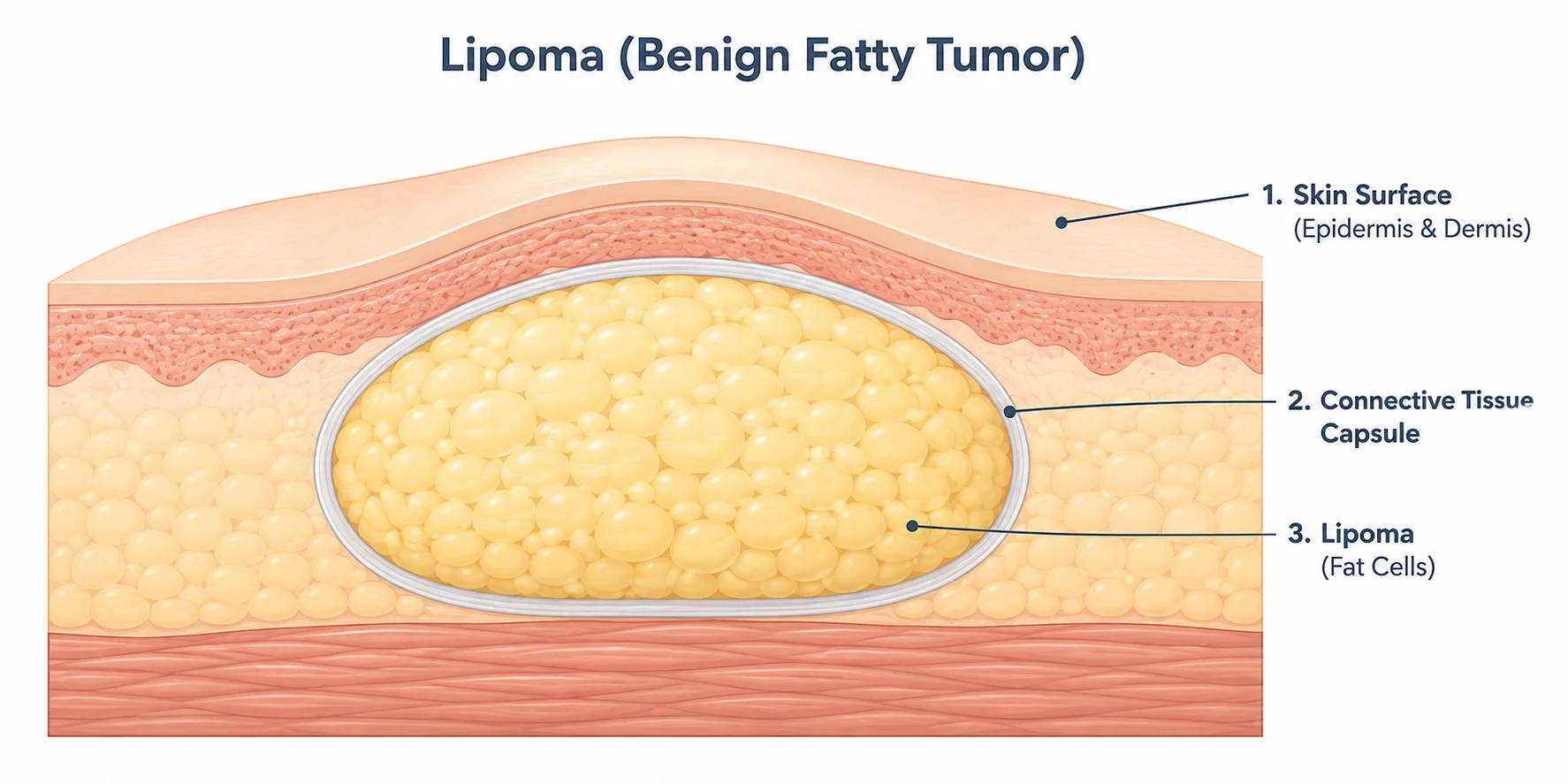
A lipoma shows up as a soft, doughy lump under the skin, and for most people, the first question after “what is this” is “do I really need to get cut open for it.” Fair question. Surgical removal is still the most reliable way to get rid of a lipoma completely, but it’s not the only path, and it’s not always the right one.
This guide walks through the non-surgical options that actually have some backing, what they can and can’t do, and the warning signs that mean you should stop reading and call a doctor instead.
What a Lipoma Actually Is
A lipoma is a benign, slow-growing lump made of mature fat cells wrapped in a thin layer of connective tissue. They’re common, showing up in roughly 1 in 1,000 people, most often between ages 40 and 60. They usually feel soft, move around when you press on them, and don’t hurt.
Cleveland Clinic notes that lipomas can appear anywhere but are most often found on the back, chest, arms, shoulders, and neck. Most stay small (under two inches), though some grow much larger.
Here’s the part that matters before you try anything at home: nobody fully understands why lipomas form. Family history plays a role, and a handful of rare genetic conditions (Gardner syndrome, Dercum’s disease, hereditary multiple lipomatosis) cause multiple lipomas to develop. But for the average single lipoma, there’s no clear trigger, which also means there’s no proven way to prevent one or shrink it through diet or lifestyle changes.
Get It Checked Before You Treat It
I want to put this before the treatment list, not after, because it’s easy to skip past a warning buried at the bottom of an article.
A lump that feels exactly like a lipoma can occasionally turn out to be something else, most seriously a liposarcoma, a rare form of cancer that can look and feel similar in its early stages. This is not meant to alarm you; the odds are heavily in favor of “it’s just a lipoma.” But a doctor typically confirms that with a physical exam and sometimes an ultrasound, and if there’s any doubt, a biopsy.
See a healthcare provider before pursuing any treatment, surgical or not, if the lump:
- Is growing quickly, over weeks rather than months or years
- Feels hard or fixed in place instead of soft and mobile
- Is painful, especially if it wasn’t before
- Is larger than about 2 inches, or keeps getting bigger
None of the non-surgical options below are meant to replace that first evaluation. Think of this article as “what happens after a doctor confirms it’s a lipoma,” not “how to skip that step.”
Non-Surgical Treatment Options
Corticosteroid Injections
This is the most established non-surgical route, and it’s been used in clinical practice for decades. A doctor injects a corticosteroid, usually triamcinolone acetonide mixed with a local anesthetic, directly into the center of the lipoma.
The steroid causes localized fat atrophy: the fat cells at the injection site break down and shrink over the following weeks. A clinical review published in American Family Physician describes a 1-to-1 mix of 1% lidocaine and triamcinolone at 10 mg/mL, with results typically appearing within three to four weeks. Injections tend to work best on lipomas smaller than about an inch in diameter, and the procedure may need to be repeated to get a meaningful reduction in size.
What this treatment doesn’t do is eliminate the lipoma outright in most cases. It shrinks it. Complete disappearance happens occasionally but isn’t the expectation you should walk in with. Repeat sessions are common, and results vary based on the size and location of the lump.
Side effects are generally mild but real: some patients experience localized skin thinning (atrophy) or lighter patches of skin (hypopigmentation) around the injection site, particularly with higher steroid concentrations. A dermatologist will typically use the lowest effective dose to reduce that risk.
Deoxycholic Acid Injections
Deoxycholic acid, the same compound used in Kybella for reducing chin fat, has started showing up as an off-label option for larger lipomas. It works by breaking down fat cell membranes at the injection site.
A 2025 case report published in Cureus documented a 39-year-old patient with a 14 cm lipoma on her back who received two rounds of deoxycholic acid injections three months apart. Four months after starting treatment, she saw a 50% reduction in the size of the lesion, avoiding a surgery that would likely have left a large scar given the lipoma’s size.
That’s one documented case, not a large trial, so it’s worth reading as “here’s a real result someone achieved,” not “here’s what’s guaranteed to happen for you.” It’s currently used off-label for this purpose, meaning it hasn’t been FDA-approved specifically for lipoma treatment. Ask a dermatologist whether you’re a reasonable candidate before assuming this is an option.
Liposuction
Technically a procedure rather than a home remedy, liposuction sits in a middle zone between “leave it alone” and “full surgical excision.” A provider inserts a thin needle or cannula and suctions out the fatty tissue, which avoids the larger incision and visible scarring that comes with cutting the whole lipoma out.
The tradeoff: liposuction rarely removes 100% of the lipoma’s capsule. Because a thin shell of fibrous tissue often stays behind, there’s a higher chance the lump partially regrows compared to surgical excision, where the whole capsule comes out at once. It’s a reasonable choice for larger lipomas in spots where a long incision scar would be a bigger cosmetic concern than the small chance of recurrence.
Emerging and Investigational Options
A few newer approaches are worth knowing about, mainly because you may see them mentioned elsewhere, even though they’re not yet standard options you can walk into a clinic and request.
CBL-514, an investigational injectable, is being studied specifically for lipoma reduction, including in a Phase IIb trial that was still running as of early 2026, with results expected later in the year. If the data holds up, it could eventually become the first drug approved specifically for lipomas rather than used off-label. It isn’t available for general use yet.
Focused ultrasound and other non-invasive fat-reduction technologies are also being explored for lipomas, borrowing techniques originally developed for cosmetic fat reduction elsewhere on the body. These remain early-stage for this specific use.
None of these are “try this at home” options. I’m including them so you have accurate context if you come across the terms, not as a recommendation to seek them out right now.
What Doesn’t Have Real Evidence Behind It
You’ll find plenty of articles listing home remedies, apple cider vinegar, turmeric paste, flaxseed oil, chickweed, and the like, as ways to “shrink” a lipoma naturally. I’m not going to repeat that list here as if it’s a credible option, because there’s no clinical research showing any of these actually reduce fat cell mass inside an encapsulated lipoma. Rubbing something on the skin’s surface doesn’t reach fat cells sitting beneath it, and no controlled study has found otherwise.
If a lipoma is small and not bothering you, the honest, evidence-backed answer is that doing nothing is also a legitimate option. Most lipomas never need treatment at all.
Comparing Your Options
| Option | Best For | What to Expect | Downsides |
|---|---|---|---|
| Steroid injection | Lipomas under 1 inch | Partial shrinkage over 3-4 weeks, may need repeats | Rarely eliminates fully; possible skin thinning |
| Deoxycholic acid | Larger lipomas where scarring is a concern | Gradual reduction over months, based on limited case data | Off-label use; not widely available |
| Liposuction | Larger lipomas, cosmetically sensitive areas | Reduced size with minimal scarring | Capsule often remains; higher recurrence risk |
| Watchful waiting | Small, painless, stable lipomas | No change, but no risk either | Doesn’t address cosmetic concerns |
| Surgical excision | Complete removal, diagnostic certainty | Full removal in one procedure | Requires incision, local scarring |
Why People Try to Avoid Surgery in the First Place
It’s worth naming the actual reasons people search for this, because they’re mostly reasonable. Surgical excision means an incision, stitches, and a visible scar, which matters more depending on the lipoma’s location. Some people are wary of anesthesia or the downtime that comes with a procedure. Cost is a factor too, non-surgical office visits are often cheaper than a formal excision, especially if insurance treats the lipoma as cosmetic rather than medically necessary.
None of that makes surgery the wrong choice for everyone. For a lipoma causing nerve pain, restricting movement, or growing in a way that concerns your doctor, excision is still the most direct way to solve the problem for good, and it’s the only option that removes the entire capsule in one step, which is also why recurrence at the same site is rare after excision.