
If your “cold” has hung around for more than a week and you’re starting to wonder whether it’s actually something else, you’re asking the right question. Sinus infections share a lot of overlap with colds and allergies in the early days, which is exactly why so many people miss the signs until they’re miserable.
Seek emergency care right away if a sinus infection comes with vision changes, swelling around one or both eyes, a severe headache, confusion, or a stiff neck. These can signal that the infection has spread beyond your sinuses, and they need immediate evaluation. That’s rare, but it’s worth knowing before we get into the more common, everyday symptoms below.
What a Sinus Infection Actually Is
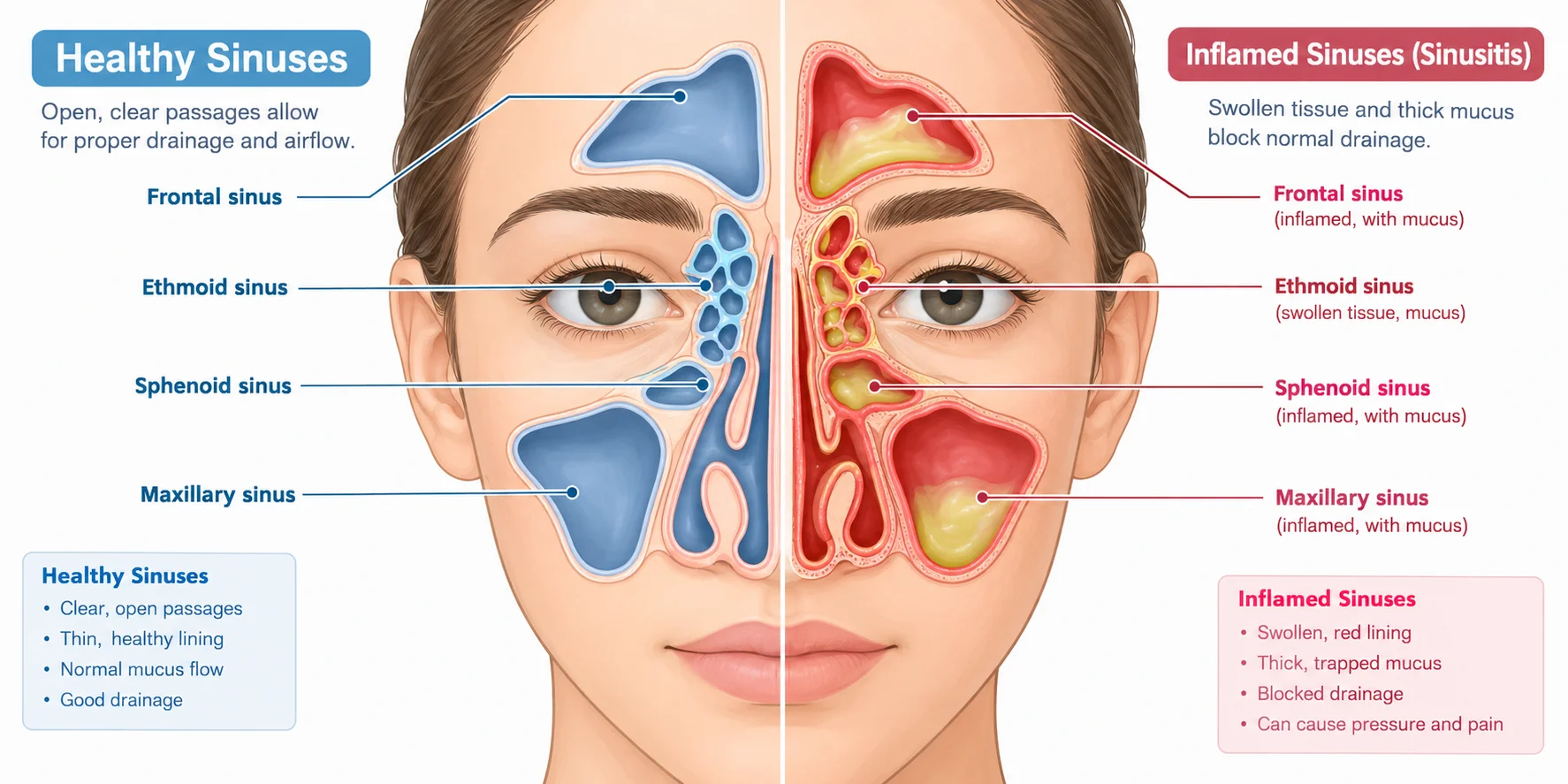
Sinusitis is inflammation of the tissue lining your sinuses, the air-filled spaces around your nose, eyes, and forehead. When that lining swells, it blocks normal drainage, and mucus builds up instead of flowing the way it should. It’s usually triggered by the common cold, though other viruses, bacteria, fungi, and allergies can cause it too.
Doctors generally sort it into two categories based on how long it sticks around. Acute sinusitis typically clears up within 10 days to four weeks, while chronic sinusitis is diagnosed when symptoms don’t let up for 12 weeks or more. It’s a common problem: roughly 1 in 8 adults deal with a sinus infection at some point each year, according to Cleveland Clinic, and it often shows up right after a cold that just won’t quit.
The Core Symptoms to Watch For
Most sinus infections announce themselves through a cluster of symptoms rather than just one. Here’s what tends to show up:
- Facial pain or pressure, especially around the cheeks, eyes, or forehead, that often gets worse when you bend forward
- Nasal congestion that makes it hard to breathe through your nose
- Thick, discolored mucus, usually yellow or green, either draining from the nose or dripping down the back of the throat
- Postnasal drip that irritates the throat and can trigger a nagging cough, particularly at night
- Reduced or lost sense of smell and taste
- Headache, often concentrated around the sinuses rather than all over
- Fatigue that lingers well beyond what a typical cold would cause
- Fever, though this is more common with bacterial infections than viral ones
- Ear pressure or dull ear pain
- Bad breath unrelated to dental hygiene
- Tooth or jaw pain, especially in the upper teeth, which can catch people off guard since it feels more dental than sinus-related
That combination of pressure and thick mucus is what creates the “heavy face” feeling so many people describe, often paired with a nonstop postnasal tickle that sets off frequent coughing.
Is It a Cold, Allergies, or a Sinus Infection?
This is where most people get stuck, because the early symptoms genuinely do look alike. Timing is the most useful clue you have.
Cold symptoms typically peak around day three to five and then start improving, according to Cleveland Clinic rhinologist Dr. Troy Woodard. If you’re still dealing with a stuffy nose, facial pressure, and discolored mucus after 10 days, or if you seemed to be getting better and then suddenly got worse again, that pattern points toward a sinus infection rather than a lingering cold.
Doctors actually have a name for that second pattern: “double sickening,” where you improve for a few days and then relapse with new or worsening symptoms. It’s one of the more reliable signs that a viral infection has developed into a bacterial one. Research reviewed by the American Academy of Family Physicians identifies the classic combination pointing toward a bacterial sinus infection as one-sided facial pain or pressure, a fever above 102°F, and thick discharge paired with a blocked nose. None of these signs alone confirms a bacterial infection, but seeing them together raises the odds considerably. Notably, the color of your mucus isn’t actually one of the reliable predictors, despite how often people assume it is.
Allergies tend to bring on clear, thin discharge along with itchy eyes and sneezing fits, without the thick colored mucus or facial pain that sinus infections cause. If your symptoms flare with the seasons or around specific triggers like pollen or dust, allergies are the more likely culprit.
How Long Symptoms Usually Last
Most acute sinus infections run their course in seven to 10 days, though some linger for two to four weeks, and many clear up without any treatment at all. That timeline matters because it’s part of how doctors decide whether antibiotics make sense.
Clinical guidelines from the American Academy of Otolaryngology-Head and Neck Surgery say a sinus infection should be treated as likely bacterial when purulent nasal drainage combined with nasal obstruction, facial pain, pressure, or fullness persists without improvement for at least 10 days after cold symptoms started, or when symptoms that were already improving suddenly worsen again. That’s the double sickening pattern in clinical terms, and it’s a big part of why doctors often ask you to wait out the first week before jumping to antibiotics. If your symptoms haven’t budged after 10 days, or they get worse after initially improving, that’s generally when a healthcare provider will consider a bacterial cause.
If symptoms stretch past four weeks and keep recurring, or if they never fully go away for 12 weeks straight, that’s chronic sinusitis territory, and it usually needs a different approach than a standard infection would.
When to See a Doctor
For most people, a sinus infection is a wait-it-out situation. But there are clear signals that it’s time to check in with a healthcare provider rather than tough it out at home:
- Symptoms last longer than 10 days without any improvement
- Symptoms improve and then suddenly get worse
- Fever climbs above 102°F
- Pain is severe or concentrated on one side of your face
- You’re getting sinus infections repeatedly throughout the year
- Symptoms have gone on for 12 weeks or longer
Untreated sinus infections rarely turn into something serious, but according to Cleveland Clinic otolaryngologist Dr. Raj Sindwani, it can happen. That’s the reasoning behind the 10-day guideline: it gives a viral infection time to resolve on its own while still catching a bacterial one before it has a chance to spread.
Emergency Warning Signs
This bears repeating because it matters more than anything else in this article. Go to the emergency room immediately if a sinus infection comes with new vision problems, significant swelling around the eyes, a severe headache, confusion, or trouble speaking. Other red flags include double vision, eye pain, a bulging eye, a stiff neck, or a high fever, along with any difficulty breathing or unusually foggy, sluggish thinking.
These symptoms can indicate that an infection has spread beyond the sinuses toward the eye socket or, in rare cases, toward the brain. It’s uncommon, but untreated infections can occasionally lead to serious complications like orbital cellulitis, meningitis, or a brain abscess. Getting treatment right away is what keeps these rare complications from becoming life-threatening ones. If you notice any of these signs, don’t wait to see if they pass. Head to urgent or emergency care the same day.