If your CT scan or ultrasound just came back showing a 5mm kidney stone, you’re probably somewhere between relief and panic. Relief because it’s not the golf-ball-sized horror story you’ve heard about. Panic because you’re still in pain and nobody’s told you what happens next.
Here’s the short version: 5mm sits right at a genuine decision point in kidney stone care. It’s small enough that most people pass it without surgery, but large enough that “just wait it out” isn’t automatically the right call either. What actually happens depends on exactly where the stone is sitting and how your body responds over the next few weeks.
This guide walks through what a 5mm stone means in practical terms, what the passage process actually feels like, when medication helps, and the specific signs that mean you shouldn’t wait any longer to get checked out.
How Big Is a 5mm Kidney Stone, Really?
Five millimeters is about the size of a large grain of rice or a pencil eraser tip. It doesn’t sound like much, and structurally it isn’t. The problem is where it has to go.
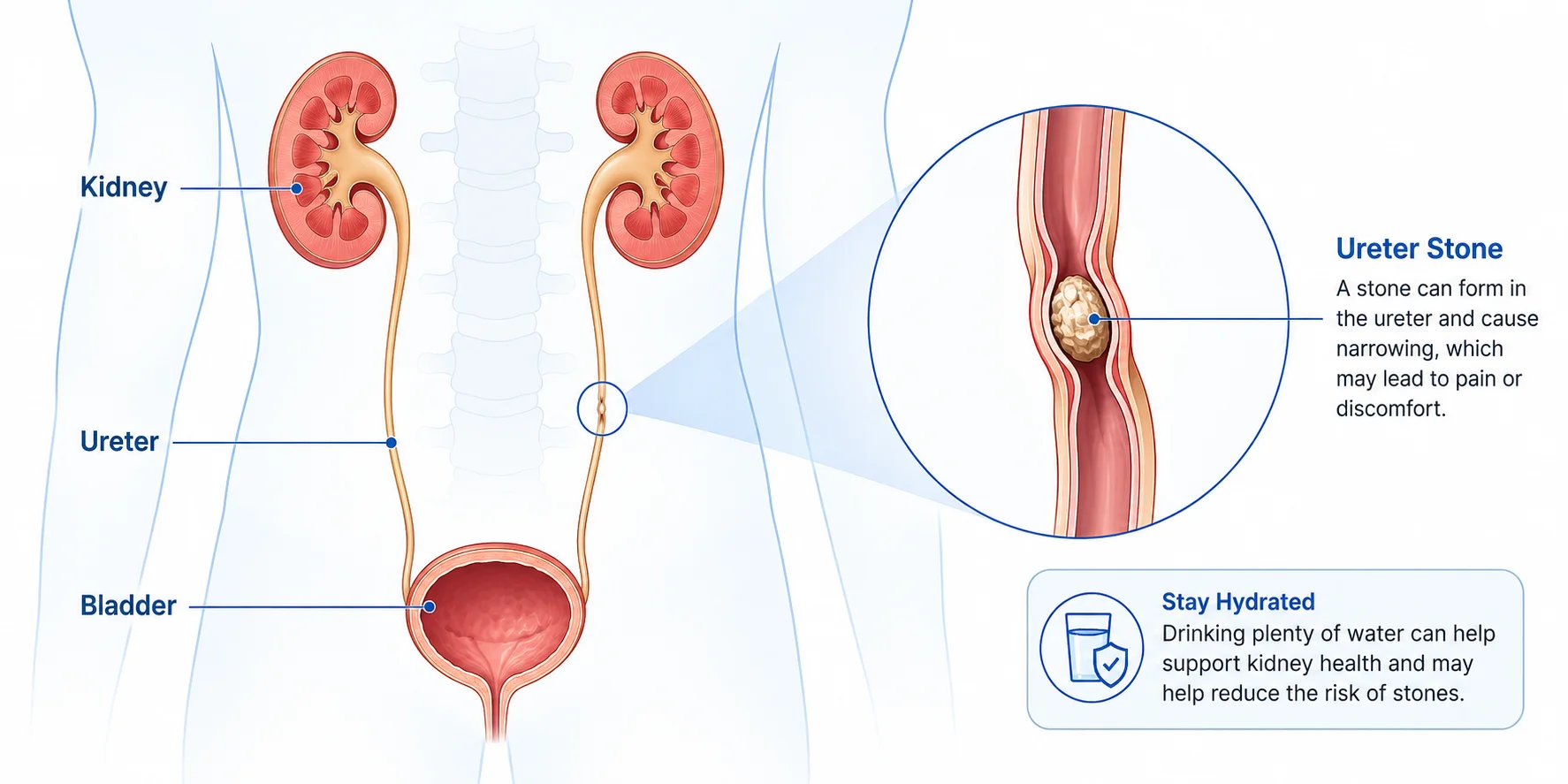
The ureter, the tube connecting each kidney to the bladder, is only about 3-4mm wide at its narrowest points. A 5mm stone is bigger than that opening, which is exactly why it causes pain: your body is trying to squeeze something through a space it doesn’t quite fit through. That’s also why size alone doesn’t tell the whole story. A smooth, round 5mm stone can slip through more easily than a jagged 4mm one with sharp edges catching on the ureter wall.
Doctors typically find these on a CT scan, since it’s the most precise way to measure stone size and pinpoint location. That location matters as much as the millimeter count. A 5mm stone sitting near the bladder has a much easier path ahead of it than the same size stone still up near the kidney.
Will a 5mm Kidney Stone Pass on Its Own?
This is the question everyone actually wants answered, and the honest response is: probably, but it’s not a coin flip you should treat casually.
According to the European Association of Urology’s current guideline on urolithiasis, roughly 62% of stones 5mm or larger pass spontaneously, with an average time to passage of about 17 days. Location shifts those odds meaningfully. The same guideline notes that stones under 5mm in the lower ureter, closer to the bladder, pass spontaneously in around 89% of cases, while stones of similar size still higher up in the ureter pass about 71% of the time. A stone sitting exactly at 5mm falls right at the edge between these bands, which is part of why urologists treat it as a genuine judgment call rather than a simple yes-or-no.
You’ll see other numbers floating around online, some higher, some lower. That variation isn’t sloppy reporting. Different studies track different cohorts, measure stones differently, and follow patients for different lengths of time, so the exact percentage shifts depending on which research you’re looking at. The consistent pattern across essentially all of it: passage becomes less likely as stones get larger, and 5mm is close to where those odds start meaningfully declining.
The practical takeaway from your urologist’s chair is usually this: at 5mm, watchful waiting is a reasonable first step for most people, but it’s not indefinite. There’s a window, typically four to six weeks, where waiting makes sense. Beyond that, an obstructing stone that hasn’t moved starts to carry real risk to kidney function even if the pain has quieted down.
What Passing a 5mm Stone Actually Feels Like
The pain from a moving kidney stone, called renal colic, tends to start suddenly in the flank or lower back and can radiate down toward the groin as the stone travels. It often comes in waves rather than staying constant, since the ureter spasms as it tries to push the stone along. Nausea and vomiting are common travel companions, not a separate problem.
One detail that trips a lot of people up: “passing a stone” doesn’t mean what most people assume. A urologist would describe two separate events. First, the stone moves from the kidney into the bladder, which is the part that actually hurts. Second, it exits the body through urination, which usually doesn’t hurt at all. So you can feel like the ordeal is over days before the stone has actually left your body, and you may never notice the moment it does unless you’re straining your urine to catch it.
How long the whole process takes varies enormously from person to person. Some people pass a stone within a day or two. Others carry one for weeks before it finally clears. Staying well hydrated genuinely helps by keeping urine flow higher, but there’s no proven trick, not water, not beer, not any particular position, that reliably speeds things up beyond that. Be skeptical of anything online promising a fast fix.
When Medication Comes Into Play
If your doctor is managing your 5mm stone conservatively rather than moving straight to a procedure, there’s a good chance they’ll prescribe tamsulosin, an alpha-blocker that relaxes the smooth muscle in the ureter. It doesn’t shrink the stone or push it out directly. What it does is widen the passageway slightly, which gives the stone an easier path and can shorten the time it takes to pass.
Current American Urological Association guidance strongly recommends offering this kind of medical therapy for about 30 days to adults and children with distal ureteral stones of 10mm or smaller, which comfortably includes a 5mm stone. It’s typically paired with an anti-inflammatory or other pain medication to manage the colic while you wait. This isn’t a guaranteed fix. Not everyone responds to it, and some more recent large trials have questioned how much benefit alpha-blockers provide for the smallest stones specifically. But it remains standard practice because for many patients, it does meaningfully shorten the ordeal and reduce pain episodes along the way.
If four to six weeks pass without progress, or if the stone is causing complications, the conversation shifts toward active removal, usually ureteroscopy, where a thin scope is passed up through the urinary tract to break up or retrieve the stone directly.
Symptoms That Mean You Shouldn’t Wait
Most 5mm stones can be managed at home with pain control, hydration, and patience. But there’s a specific set of symptoms where waiting is genuinely risky, and knowing them ahead of time matters more than most of what’s in this article.
Get emergency care right away if you notice:
- Fever, chills, or confusion alongside the stone pain. This combination can signal an infected kidney stone, which is a medical emergency, not something to sleep on and reassess in the morning.
- You can’t keep any fluids down. Some nausea is expected. Being unable to stay hydrated because you can’t stop vomiting is different and needs attention.
- You’re barely urinating, or not at all. This can mean the stone is fully blocking the ureter, which needs to be addressed promptly to protect kidney function.
- Pain that’s completely unmanageable. If over-the-counter medication isn’t touching it and you’re doubled over or unable to sit still, that’s an emergency room visit, not a wait-and-see situation.
- Visible blood in your urine alongside any of the above, especially combined with fever or severe pain.
Pregnant patients and people over 60 are generally advised to have a lower threshold for seeking emergency evaluation with kidney stone symptoms, since complications can escalate faster in both groups.
If none of those apply and you’re mainly dealing with manageable discomfort, it’s still worth staying in contact with your doctor rather than going fully silent for a month. Most providers will want follow-up imaging at some point to confirm the stone has actually passed, since pain resolving isn’t the same as the stone being gone. Sometimes pain fades because the stone has settled rather than because it’s cleared the ureter.
What Happens If It Doesn’t Pass
If your 5mm stone is still sitting in place after several weeks of conservative management, or if it’s causing complications sooner than that, your urologist will typically move to a procedure rather than continuing to wait. For a stone this size, that’s most often ureteroscopy: a thin scope is guided up through the urethra, bladder, and ureter to reach the stone directly, where it’s either broken apart with a laser and removed in fragments, or extracted whole with a small basket device. It’s done under anesthesia, and most people go home the same day.
Shockwave lithotripsy, which uses focused sound waves from outside the body to fragment the stone so smaller pieces can pass on their own, is sometimes offered as an alternative for stones in this size range, though ureteroscopy tends to have a higher success rate for a single treatment.
Neither option is something to dread. Both are common, well-established procedures with good outcomes for stones this size, and your urologist will walk you through which one fits your specific situation, including where exactly the stone is sitting and your overall health.