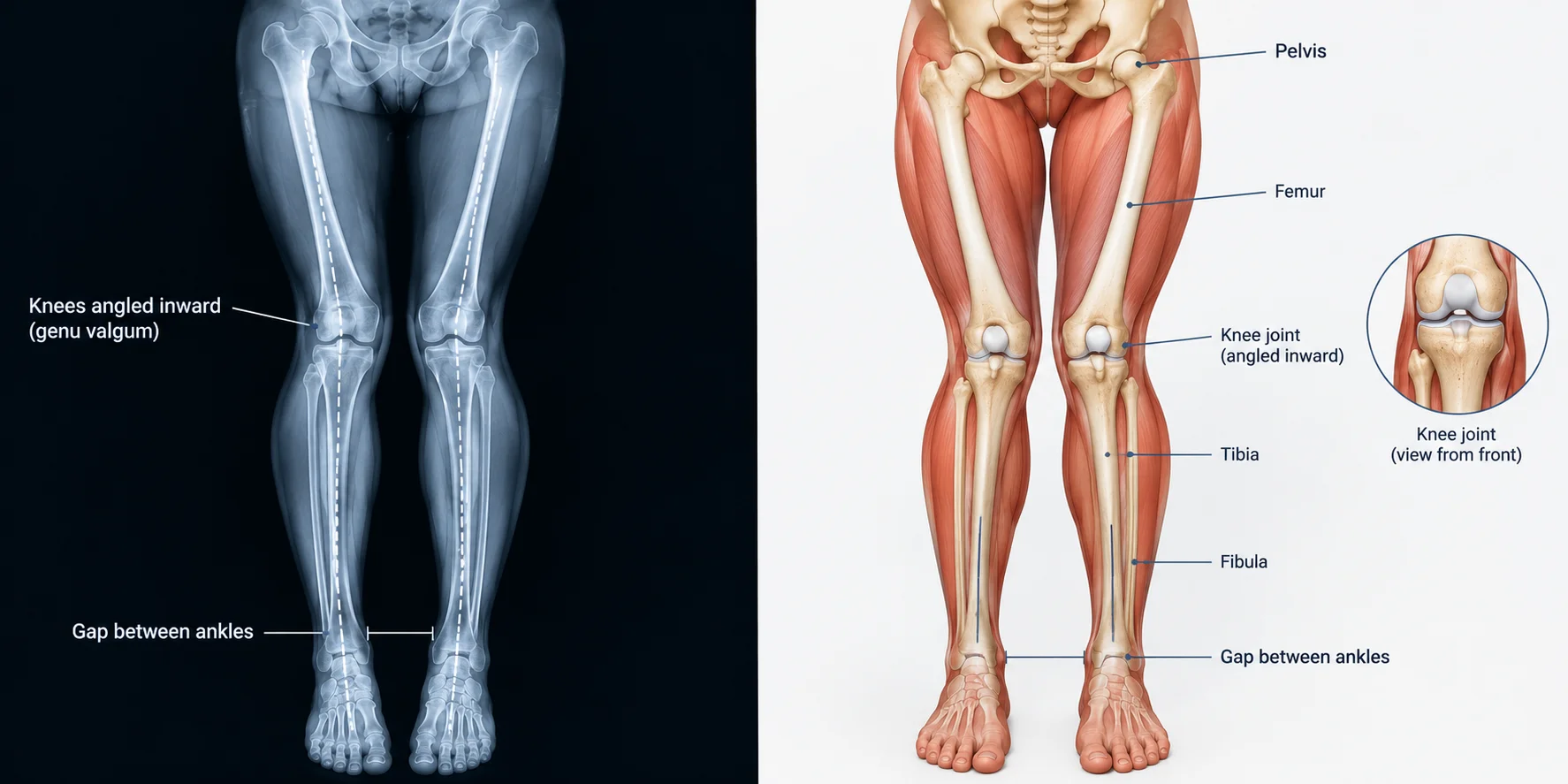
Knock-kneed legs, medically called genu valgum, describe a leg alignment in which the knees angle inward and may touch while the ankles remain separated. This appearance is particularly common during childhood and often represents a normal stage of bone development. In many children, the legs gradually become straighter as they grow.
However, knock-kneed alignment can sometimes persist into later childhood or adulthood. When it is severe, develops on only one side, becomes worse over time, or causes pain or difficulty walking, an underlying bone, joint, or metabolic problem may need to be investigated.
This guide explains what knock-kneed legs are, why they happen, how doctors diagnose the condition, available treatment options, and when medical evaluation is appropriate.
What Does Knock-Kneed Mean?
Knock-kneed is the common term for genu valgum, an alignment pattern affecting the lower limbs. When someone stands with their knees together, the knees may touch while a noticeable gap remains between the inner ankles.
Some degree of valgus alignment is normal during childhood development. According to clinical references, children typically begin developing physiologic genu valgum around age 2. It commonly becomes most noticeable between ages 3 and 4 and then gradually decreases toward the alignment normally seen around age 7.
Most children with physiologic knock knees have no pain or functional limitation and do not require treatment.
The situation is different when the alignment is unusually severe, asymmetric, progressive, or associated with other symptoms.
What Causes Knock-Kneed Legs?
There is not always a specific disease behind genu valgum. In children, it is frequently part of normal skeletal development.
Other possible causes include:
- Vitamin D deficiency and rickets
- Previous injury involving the leg or growth plate
- Bone infection
- Arthritis
- Certain genetic or skeletal conditions
- Joint hypermobility disorders
- Other metabolic bone diseases
Knock knees can also occur on one side rather than both. Unilateral deformity is more likely to require investigation because it may be associated with previous trauma, infection, or an abnormality affecting bone growth.
In adults, newly developing knock-kneed alignment should not simply be assumed to be a normal childhood variation. A healthcare professional can determine whether the change comes from the femur, tibia, knee joint, or another underlying condition.
What Are the Symptoms of Knock Knees?
The most recognizable feature is the position of the legs.
A person with genu valgum may notice that:
- The knees come together when standing.
- A gap remains between the ankles.
- The legs appear angled inward.
- The knees may rub against one another while walking.
- Walking or running may feel uncomfortable in more severe cases.
Many people have no symptoms beyond the visible alignment. Clinical sources note that most cases are asymptomatic. Pain, difficulty walking, limping, swelling, or progressive changes are reasons to seek further assessment.
The appearance alone does not tell you whether the alignment is abnormal. Age, severity, symmetry, growth pattern, and symptoms all matter.
Are Knock Knees Normal in Children?
Knock knees are particularly common in children between approximately 3 and 6 years old. During this period, the shape and alignment of the legs naturally change as bones develop.
Most physiologic genu valgum improves without treatment. Cleveland Clinic notes that many children naturally grow out of knock knees, commonly by around age 7.
Parents should nevertheless monitor how the legs develop. A pediatrician or orthopedic specialist may recommend evaluation if the condition is unusually pronounced, affects only one leg, becomes progressively worse, or continues beyond the expected developmental period.
When Should You See a Doctor?
Medical evaluation is particularly important when knock-kneed alignment is accompanied by other concerns.
The NHS recommends seeking medical advice when the ankle gap is greater than about 8 cm with the knees together, when one or both knees are painful, swollen, stiff, or warm, when only one leg is affected, or when the condition is worsening. Difficulty walking, limping, unequal leg lengths, and knock knees that first appear during adulthood are also reasons for assessment.
For a child, it is also worth discussing the condition with a healthcare professional if growth appears unusual or the child has other symptoms involving the bones or joints.
An evaluation does not necessarily mean treatment will be needed. In many cases, monitoring is all that is required.
How Is Genu Valgum Diagnosed?
A healthcare professional generally begins with a physical examination.
The clinician may observe:
- Standing leg alignment
- Walking pattern
- Knee and ankle position
- Whether the deformity is symmetrical
- Range of motion
- Signs of pain or instability
- Overall growth and development
In straightforward cases, additional testing may not be necessary. However, imaging can become important when the alignment is excessive, asymmetric, progressive, associated with trauma, or persists beyond the expected developmental stage.
For suspected pathologic genu valgum, standing long-leg X-rays can show the mechanical alignment of the lower limbs. These images help clinicians determine whether the deformity mainly originates from the femur, tibia, or another part of the leg.
Blood tests may sometimes be considered when a metabolic or nutritional bone disorder is suspected.
How Are Knock Knees Treated?
Treatment depends heavily on the person’s age, severity of the alignment, symptoms, and underlying cause.
Observation
For young children with normal developmental genu valgum, observation is usually appropriate. Regular examinations allow the healthcare provider to monitor whether the alignment is improving naturally.
Physical Therapy
Physical therapy may be recommended when muscle strength, movement patterns, or functional problems contribute to symptoms. Exercises can help improve strength and movement control, although exercises should not be considered a universal method for physically straightening mature bones.
Treating an Underlying Condition
If knock knees are related to vitamin D deficiency, rickets, infection, injury, or another medical condition, treatment focuses on the underlying cause.
For example, correcting an identified nutritional or metabolic bone disorder may help address abnormal bone development. The appropriate treatment should be based on medical testing rather than taking supplements without determining whether a deficiency exists.
Bracing
Bracing is not necessary for most children with physiologic genu valgum. In selected cases, a specialist may consider supportive treatment depending on the cause and severity.
Surgery
Surgery is uncommon for ordinary childhood knock knees. It may be considered when significant deformity persists, particularly when the condition is causing functional problems or is unlikely to correct naturally.
For growing children with significant pathologic genu valgum, orthopedic specialists may use growth-modulation procedures. In skeletally mature patients, corrective bone surgery called an osteotomy may sometimes be considered.
Can Exercises Fix Knock Knees?
This depends on what is causing the appearance.
Exercise can improve muscle strength, balance, movement control, and physical function. Physical therapy may therefore be useful for some people, particularly when symptoms or movement difficulties are present.
However, exercises cannot reliably reshape mature bones or correct every structural cause of genu valgum. Someone with significant or persistent alignment changes should receive an appropriate assessment before relying on exercise programs marketed as a way to permanently straighten the legs.
A physical therapist or orthopedic clinician can determine whether strengthening and movement work is appropriate for the individual.
Can Adults Have Knock Knees?
Although genu valgum is commonly discussed in children, some people continue to have the alignment into adulthood. New or worsening knock-kneed alignment in an adult deserves medical assessment, particularly if it is accompanied by pain, swelling, instability, or difficulty walking.
The cause can be different from ordinary childhood development. Previous injury, arthritis, bone disorders, or other structural problems may contribute to abnormal alignment.