If you’ve spent any time reading about codependency, you’ve probably run into Pia Mellody Codependency name even if nobody told you it belonged to her. Terms like “core issues,” “functional boundaries,” and “owning your reality” all trace back to one former psychiatric nurse who turned her own painful childhood into one of the most widely used frameworks in addiction and relationship treatment.
Mellody didn’t invent the idea of codependency. But she’s the one who took a vague, overused word and gave it an actual structure: five specific symptoms, a theory of where they come from, and a language therapists still use today. This guide walks through her model in plain terms, what each symptom looks like in daily life, and what her approach to recovery actually involves.
Who Is Pia Mellody Codependency?
Pia Mellody spent years as the head of nursing at The Meadows, a well-known addiction treatment center in Arizona, before developing the codependency model she’s now known for. Her own symptoms, by her account, stemmed from a traumatic childhood and a severely dysfunctional family system, and she struggled for years with low self-esteem, unhealthy shame, and a perfectionistic hyper-vigilance in her work and personal life.
That personal history matters, because it shaped the model itself. Mellody wasn’t working from an abstract theory. She spent thousands of hours interviewing and developing healing strategies alongside patients at The Meadows, building her framework out of both lived experience and clinical observation. Her ideas eventually connected back to earlier psychological work, too. Karen Horney’s writing on dependent personality, for instance, described people who lacked a healthy sense of autonomy and sought their entire sense of self from other people, which lines up closely with what Mellody would later organize into a formal theory.
She laid out that theory most fully in her 1989 book Facing Codependence, still considered the primary text on the model, and later in the companion workbook Breaking Free.
The Five Core Symptoms of Codependency
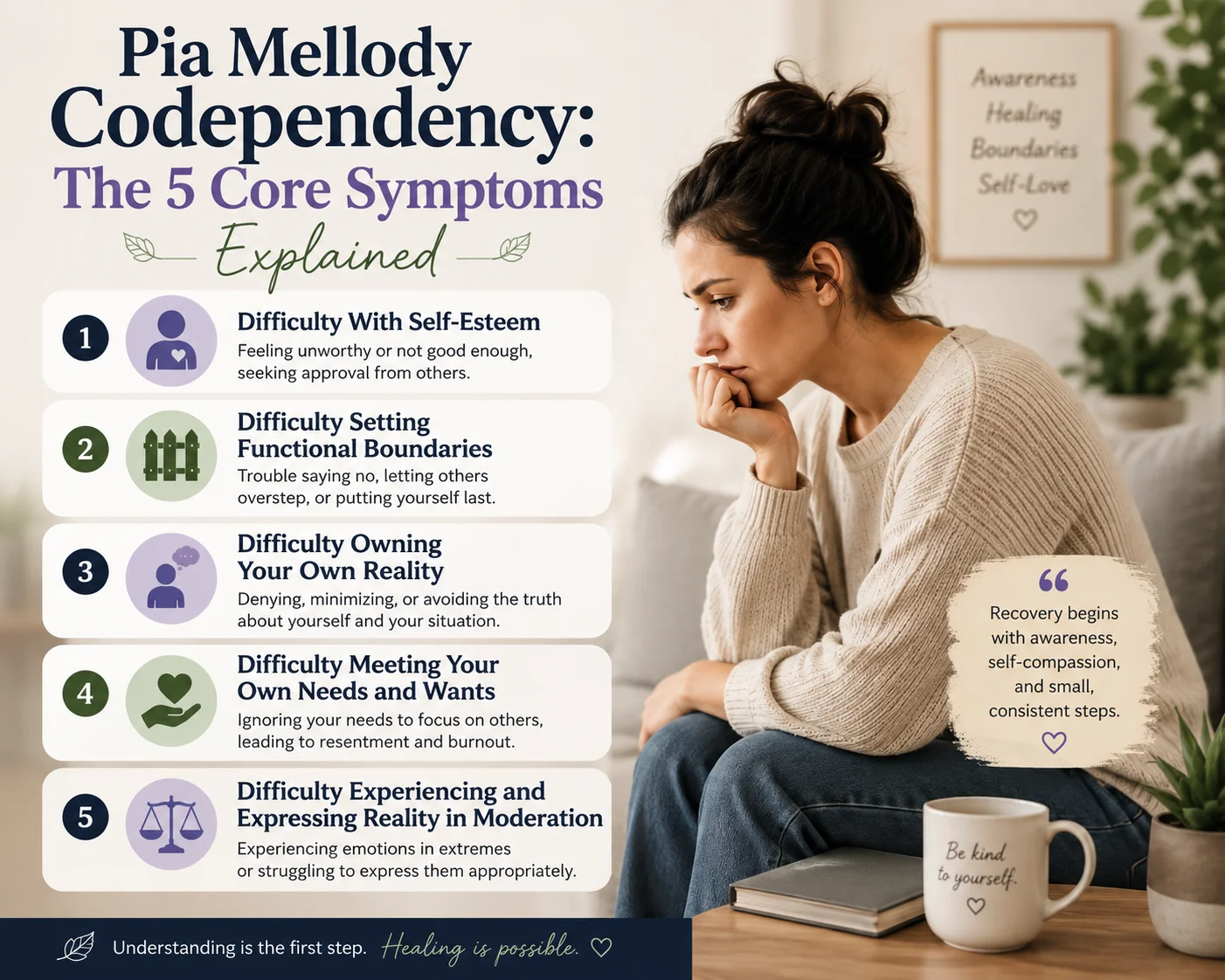
This is the heart of Mellody’s framework, and it’s worth sitting with each one individually rather than skimming the list. According to her model, codependency isn’t one single trait. It’s a cluster of five related difficulties, all rooted in a person’s relationship with themselves.
1. Difficulty With Self-Esteem
For Pia Mellody Codependency, this isn’t just “low self-esteem” in the everyday sense. Healthy self-esteem, in her framework, comes from knowing you have inherent worth equal to everyone else’s, a worth that can’t be shaken by your failures or your accomplishments. Codependents tend to miss that steady middle ground entirely.
Instead, the symptom shows up as feeling better than other people or worse than them, often swinging between the two, sometimes over-identifying with your strengths while shaming yourself for your weaknesses. Mellody has a specific term for this: rather than a genuine internal sense of worth, codependents often develop what she calls “other-esteem,” meaning their sense of value depends entirely on how someone else is responding to them in the moment.
2. Difficulty Setting Functional Boundaries
Boundaries, in Mellody’s model, aren’t walls. They’re closer to a permeable membrane, something that protects you without cutting you off from other people. Codependents tend to land on one of two broken versions of this.
Some have boundaries so weak they’re essentially invisible, which leaves them open to being used, dismissed, or overwhelmed by others’ demands. Others build boundaries so rigid they function like walls, keeping people at a safe distance but also blocking real closeness. It’s common for someone to swing between the two, being a pushover in one relationship and completely shut down in another.
3. Difficulty Owning Your Own Reality
This one is the hardest to explain and often the hardest to spot in yourself. “Owning your reality” means being able to say, clearly and without much static, what you think, what you feel, what happened, and what your body is telling you.
Codependents frequently struggle to acknowledge and articulate their own experiences, feelings, behaviors, and even physical sensations, which leaves them with a persistent sense of detachment from themselves. If someone asks “how do you feel about that,” and you genuinely don’t know, or you answer with what you think you’re supposed to feel, that’s this symptom in action.
4. Difficulty Meeting Your Own Needs and Wants
This one can show up in a few different ways. Some people can identify their needs clearly but feel deeply uncomfortable meeting them, and won’t ask others to meet those needs even when it would be entirely reasonable to ask. Others struggle earlier in the chain: they genuinely don’t know what they need, or they’ve outsourced that knowledge to someone else entirely, waiting for another person to tell them what they should want.
There’s also a common mix-up between wants and needs, where someone will indulge a want, like buying yet another pair of shoes, while neglecting an actual need, like going to the doctor or keeping healthy food in the house.
5. Difficulty Experiencing and Expressing Reality in Moderation
The last symptom is about degree, not content. It’s the difference between having a reaction and being run by one. This shows up as difficulty experiencing and expressing emotions moderately, swinging between being too reactive and not reactive at all, black-and-white thinking, raging outbursts on one end or complete shutdown and silence on the other.
Mellody sometimes calls this a problem of containment. The emotion itself isn’t the issue. The issue is that it arrives at full volume or not at all, with very little room in between.
Where These Symptoms Come From
Pia Mellody Codependency, theory of origin is arguably as important as the symptom list itself, because it reframes codependency as a survival adaptation rather than a character flaw.
Her starting point is that every child is, by nature, valuable, vulnerable, imperfect, dependent, and immature. When a child’s caregivers repeatedly fail to honor those basic attributes, whether through outright abuse or through subtler, “less-than-nurturing” patterns, the five core symptoms begin to take root.
This is a broader definition of harm than most people expect. Mellody categorizes the abuse behind codependency into five types: physical, sexual, emotional, intellectual, and spiritual. That last category, spiritual abuse, tends to surprise people, since it’s rarely discussed as its own distinct form of harm in most conversations about childhood wounds. None of these categories require dramatic, headline-level trauma. A household that’s chronically critical, emotionally unpredictable, or subtly dismissive can produce the same core symptoms as more overt abuse.
Mellody also draws a useful line between “good” and “bad” parents versus “functional” and “dysfunctional” ones. The functional/dysfunctional framing matters because it sidesteps the defensiveness that comes with labeling a parent as simply bad, and Mellody is direct on this point: in a functional family, every member understands that everybody is imperfect. The goal isn’t to assign blame. It’s to identify a pattern clearly enough that it can actually be interrupted.
Secondary Symptoms: What Codependency Turns Into
Pia Mellody Codependency didn’t stop at the five core symptoms. She also identified a set of secondary symptoms, the downstream behaviors that tend to develop once those five root issues have been in place for a while. These include negative control, resentment, impaired spirituality, addictions, mental or physical illness, and difficulty with intimacy.
One useful way to think about it: the core symptoms describe a bruised relationship with yourself. The secondary symptoms are what that bruise starts to look like once it shapes your actual behavior in the world.
Negative control is a good example. Someone who can’t trust their own reality (symptom 3) or regulate their emotions (symptom 5) often starts trying to manage that instability by controlling the people and situations around them instead. It’s not a separate problem so much as a coping strategy layered on top of the original five.
Pia Mellody Codependency and Addiction
Mellody model didn’t emerge from general relationship counseling. It came out of addiction treatment, and the two are deeply intertwined in her work. Her framework has become a core model for treating addictions of virtually every kind, along with the codependency that so often sits underneath them.
The connection runs in both directions. Someone with unmanaged core symptoms may turn to substances, work, sex, food, or a relationship itself as a way to numb an intolerable inner state, which is one of the secondary symptoms mentioned above. And someone in a relationship with an addicted partner often develops or intensifies codependent patterns as a survival response, organizing their entire life around managing someone else’s crisis. This is part of why Mellody model is used so widely in dual-diagnosis and family treatment settings, not just in individual therapy.
What Recovery Looks Like in Mellody Model
Mellody approach to recovery isn’t a quick fix, and she’s fairly direct about that. Recovery from codependence is a genuinely challenging journey, one that involves real discomfort and the surfacing of emotions that have been suppressed for a long time.
A few elements come up consistently across her work:
Starting with acknowledgment. Before anything else, Mellody asks people to actually recognize that these patterns exist in their life. She encourages a written “Step One” style exercise, borrowed from twelve-step language, where someone reflects concretely on their own encounters with each of the five core symptoms rather than treating codependency as an abstract label.
Naming the family patterns without assigning blame. As covered above, this means looking honestly at what was functional and dysfunctional in your family of origin, without needing to villainize anyone to do it.
Working with support, not alone. Mellody points to two kinds of support in particular: a codependency sponsor, someone further along in their own recovery who can offer honest but nurturing guidance, and a therapist who specifically works with codependency, for more clinical support.
Breaking the pattern across generations. Mellody is explicit that dysfunctional parenting shaped by unaddressed codependency tends to repeat itself across generations, and that it’s on parents to confront their own issues if they want to interrupt that cycle rather than passing it forward. Her point isn’t that children need to wait for perfect parents. It’s that a parent’s own recovery work is itself a gift to their kids, modeling something healthier than what they were shown.
None of this is about achieving flawless boundaries or perfect emotional regulation forever. It’s closer to building a track record: more moments where you notice a pattern, name it, and choose something different than you did the last time.
A Note If You’re Reading This About Yourself
If parts of this list felt uncomfortably familiar, that’s common, not a diagnosis. By most accounts, a large share of people show at least some of these patterns to some degree, and recognizing yourself in the symptoms doesn’t mean something is broken in you. It means a set of adaptations that once helped you get through a difficult environment are still running, even in situations where you don’t need them anymore.
Working through this on your own with a book is a reasonable starting point, but Mellody model is meant to be worked with support, whether that’s a therapist trained in her framework, a twelve-step-adjacent codependency group, or both. If any of this brings up strong distress, that’s worth bringing directly to a mental health professional rather than sitting with it alone.
Frequently Asked Questions
What are Pia Mellody five core symptoms of codependency? Difficulty with self-esteem, difficulty setting functional boundaries, difficulty owning your own reality, difficulty meeting your own needs and wants, and difficulty experiencing and expressing reality in moderation.
Is codependency an official mental health diagnosis? No. Codependency isn’t a formal diagnosis in the DSM. It’s a descriptive framework used widely in addiction and relationship treatment, and Mellody model is one of the most established versions of it.
What causes codependency, according to Mellody? Mellody traces it to childhood environments where a child’s basic nature, being valuable, vulnerable, imperfect, dependent, and immature, wasn’t respected by caregivers. She identifies five categories of abuse that can trigger this: physical, sexual, emotional, intellectual, and spiritual.
What’s the difference between core symptoms and secondary symptoms? The five core symptoms describe a person’s internal, self-directed patterns. Secondary symptoms, like negative control, resentment, or addiction, are the behaviors that tend to develop later as ways of coping with those core issues.
What book should I start with if I want to learn Mellody model directly? Facing Codependence is her foundational text and covers the full model in depth. Her companion workbook, Breaking Free, is designed for more hands-on recovery work once you understand the framework itself.
Can you recover from codependency? Yes, though Mellody is clear that it’s a real process, not a quick shift. Recovery typically involves acknowledging the patterns, understanding their origin without excessive self-blame, and working with support such as a therapist or codependency sponsor.